
India vs Sri Lanka 1st Test Day 3: Rain Threatens India’s Dominance in Galle
India resume Day 3 in a commanding position at 460/9 after Devdutt Padikkal’s outstanding 167 in Galle. With rain threatening to disrupt play, the weather could determine whether India can turn their advantage into a result.
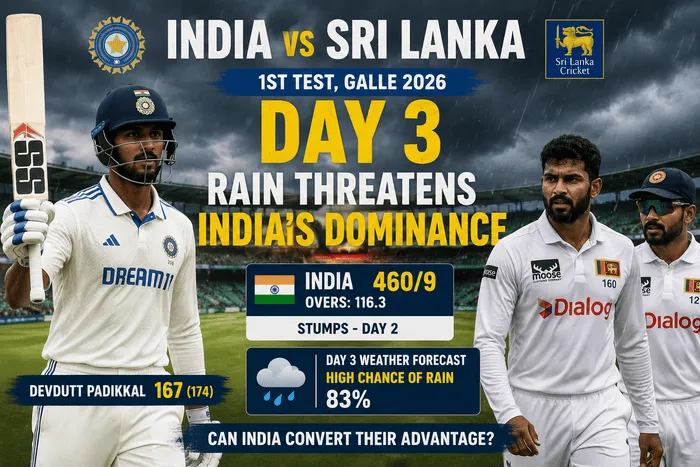
Table of Contents
India vs Sri Lanka 1st Test Day 2 Recap: Padikkal’s 167 Puts India in Control
India reached 460/9 at stumps on a rain-hit second day in Galle, with Devdutt Padikkal’s maiden Test century providing the foundation for a commanding total.
India strengthened their position on Day 2 of the first Test against Sri Lanka, reaching 460/9 at stumps at the Galle International Stadium. The day was heavily affected by rain, with a long delay before play eventually resumed.
The biggest story was Devdutt Padikkal’s 167. The left-hander converted his overnight progress into a maiden Test century and produced the defining innings of India’s first innings so far. He struck 15 fours and one six before Prabath Jayasuriya dismissed him by stumping him after drawing him out of his crease. :contentReference[oaicite:1]{index=1}
| India Batting | Score |
|---|---|
| India | 460/9 |
| Devdutt Padikkal | 167 |
| KL Rahul | 82 |
| Dhruv Jurel | 51 |
| Rishabh Pant | 39 |
| Not Out at Stumps | Kuldeep Yadav 12*, Prasidh Krishna 1* |
Rahul Returned After Retiring Hurt
KL Rahul resumed his innings after retiring hurt on 77 on the opening day because of cramps. He eventually moved to 82 before debutant spinner Keshara Nuwantha dismissed him.
Rahul’s return was important because India had already lost one wicket early in the innings. His partnership with Padikkal helped the visitors maintain control before Sri Lanka’s spinners began to make an impact. :contentReference[oaicite:2]{index=2}
Jurel and Pant Added Further Momentum
Rishabh Pant made a brisk 39, but Nuwantha claimed his first Test wicket after Pant charged down the pitch and was caught at deep mid-wicket.
Dhruv Jurel then produced a quick 51. He had earlier survived a dropped chance before Sri Lanka captain Dhananjaya de Silva completed a superb catch to end the innings. :contentReference[oaicite:3]{index=3}
Sri Lanka’s Spinners Finally Fight Back
Despite India’s dominant total, Sri Lanka did manage to regain some control through spin. Prabath Jayasuriya took 4/109, while debutant Keshara Nuwantha claimed 3/175.
The two spinners accounted for six of India’s seven wickets to fall during the day, giving Sri Lanka something to build on despite spending much of the innings under pressure. :contentReference[oaicite:4]{index=4}
Day 2 takeaway: India remain firmly in control at 460/9, but Sri Lanka’s spinners showed that the pitch can still offer assistance. The bigger question for Day 3 is whether rain will allow India enough time to convert their batting advantage into scoreboard pressure.
How India Took Control Against Sri Lanka in Galle
India’s massive first-innings total has put the visitors firmly in control, with Devdutt Padikkal’s 167 at the heart of their dominant batting performance.
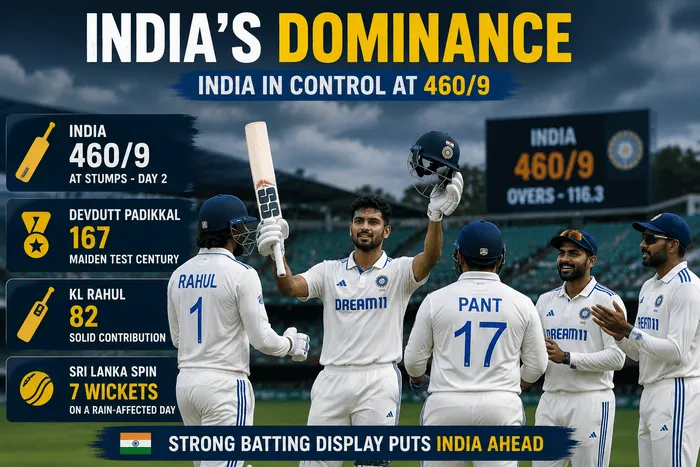
India have established a commanding position in the first Test against Sri Lanka after reaching 460/9 at the end of Day 2. The visitors’ batting effort has given them a substantial platform before Sri Lanka begin their first innings.
The defining performance came from Devdutt Padikkal, who produced a maiden Test century and continued on to score an outstanding 167. His innings provided the stability and scoring momentum India needed after rain restricted the amount of play available on Day 2.
Padikkal’s 167 Changed the Shape of the Match
Padikkal’s innings was the biggest reason India were able to build such a substantial total. He combined patience with controlled aggression and remained at the crease long enough to turn India’s strong start into a potentially match-defining score.
His dismissal eventually gave Sri Lanka some relief, but by that stage India had already crossed the 450-run mark and were in a position to put considerable pressure on the home side.
KL Rahul Provided Crucial Support
KL Rahul’s 82 was another important contribution to India’s first innings. After retiring hurt with cramps on the opening day, Rahul returned to the crease and continued the partnership that helped India maintain control.
Rishabh Pant’s 39 and Dhruv Jurel’s 51 added further momentum as India moved towards a massive total. Jurel’s contribution was particularly useful in the middle and lower-middle order as the visitors continued to put pressure on Sri Lanka.
| Indian Batter | Score | Impact |
|---|---|---|
| Devdutt Padikkal | 167 | Maiden Test century and innings-defining knock |
| KL Rahul | 82 | Important top-order contribution |
| Dhruv Jurel | 51 | Valuable middle-order runs |
| Rishabh Pant | 39 | Quick scoring contribution |
| India | 460/9 | Commanding first-innings position |
Rain Has Limited India’s Opportunity to Press Home the Advantage
India’s dominance needs to be viewed alongside the weather interruptions. Day 2 was heavily affected by rain, which reduced the amount of cricket available and prevented India from getting as many overs as they would have wanted.
That becomes particularly important on Day 3. India are only one wicket away from completing their first innings, but their bigger objective will be to create enough time to bowl Sri Lanka out and push for a result.
India’s position: At 460/9, India have done most of the difficult work with the bat. The major question now is whether the weather allows them enough playing time to turn that advantage into match-winning pressure.
Sri Lanka Fight Back Through Spin as India Lose Seven Wickets
Sri Lanka’s spin attack finally found a way into India’s strong batting line-up, with Prabath Jayasuriya and debutant Keshara Nuwantha combining for six wickets on a rain-hit Day 2.
Sri Lanka may still be behind in the match, but their bowling attack provided some encouragement during the second half of Day 2. After India moved from 288/2 to 460/9, the hosts’ spinners made regular breakthroughs and prevented the visitors from completely running away with the innings.
Prabath Jayasuriya was the standout bowler, finishing with 4/109. Debutant Keshara Nuwantha supported him with an impressive 3/175. Together, they accounted for six of India’s seven wickets to fall during the day. :contentReference[oaicite:1]{index=1}
| Sri Lanka Bowler | Overs | Runs | Wickets |
|---|---|---|---|
| Prabath Jayasuriya | 39 | 109 | 4 |
| Keshara Nuwantha | 39 | 175 | 3 |
| Combined | 78 | 284 | 7 |
Jayasuriya Delivers the Breakthroughs
Jayasuriya’s experience at Galle became important once Sri Lanka started finding wickets. The left-arm spinner claimed four wickets and played a major role in stopping India’s middle and lower order from extending the innings even further.
His biggest breakthrough came when he dismissed Devdutt Padikkal for 167, ending the innings that had been the foundation of India’s enormous total. Padikkal was stumped after advancing down the pitch, bringing an outstanding maiden Test century to an end. :contentReference[oaicite:2]{index=2}
Nuwantha Makes an Impact on Test Debut
Debutant Keshara Nuwantha also provided Sri Lanka with an important boost. He claimed 3/175, including the wickets of KL Rahul and Rishabh Pant, giving the hosts a glimpse of what he can offer despite India’s high scoring rate.
Nuwantha’s dismissal of Rahul was particularly significant because the Indian batter had returned after retiring hurt with cramps on the opening day. Rahul eventually made 82 before the debutant removed him. :contentReference[oaicite:3]{index=3}
Sri Lanka Still Have a Huge Challenge Ahead
The bowling fightback has improved Sri Lanka’s position, but it does not change the overall match situation. India are still only one wicket away from completing a first innings of 460 or more, and the visitors have the opportunity to put Sri Lanka under immediate scoreboard pressure.
The weather is therefore crucial. If rain again removes large portions of Day 3, Sri Lanka’s bowling recovery could become more valuable because every lost session reduces India’s opportunity to take 20 wickets.
Sri Lanka’s positive: Jayasuriya and Nuwantha have shown that the Galle surface can offer opportunities to spin, and their combined six wickets on Day 2 prevented India from pushing even further beyond 460.
But the bigger picture: Sri Lanka still face a substantial first-innings deficit if India finish around their current total. Their immediate priority on Day 3 will be to survive India’s opening bowling attack and make the most of any assistance from the pitch.
Day 3 Weather: Rain Threatens India’s Dominance in Galle
India’s strong position could be undermined by another rain-affected day, with the latest Galle forecast showing a high chance of precipitation throughout Monday.
Weather has become India’s biggest obstacle in the first Test against Sri Lanka. After rain significantly reduced the amount of cricket on Day 2, the latest forecast for Monday, August 17 suggests that Day 3 could again be interrupted by showers.
According to the latest forecast cited by NDTV, Galle has an overall 83% chance of precipitation on Monday. The hourly outlook also keeps the rain threat alive through much of the scheduled playing window. :contentReference[oaicite:1]{index=1}
| Time | Reported Rain Chance |
|---|---|
| 10 AM | 51% |
| 11 AM | 47% |
| 12 PM | 44% |
| 1 PM | 48% |
| 2 PM | 52% |
| 3 PM | 45% |
| 4 PM | 39% |
| 5 PM | 34% |
| 6 PM | 40% |
Another Stop-Start Day Is Possible
The biggest concern is not necessarily a complete washout. Instead, repeated showers could create a stop-start day, with players leaving the field several times and valuable overs disappearing from the schedule.
That scenario would directly affect India’s plans. The visitors are only one wicket away from completing their first innings, but they need enough time to bowl Sri Lanka out and build the pressure required to force a result.
Why Rain Matters More to India Than Sri Lanka
At 460/9, India have already built a substantial advantage with the bat. Their problem is now time. Every lost session reduces the number of overs available to take Sri Lanka’s wickets and potentially force a result.
Sri Lanka, meanwhile, can benefit from a reduction in playing time. Their spinners have already taken seven Indian wickets, and a shortened Test would make India’s dominant first-innings position less decisive than it otherwise would be.
The WTC Result Equation Could Become Important
The weather threat also increases the significance of the result beyond this individual Test. India need results in their World Test Championship campaign, so a match that drifts toward a draw because of lost playing time would be a frustrating outcome after such a strong batting display.
Current reporting has also highlighted the possibility that further rain could turn India’s commanding position into a costly draw from their WTC perspective. :contentReference[oaicite:2]{index=2}
Weather warning: The latest forecast gives Galle an 83% overall precipitation chance for Day 3. With rain probabilities remaining significant through the afternoon, another interruption-heavy day is a genuine possibility. :contentReference[oaicite:3]{index=3}
Key takeaway: India have the scoreboard advantage, but the weather controls how much time they have to use it. The more overs lost on Day 3, the harder it becomes for India to turn 460/9 into a match-winning position.
What India Need on Day 3 to Push for a Result
India are only one wicket away from completing their first innings, but the bigger challenge will be creating enough time to take Sri Lanka’s ten wickets.
India begin Day 3 in a commanding position at 460/9, but the score alone does not guarantee control of the match. With rain threatening another interruption, India’s priority will be to finish the innings quickly and maximise every available over with the ball.
Finish the First Innings Quickly
India have only one wicket remaining, with Kuldeep Yadav and Prasidh Krishna at the crease overnight. The first objective is straightforward: add as many useful runs as possible without spending too much time at the crease.
Even another 10-20 runs could prove valuable if the pitch continues to offer assistance to the spinners, but India cannot afford to spend a large part of the morning session trying to stretch the total if rain eventually limits the day’s play.
Attack Sri Lanka Immediately
Once Sri Lanka begin their first innings, India should look to attack rather than simply defend their advantage. A substantial first-innings total gives the visitors the freedom to place catching fields and put pressure on the Sri Lankan top order.
The early wickets will be particularly important. If India can remove two or three top-order batters quickly, Sri Lanka could find themselves under significant scoreboard pressure before the weather becomes the dominant factor.
Use Spin at the Right Time
Sri Lanka’s own bowling performance on Day 2 showed that spin can be effective on the Galle surface. Prabath Jayasuriya and Keshara Nuwantha combined for seven wickets, making it reasonable for India to expect their own spinners to have a role once Sri Lanka begin batting.
India’s spin resources could therefore become central to their attempt to force a result. However, the captain will need to balance attacking fields with the possibility of rain reducing the available overs.
Make Every Over Count
The weather changes the value of every over. If play is interrupted repeatedly, India may have to take calculated risks rather than waiting for Sri Lanka to collapse naturally.
That could mean attacking fields, aggressive bowling changes and keeping the pressure on the batters even if it creates the occasional boundary opportunity.
| India’s Objective | Priority |
|---|---|
| Complete First Innings | Immediate |
| Add Useful Runs | Secondary |
| Take Early Sri Lankan Wickets | Very High |
| Exploit Spin Conditions | High |
| Maximise Available Overs | Critical |
India’s Day 3 equation: Finish the innings quickly, attack Sri Lanka’s top order and use every available over. With rain threatening, time rather than runs is now India’s biggest concern.
What Sri Lanka Need on Day 3 to Stay Alive in the Galle Test
Sri Lanka face a huge first-innings challenge after India reached 460/9, with their top order needing to absorb pressure and make the most of every available over.
Sri Lanka begin Day 3 with a difficult task. India are only one wicket away from completing a first innings of at least 460 runs, leaving the hosts under immediate scoreboard pressure once they begin batting.
The priority for Sri Lanka is not to chase India’s scoring rate. It is to survive the opening spell, build partnerships and avoid losing wickets in clusters. With rain threatening another interrupted day, every uninterrupted passage of play becomes valuable.
Sri Lanka Must Survive India’s New-Ball Attack
India’s first objective will be to attack the Sri Lankan top order. The hosts therefore need their opening batters to be disciplined outside off stump and avoid giving India early wickets.
A stable opening partnership would allow Sri Lanka to settle into the innings and reduce some of the pressure created by India’s massive first-innings total.
Partnerships Are More Important Than Scoring Rate
Sri Lanka cannot afford a succession of quick wickets. Even if the run rate remains modest, partnerships can consume valuable overs and reduce India’s opportunities to force a result.
The hosts will therefore need their experienced batters to take responsibility. Building two or three meaningful partnerships could be more important than attempting to match India’s scoring rate.
Sri Lanka’s Spinners Have Already Shown Their Value
Prabath Jayasuriya and debutant Keshara Nuwantha gave Sri Lanka a major boost on Day 2. Jayasuriya finished with 4/109, while Nuwantha took 3/175, with the pair accounting for all seven Indian wickets that fell during the day. :contentReference[oaicite:1]{index=1}
That performance should give Sri Lanka confidence that the surface can offer assistance to spin. If they can post a competitive first-innings total, their spinners could become increasingly important later in the Test.
Rain Could Work in Sri Lanka’s Favor
The weather is potentially Sri Lanka’s biggest advantage. The latest forecast gives Galle an 83% chance of precipitation on Day 3, with meaningful rain probabilities continuing across the scheduled playing hours. :contentReference[oaicite:2]{index=2}
Every lost session reduces India’s time to take 20 wickets. That means Sri Lanka can benefit from simply staying in the contest for as long as possible while the weather removes overs from the match.
| Sri Lanka’s Objective | Importance |
|---|---|
| Survive India’s Opening Attack | Critical |
| Build Long Partnerships | Very High |
| Avoid a Collapse | Critical |
| Reduce the First-Innings Deficit | Very High |
| Use Spin Conditions | High |
| Take Advantage of Lost Overs | Important |
Sri Lanka’s equation: The hosts need to survive first, score consistently second and avoid giving India quick wickets. If rain continues to interrupt play, simply reducing India’s available overs could become a major part of Sri Lanka’s route to a draw.
India vs Sri Lanka 1st Test Day 3 Match Scenarios
India have the scoreboard advantage at 460/9, but the amount of cricket lost to rain could determine whether that advantage leads to a win, a draw or a much tighter finish.
The first Test has reached an interesting stage. India are one wicket away from completing their first innings, but Sri Lanka have not yet batted. That gives the visitors a significant advantage, while the weather introduces uncertainty into the result.
The most realistic outcomes now depend on how much play is possible on Day 3 and the following sessions. India need time to take Sri Lanka’s ten wickets, while Sri Lanka’s immediate objective is to stay at the crease and reduce India’s opportunity to force a result.
Scenario 1: India Finish the Innings and Strike Early
The best scenario for India would be to remove Sri Lanka’s final Indian wicket quickly, add a few more runs and then make early breakthroughs with the ball.
If India take several Sri Lankan wickets during a substantial uninterrupted session, the pressure created by the 460-run total could become overwhelming. In that situation, India would have a clear path toward controlling the Test and pushing for victory.
Scenario 2: Sri Lanka Build a Major Partnership
Sri Lanka’s best route back into the contest is to avoid an early collapse. A long opening or middle-order partnership would consume time and reduce India’s ability to attack with aggressive fields.
If Sri Lanka can make substantial progress toward India’s first-innings total, the psychological pressure created by 460/9 would also begin to decrease.
Scenario 3: Rain Takes Away Large Portions of Day 3
This is the scenario that most threatens India’s advantage. The latest forecast indicates a significant chance of rain in Galle, and another heavily interrupted day would reduce the number of overs available to both teams.
A shortened match naturally increases the probability of a draw because India would have fewer opportunities to take the required wickets. Sri Lanka could therefore benefit simply by surviving through the interruptions.
Scenario 4: Sri Lanka Collapse Quickly
If India’s bowlers take advantage of the conditions and Sri Lanka lose wickets rapidly, the visitors could put themselves in an extremely strong position despite the rain threat.
A quick Sri Lankan first innings would give India more time to enforce scoreboard pressure and potentially create a second-innings opportunity before the Test runs out of time.
| Match Scenario | Likely Advantage | Result Impact |
|---|---|---|
| India take early wickets | India | Strongly improves India’s winning chances |
| Sri Lanka build long partnerships | Sri Lanka | Reduces India’s time to force a result |
| Heavy rain interruptions | Sri Lanka | Draw becomes increasingly likely |
| Sri Lanka collapse quickly | India | India gain a major advantage |
What Is the Biggest Threat to India’s Win?
At this stage, the biggest threat to India is not Sri Lanka’s score but lost playing time. India have already accumulated enough runs to create scoreboard pressure; they now need overs to convert that advantage into wickets.
If the weather repeatedly interrupts play, Sri Lanka can make the match increasingly difficult to finish. That is why the Day 3 forecast is central to the result equation.
99ExCh Match View: India remain in the strongest position, but the result now depends heavily on how much uninterrupted cricket is possible. A full day of play would strengthen India’s winning prospects, while repeated rain interruptions would move the match closer to a draw.
Key Players to Watch on Day 3 of India vs Sri Lanka 1st Test
With India at 460/9 and Sri Lanka yet to begin their first innings, the next session could be shaped by India’s overnight batters, their bowling attack and Sri Lanka’s most experienced batters.
The match has moved into a phase where individual performances can quickly change the result equation. India have already built the scoreboard advantage, but Sri Lanka will have their opportunity once the visitors complete their innings.
Kuldeep Yadav — India
Kuldeep Yadav remains unbeaten overnight and will be one of the first players in focus when play resumes. India need just one more wicket to complete their innings, so Kuldeep’s ability to add useful runs could have some value before the bowling innings begins.
His larger role could come with the ball. On a Galle surface where Sri Lanka’s spinners have already found assistance, Kuldeep’s variety and ability to attack through flight and turn could become important against the Sri Lankan middle order.
Prasidh Krishna — India
Prasidh Krishna is also unbeaten at the crease and could help India stretch their total slightly further. His primary importance, however, will come once Sri Lanka begin batting.
India will need early wickets, and Prasidh’s pace can provide a different challenge from the spin options. If the surface offers any movement with the new ball, his opening spell could be particularly important.
Prabath Jayasuriya — Sri Lanka
Prabath Jayasuriya has already demonstrated why he remains one of Sri Lanka’s most important Test bowlers. His four-wicket haul on Day 2 helped prevent India from extending their total even further.
His experience at Galle could become equally important when Sri Lanka eventually bowl again. If the match reaches India’s second innings, Jayasuriya is likely to be one of the players India will need to manage carefully.
Keshara Nuwantha — Sri Lanka
Keshara Nuwantha has already made an impact on his Test debut, claiming three Indian wickets. His ability to take important wickets despite conceding runs gives Sri Lanka another spin option to work with.
The bigger test will come when India put Sri Lanka under pressure with the ball. Nuwantha’s control and ability to keep creating chances could become important if the hosts manage to stay competitive.
Sri Lanka’s Top Order
While individual names will attract attention, Sri Lanka’s biggest requirement is a collective one. Their top order must survive India’s opening attack and build partnerships rather than attempting to match India’s scoring rate.
A stable start would significantly improve Sri Lanka’s chances of avoiding a large deficit. An early collapse, on the other hand, could allow India to dictate the remainder of the Test.
| Player / Unit | Team | Day 3 Importance |
|---|---|---|
| Kuldeep Yadav | India | Finish the innings and attack with spin |
| Prasidh Krishna | India | Provide pace and early breakthroughs |
| Prabath Jayasuriya | Sri Lanka | Lead Sri Lanka’s spin attack |
| Keshara Nuwantha | Sri Lanka | Build on his three-wicket Test debut |
| Sri Lanka Top Order | Sri Lanka | Survive India’s attack and build partnerships |
Key battle: India’s bowling attack against Sri Lanka’s top order could define the next major phase of the Test. If India strike early, their 460/9 becomes even more powerful; if Sri Lanka build partnerships, the rain threat gives them additional hope of saving the match.
India vs Sri Lanka 1st Test Day 3 FAQs
Key questions about India’s 460/9, Devdutt Padikkal’s 167, the Day 3 rain threat and the possible result scenarios in Galle.
India reached 460/9 at stumps on Day 2 of the first Test against Sri Lanka in Galle.
Devdutt Padikkal scored 167, registering his maiden Test century and producing the defining innings of India’s first innings.
The latest Galle forecast indicates a high chance of precipitation on Day 3. Further interruptions could reduce India’s available time to take Sri Lanka’s wickets and force a result.
India need one more wicket to complete their first innings, with Kuldeep Yadav and Prasidh Krishna unbeaten at the end of Day 2.
Prabath Jayasuriya took 4/109, while debutant Keshara Nuwantha claimed 3/175. Together, they took six of the seven Indian wickets that fell during Day 2.
Sri Lanka need to survive India’s opening attack, build long partnerships and avoid losing wickets in clusters. Reducing India’s available bowling time will also become important if rain continues.
Yes, but India’s chances of forcing a result will depend heavily on how much uninterrupted cricket remains. India have the scoreboard advantage, but repeated rain interruptions could increase the likelihood of a draw.
India Have the Advantage, But Rain Could Change the Galle Test
India have done the hard work with the bat at 460/9, but the Day 3 weather could determine whether their dominance turns into a Test victory.
India head into Day 3 of the first Test against Sri Lanka in a commanding position. At 460/9, the visitors have built a huge first-innings platform, with Devdutt Padikkal’s 167 standing out as the defining performance of the match so far.
KL Rahul’s 82, Dhruv Jurel’s 51 and Rishabh Pant’s 39 also helped India maintain control, while Sri Lanka’s spinners eventually fought back through Prabath Jayasuriya and debutant Keshara Nuwantha.
The biggest uncertainty now is not India’s batting position but the weather. Another rain-affected day would reduce the number of overs available to India, making it harder for the visitors to take all ten Sri Lankan wickets and force a result.
If India can finish their innings quickly and get early wickets when Sri Lanka begin batting, their 460/9 could become extremely difficult for the hosts to overcome. But if Sri Lanka build partnerships and rain continues to interrupt play, the draw becomes increasingly realistic.
For Sri Lanka, survival is the immediate priority. Their top order needs to absorb India’s attack, avoid a collapse and make the most of every uninterrupted period of play. Their spinners have already shown that they can create problems on the Galle surface.
99ExCh Match View: India remain firmly in control at 460/9, but rain is now the biggest threat to their winning chances. A full day of play would give India the best opportunity to convert their dominant position into a result, while repeated interruptions would strengthen Sri Lanka’s chances of saving the Test.
The latest weather update and confirmed match situation should be checked again before making any final assessment, especially if rain causes further delays or reduces the scheduled playing time.