
Devdutt Padikkal Hits Second Consecutive Test Century Against Sri Lanka
Devdutt Padikkal scored 117 in Colombo to register his second consecutive Test century, strengthening his case at No. 3 for India after his 167-run effort in the first Test at Galle.
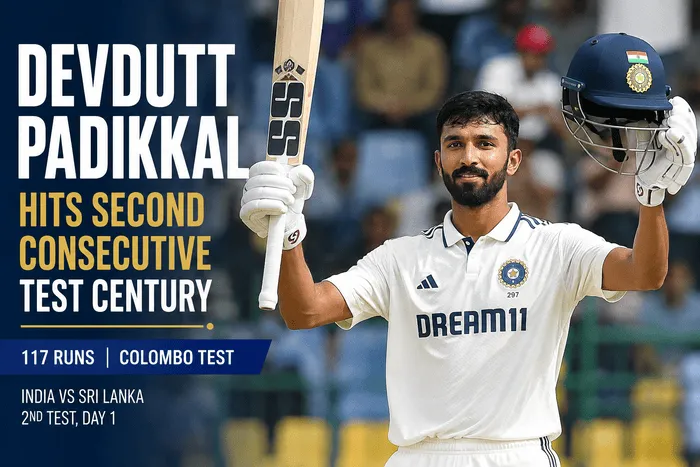
Devdutt Padikkal Hits Second Consecutive Test Century
Devdutt Padikkal continued his impressive start to India’s Test series against Sri Lanka by scoring 117 in the second Test at the Sinhalese Sports Club in Colombo. The century was his second in consecutive Tests, following his outstanding 167 in the series opener at Galle.
Padikkal reached his century from 168 balls and once again showed the patience and shot selection required to succeed in Test cricket. His innings came at an important stage for India after the visitors had lost two early wickets and needed a substantial partnership to rebuild their first innings.
The left-hander responded with a composed innings that combined controlled strokeplay with long periods of concentration. He eventually made 117 before being dismissed by Keshara Nuwantha, but by then he had already helped India move into a strong position.
Padikkal’s latest century is particularly notable because it has come in successive matches rather than being an isolated breakthrough. His 167 at Galle established his ability to play a long Test innings, while the 117 in Colombo showed that he could reproduce that performance in different match circumstances.
The back-to-back hundreds have also strengthened the 24-year-old’s position in India’s Test middle order. His performances have given the team another dependable option at No. 3 and increased the competition for places in the batting lineup.
| Performance | Score | Venue |
|---|---|---|
| First Test | 167 | Galle |
| Second Test | 117 | Colombo |
| Consecutive Centuries | 2 | Two-Test Series |
Key Moment: Padikkal’s 117 in Colombo followed his 167 in Galle, giving him centuries in both Tests of the series and further strengthening his credentials at No. 3.
How Padikkal Built His 117 in Colombo
Devdutt Padikkal’s 117 was built around patience, controlled strokeplay and a willingness to absorb pressure after India lost early wickets. Batting at No. 3, he had to settle in against a Sri Lankan attack that created several opportunities during the opening phase of his innings.
Padikkal survived two early chances, including opportunities in the slip cordon, but he responded by tightening his defence and becoming increasingly comfortable at the crease. Rather than chasing deliveries outside the off stump, he waited for scoring opportunities and gradually took control of the innings.
He reached his half-century from 90 balls before accelerating as his understanding of the conditions improved. His century came from 168 deliveries, while his completed innings of 117 was recorded from 193 balls, with his ability to combine defence and boundary scoring helping him build another substantial Test innings.
Padikkal’s shot selection was one of the strongest features of the innings. He used soft hands against the spin, found gaps through the off side and avoided giving Sri Lanka repeated opportunities once he had settled. His approach allowed India to recover from 66/2 and build a much stronger position before the later wickets fell.
The innings eventually ended when Keshara Nuwantha dismissed Padikkal for 117. By then, however, the left-hander had done the central job of converting a difficult start into a major score and giving India a strong platform in the second Test.
| Batting Milestone | Detail |
|---|---|
| Final Score | 117 |
| Balls Faced | 193 |
| Half-Century | 90 balls |
| Position | No. 3 |
| Dismissed By | Keshara Nuwantha |
Key Point: Padikkal’s ability to survive the early pressure and convert his start into 117 was central to India’s recovery on the opening day in Colombo.
Padikkal and Shubman Gill Rescue India After Early Wickets

India were under some pressure after losing KL Rahul and Yashasvi Jaiswal during the opening session of the second Test in Colombo. With the score reduced to 66/2, Devdutt Padikkal and captain Shubman Gill came together and began the recovery with a patient third-wicket partnership.
The pair added 120 runs for the third wicket, giving India the stability they needed after the early setbacks. Gill played the anchor role while Padikkal gradually increased his scoring rate, allowing India to move from 66/2 to 186/2 before the partnership was finally broken.
Gill reached his half-century from 108 balls and finished with 50. His dismissal at the stroke of tea brought the partnership to an end, but the foundation had already been laid for Padikkal to continue his innings into the final session.
Padikkal eventually converted the strong platform into his second consecutive Test century. He finished with 117 from 193 balls, including 12 fours, while India’s score moved to 300/5 by stumps.
| Partnership Detail | Figures |
|---|---|
| Wicket | Third wicket |
| Partnership | 120 runs |
| Padikkal | 117 off 193 balls |
| Shubman Gill | 50 off 108 balls |
| India’s Score After Partnership | 187/3 |
The partnership was ultimately the turning point of India’s first day. Sri Lanka had created early pressure, but Gill and Padikkal absorbed the difficult spells and prevented the hosts from building on those breakthroughs. Their stand allowed India to regain control before Padikkal continued the recovery alongside the lower middle order.
Key Partnership: Padikkal and Gill’s 120-run stand transformed India’s position from 66/2 into a strong platform and played a central role in India’s 300/5 at stumps.
From 167 in Galle to 117 in Colombo
Padikkal’s second century becomes even more significant when viewed alongside his performance in the opening Test at Galle. He scored a career-defining 167 in the first innings of that match, earning Player of the Match honours as India began the series with a strong victory.
Rather than allowing that performance to remain a one-off, Padikkal followed it with another substantial innings in Colombo. His 117 in the second Test means he has now scored hundreds in both matches of the series, providing India with remarkable consistency at the top of the order.
The two innings were also produced in different circumstances. In Galle, Padikkal converted a strong start into 167 and played a major role in India’s first-innings dominance. In Colombo, he had to recover from India’s early setbacks and build partnerships before eventually reaching another century.
The sequence is particularly notable because Padikkal has been operating at No. 3, a position that demands patience after an early wicket but also the ability to take advantage when conditions become easier for batting. His consecutive hundreds suggest that he is adapting quickly to the demands of the role.
His Colombo hundred also means Padikkal has produced a century in consecutive Tests on the same overseas tour. The achievement adds another layer to a series in which the left-hander has moved from being a replacement option into one of India’s most important batting contributors.
| Test | Venue | Padikkal’s Score | Outcome |
|---|---|---|---|
| 1st Test | Galle | 167 | Player of the Match |
| 2nd Test | Colombo | 117 | India 300/5 at Stumps, Day 1 |
| Series | Sri Lanka | 284 runs | Two consecutive centuries |
Across the two Tests, Padikkal has therefore accumulated 284 runs from two centuries. The numbers underline how quickly his role in India’s Test setup has changed during this tour. After entering the squad as a replacement for the injured Sai Sudharsan, he has responded with two major performances in succession.
Series Highlight: Padikkal’s 167 in Galle followed by 117 in Colombo makes him one of the defining performers of India’s two-Test series in Sri Lanka.
Why Padikkal’s Back-to-Back Hundreds Matter
Devdutt Padikkal’s consecutive Test centuries have turned an impressive individual run of form into a significant milestone for Indian cricket. After making 167 in the first Test at Galle, Padikkal followed it with 117 in Colombo, giving him hundreds in both Tests of the Sri Lanka series.
The achievement is particularly notable because it came in consecutive away Tests. Padikkal became the first India No. 3 since Cheteshwar Pujara in 2018-19 to score centuries in consecutive Tests, underlining how quickly the left-hander has adapted to the demands of the position.
Padikkal has also joined an exclusive group of Indian batters who have scored two centuries in the same Test series in Sri Lanka. His 167 in Galle and 117 in Colombo put him alongside established names from India’s Test history, adding further weight to the significance of his current form.
The context of the Colombo innings makes the achievement even stronger. India were reduced to 66/2 before Padikkal and Shubman Gill produced a 120-run third-wicket partnership. Padikkal then continued after Gill’s dismissal and eventually converted his second substantial innings of the series into another century.
His consistency is also important for India’s long-term planning. The No. 3 position has been closely watched since the changes in India’s Test batting order, and Padikkal’s two centuries provide strong evidence that he can handle the responsibility against quality opposition away from home.
| Milestone | Padikkal’s Achievement |
|---|---|
| Consecutive Test Centuries | 167 in Galle, 117 in Colombo |
| Series Centuries in Sri Lanka | 2 |
| Series Runs | 284 |
| Batting Position | No. 3 |
| Colombo Innings | 117 off 193 balls |
For Padikkal, the biggest significance is that both centuries have come in different match situations. The Galle hundred established his ability to build a huge score, while the Colombo hundred demonstrated that he could absorb early pressure and rebuild an innings after India lost wickets.
Record Moment: Padikkal’s 167 and 117 make him the seventh Indian batter to score two centuries in a single Test series in Sri Lanka, while his consecutive hundreds have strengthened his claim for the No. 3 role.
Padikkal Strengthens His Case at No. 3
Devdutt Padikkal’s back-to-back Test centuries have significantly strengthened his case for a permanent place at No. 3 in India’s Test batting order. His 167 in Galle showed his ability to build a major innings, while the 117 in Colombo demonstrated that he can respond when India are under early pressure.
The No. 3 position requires a batter who can adapt quickly to the match situation. If an opener falls early, the No. 3 batter must be prepared to face the new ball. If India have a solid start, the same batter needs to build partnerships and convert the advantage into a substantial score. Padikkal has displayed both qualities during this series.
His partnership with Shubman Gill in Colombo was particularly important. India were 66/2 when the pair came together, but they added 120 runs for the third wicket. Padikkal then continued after Gill’s dismissal and completed another century, showing that he can carry responsibility deep into an innings.
The consistency is also important because Padikkal’s opportunity in the series came amid changes to India’s batting combination. Instead of needing several matches to establish himself, he has produced two centuries in two Tests and accumulated 284 runs across the series.
His performances therefore give India’s selectors an encouraging option in the middle order. Padikkal’s left-handed batting also adds variety to the lineup, while his ability to occupy the crease for long periods can provide stability around India’s stroke-making batters.
| No. 3 Case | Padikkal’s Evidence |
|---|---|
| Recent Test Scores | 167 and 117 |
| Series Runs | 284 |
| Consecutive Centuries | 2 |
| Colombo Partnership | 120 runs with Shubman Gill |
| Batting Style | Left-handed |
The key challenge now is maintaining this level of consistency beyond the Sri Lanka series. Two hundreds provide a strong foundation, but establishing himself as India’s long-term No. 3 will require Padikkal to continue converting starts into substantial scores against different attacks and conditions.
Selection Boost: Two consecutive centuries and 284 runs in the series have given Padikkal a strong case to continue as India’s No. 3 batter.
India Reach 300/5 Despite Late Sri Lanka Fightback
India finished the opening day of the second Test against Sri Lanka on 300/5 at the Sinhalese Sports Club in Colombo. Devdutt Padikkal’s 117 was the standout contribution, but Sri Lanka managed to fight back during the final stages of the day and prevent India from finishing with an even stronger total.
India had chosen to bat first and initially made steady progress before losing KL Rahul and Yashasvi Jaiswal. Padikkal and Shubman Gill then rebuilt the innings with a 120-run third-wicket partnership, moving India from 66/2 to a much healthier position.
Gill’s dismissal for 50 opened the door for Sri Lanka to regain some control. Rishabh Pant was also forced to retire hurt after being struck on the wrist, adding another twist to India’s first-innings progress. The wicketkeeper-batter’s injury meant Ravindra Jadeja came in earlier than expected.
Jadeja contributed 43 and shared another useful partnership with Padikkal before the left-hander was eventually dismissed for 117. Sri Lanka’s Asitha Fernando was the most successful bowler, finishing the day with 3/46.
The late wickets prevented India from completely dominating the opening day. Jadeja fell in the final over, leaving Dhruv Jurel and debutant Saransh Jain unbeaten at the close. India therefore ended the day in a strong position, but Sri Lanka still had an opportunity to make further inroads with the second new ball and the remaining Indian batting order.
| India Batting | Score |
|---|---|
| Devdutt Padikkal | 117 |
| Shubman Gill | 50 |
| Yashasvi Jaiswal | 45 |
| Ravindra Jadeja | 43 |
| Score at Stumps | 300/5 |
Day 1 Summary: Padikkal’s second consecutive century put India in control for long periods, while Sri Lanka’s late wickets kept the hosts in contention at 300/5.
What Comes Next for Devdutt Padikkal
Devdutt Padikkal has given India’s selectors plenty to consider after scoring centuries in both Tests of the Sri Lanka series. His 167 in Galle and 117 in Colombo have transformed his tour from an opportunity into a strong statement about his ability to bat at No. 3.
The immediate priority for Padikkal will be to maintain the same discipline that produced his two major innings. The Colombo hundred was particularly encouraging because he had to rebuild after India lost early wickets before eventually converting his start into 117.
His performances also give India another reliable left-handed option in the top order. That variety can be valuable against different bowling attacks, while Padikkal’s ability to occupy the crease for long periods provides balance around India’s more aggressive batters.
The competition for India’s No. 3 position will remain an important part of the selection discussion. Padikkal was included in the original Test squad for the Sri Lanka tour, and his consecutive centuries have now strengthened his credentials considerably.
At the same time, two successful Tests do not automatically settle a long-term selection decision. Padikkal will need to continue converting opportunities into substantial scores when India face different conditions and attacks. Sustained performances will ultimately determine whether this run becomes the beginning of a longer Test career at No. 3.
For now, however, Padikkal has done exactly what a batter competing for a permanent place needs to do: he has responded to an opportunity with runs. His consecutive centuries have made him one of the most important talking points from India’s Sri Lanka tour and given the team another strong option in the top order.
| What Padikkal Has Done | Current Record |
|---|---|
| First Test | 167 in Galle |
| Second Test | 117 in Colombo |
| Series Runs | 284 |
| Consecutive Test Centuries | 2 |
| Current Batting Position | No. 3 |
What’s Next: Padikkal’s immediate challenge is to sustain his current form and convert this exceptional Sri Lanka series into a longer-term opportunity in India’s Test batting order.
Frequently Asked Questions
Devdutt Padikkal scored 117 runs in India’s first innings against Sri Lanka in the second Test in Colombo.
Yes. Padikkal followed his 167 in the first Test at Galle with 117 in Colombo, giving him centuries in consecutive Tests.
Padikkal scored 167 in the first Test at Galle before making another century in Colombo.
Devdutt Padikkal and Shubman Gill added 120 runs for the third wicket after India were reduced to 66/2.
India finished Day 1 of the second Test on 300/5, with Padikkal’s 117 the top score of the innings.
The consecutive centuries have strengthened Padikkal’s case for a longer run at No. 3 in India’s Test batting order and demonstrated his ability to perform consistently in overseas conditions.
Final Thoughts
Devdutt Padikkal’s second consecutive Test century has turned India’s Sri Lanka series into a major breakthrough moment for the young left-hander. After scoring 167 in Galle, he produced another composed 117 in Colombo to demonstrate that his first hundred was not an isolated performance.
The Colombo innings was particularly valuable because India lost early wickets and needed someone to rebuild the innings. Padikkal responded alongside Shubman Gill, helped establish a 120-run partnership and then continued after Gill’s dismissal to complete another three-figure score.
Across the two Tests, Padikkal has now scored 284 runs and registered centuries in consecutive matches. The consistency has strengthened his credentials at No. 3 and given India’s selectors another dependable option in the Test batting order.
The bigger challenge for Padikkal will be maintaining this level of performance beyond the current series. Two consecutive hundreds provide an excellent foundation, but sustained runs against different attacks and in different conditions will ultimately determine his long-term position in India’s Test side.
For now, though, Padikkal has made the most of his opportunity in Sri Lanka. His ability to convert starts into major scores, absorb pressure after early wickets and build partnerships has made him one of the standout performers of India’s tour.
Key Takeaway: Devdutt Padikkal’s 167 in Galle and 117 in Colombo have given him back-to-back Test centuries and significantly strengthened his case as India’s No. 3 batter.