
India vs Sri Lanka 2nd Test: Rain Threatens India’s Push for Series Sweep
India remain in a strong position in Colombo, but rain on Day 5 could prevent them from completing a 2–0 series sweep against a fighting Sri Lanka side.
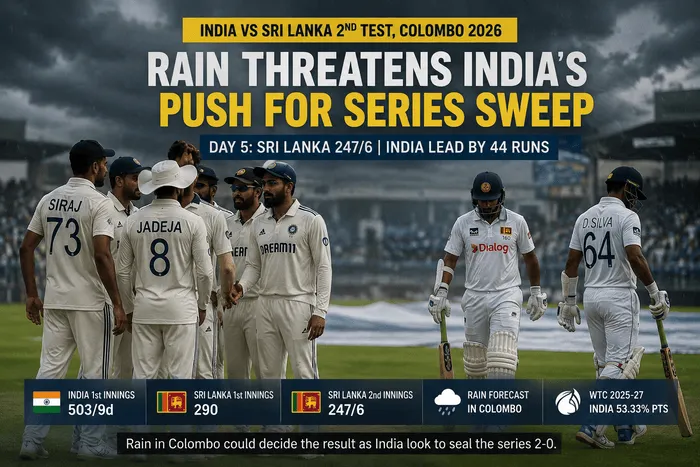
Table of Contents
- India vs Sri Lanka 2nd Test: Current Match Situation
- Why India Are Still in Control
- Sri Lanka’s Fightback and the Four-Wicket Equation
- Why Rain Could Decide the Result
- Key Players to Watch on Day 5
- What India Need to Win the Test
- WTC Implications for India
- What Happens If Rain Washes Out Play?
- Frequently Asked Questions
- Conclusion
India vs Sri Lanka 2nd Test: Current Match Situation
India remain firmly in control of the second Test in Colombo, but Sri Lanka have managed to keep the contest alive heading into the final day.
India enter the final stage of the second Test against Sri Lanka with a clear advantage, but the match is not yet beyond the hosts. After taking a commanding first-innings lead, India enforced the follow-on and put Sri Lanka under immediate pressure. By the end of Day 4, however, Sri Lanka had fought back strongly enough to create a small lead and keep the possibility of a draw alive.
India declared their first innings at 503 for 9, built around centuries from Devdutt Padikkal and Dhruv Jurel. Sri Lanka were then dismissed for 290, leaving India with a 213-run first-innings advantage. With rain already affecting the schedule in Colombo, captain Shubman Gill opted for the follow-on rather than spending additional time batting again.
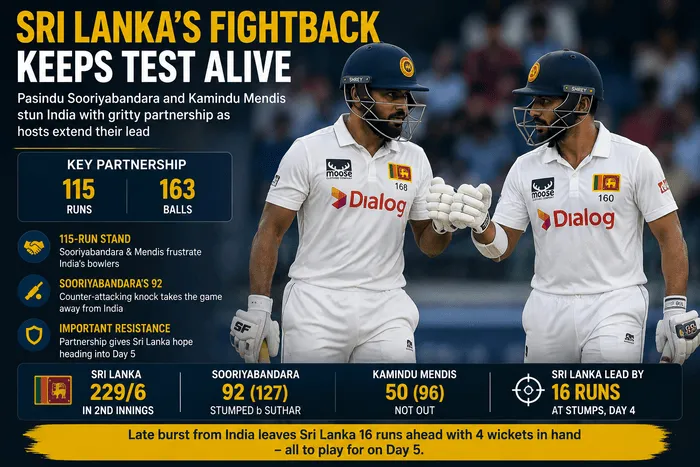
The decision gave India more time to take the remaining Sri Lankan wickets and chase what should eventually be a modest target. Sri Lanka initially struggled after being asked to bat again, but Pasindu Sooriyabandara and Kamindu Mendis produced a crucial partnership that carried the hosts beyond India’s first-innings total.
India eventually regained momentum in the final session. Manav Suthar dismissed Sooriyabandara for 92, while Saransh Jain and Suthar added further breakthroughs as Sri Lanka’s resistance began to fade. Rain then interrupted proceedings and brought the fourth day’s play to an early close.
At stumps, Sri Lanka were 229 for 6, giving them a lead of only 16 runs with four wickets still in hand. That leaves India needing to finish the innings quickly and then chase the remaining runs before Colombo’s weather removes too much playing time from the final day.
Day 5 equation: India need four more Sri Lankan wickets before they can begin the chase. The longer Sri Lanka survive and the more rain interrupts play, the greater the risk that India’s dominant position ends in a draw.
Why India Are Still in Control
India have created a strong winning position through a commanding first innings, an aggressive follow-on decision and a late burst of wickets.
India’s position in the Colombo Test is the result of pressure built across several sessions rather than one isolated performance. After posting 503 for 9 declared, India bowled Sri Lanka out for 290 and secured a 213-run first-innings lead. That gave Shubman Gill the opportunity to enforce the follow-on and, more importantly, preserve valuable time for a potential fourth-innings chase.
The follow-on was particularly significant because rain had already interrupted the Test. Instead of using another session to extend India’s own total, Gill sent Sri Lanka straight back to the crease. The decision carried some risk because India’s bowlers had already worked hard, but the potential reward was greater: India could finish the match without needing to spend a long second innings at the crease.
Sri Lanka did make India work for the breakthrough. Pasindu Sooriyabandara attacked the spinners and, together with Kamindu Mendis, produced a 115-run partnership. That temporarily shifted the pressure back onto India and raised questions about whether the follow-on had given Sri Lanka a route back into the contest.
India responded strongly in the final session. Manav Suthar removed Sooriyabandara for 92 after setting up the batter to charge down the pitch, with Rishabh Pant completing the stumping. Saransh Jain then removed Niroshan Dickwella before Suthar struck again, leaving Sri Lanka six wickets down and only 16 runs ahead when rain stopped play.
The equation therefore remains heavily tilted toward India. Sri Lanka have to extend their lead while protecting their remaining wickets, whereas India need only four more breakthroughs before beginning what should be a relatively small chase. The biggest threat to India’s advantage is no longer the required runs; it is the amount of playing time available.
Key Match Reading
India’s biggest advantage is the combination of a substantial first-innings lead and a small target. If the bowlers can remove the remaining Sri Lankan batters quickly, India should have a clear route to victory. The weather, however, could reduce that opportunity considerably.
Sri Lanka’s Fightback and the Four-Wicket Equation
Sri Lanka fought back after the follow-on, but India’s late wickets kept the visitors firmly in control heading into Day 5.
Sri Lanka looked under serious pressure after being asked to follow on, but the hosts refused to let the Test slip away quietly. A crucial partnership between Pasindu Sooriyabandara and Kamindu Mendis gave Sri Lanka the platform they needed to move ahead of India’s first-innings total.
Sooriyabandara played one of the most important innings of the match, scoring 92 runs before Manav Suthar ended his resistance. His counter-attacking approach helped Sri Lanka absorb the pressure of the follow-on and forced India’s bowlers to work for every breakthrough.
Kamindu Mendis provided equally valuable support. His unbeaten contribution kept the partnership intact for a long period and allowed Sri Lanka to turn a difficult position into a narrow lead. Their stand added 115 runs and became the defining phase of Sri Lanka’s second innings on Day 4.
India eventually regained control with a late burst of wickets. Suthar removed Sooriyabandara through a stumping completed by Rishabh Pant, while Saransh Jain also struck before rain brought the day to an early conclusion.
Sri Lanka therefore went into the final day with four wickets remaining and a 16-run lead. That is hardly a commanding position, but it is enough to make the final day’s weather and first hour of play extremely important.
The Four-Wicket Equation
Sri Lanka’s objective is simple: extend the lead as much as possible and force India to chase under difficult time conditions. India, meanwhile, need early wickets. Every over lost to rain increases Sri Lanka’s chances of escaping with a draw despite India’s dominant first-innings performance.
Why Rain Could Decide the Result
India’s path to victory has become more complicated as Sri Lanka extend their lead and rain threatens to reduce the remaining playing time in Colombo.
Rain has emerged as the biggest obstacle between India and a potential series sweep. The visitors entered Day 5 needing only four wickets to begin a relatively small chase, but Sri Lanka have used the opening session to change the equation significantly.
By lunch on Day 5, Sri Lanka had moved to 329 for 6, extending their overall lead to 116 runs. Sonal Dinusha and Keshara Nuwantha continued their resistance after surviving the final session on Day 4, putting together a substantial partnership and forcing India to spend more time in the field.
That extra time matters because Colombo’s weather forecast has already become a major part of the match equation. Reports for Thursday indicate a high probability of precipitation during important parts of the day. The forecast cited by NDTV put the chance of rain above 80 percent between 10 AM and noon, with the probability remaining above 50 percent during the afternoon.
India therefore face two separate challenges. First, the bowlers must dismiss Sri Lanka as quickly as possible. Second, the batting side must make the chase count if enough overs remain. Every additional run scored by Sri Lanka increases the target, while every rain interruption removes valuable time from India’s attempt to complete the chase.
The situation is especially important because a Test match cannot simply be judged by the size of the eventual target. India could still be in a strong position if Sri Lanka are bowled out quickly, but a prolonged final innings for the hosts followed by rain would leave India with very little time to chase.
For Sri Lanka, the strategy is now straightforward: survive, add as many runs as possible and allow the weather to become an additional layer of protection. India, on the other hand, need to attack immediately and avoid giving the hosts enough time to push the target beyond a manageable range.
Weather equation: India’s biggest opponent may no longer be the required target. If rain removes substantial playing time after Sri Lanka set a competitive lead, the visitors could be forced to settle for a draw despite dominating much of the Test.
Key Players to Watch on Day 5
The final day could be decided by India’s ability to take quick wickets and Sri Lanka’s lower-order resistance under increasing time pressure.
Manav Suthar: India’s Main Threat
Manav Suthar has emerged as one of India’s most important performers in the series. His left-arm spin has repeatedly created problems for Sri Lanka, and he played a decisive role late on Day 4 by dismissing Pasindu Sooriyabandara for 92.
Suthar now has another important assignment: breaking the partnership between Sonal Dinusha and Keshara Nuwantha and giving India enough time to complete the chase. His ability to attack the stumps while varying his pace could be crucial if the pitch continues to offer assistance.
Sonal Dinusha
Dinusha has already scored a century in Sri Lanka’s first innings and remains an important resistance figure in the second innings. His ability to occupy the crease has become particularly valuable as Sri Lanka try to build a lead large enough to consume India’s remaining time.
Keshara Nuwantha
Nuwantha’s role has become increasingly important after Sri Lanka’s middle order was disrupted. His resistance alongside Dinusha has already forced India to spend valuable overs searching for the seventh wicket.
Ravindra Jadeja
Jadeja remains another major factor for India. His ability to attack from one end while Suthar operates from the other could help India break Sri Lanka’s remaining resistance quickly. He also provides India with an experienced option if the chase begins under a tight time window.
The Key Battle
The most important contest on Day 5 is likely to be India’s spinners against Sri Lanka’s remaining batters. If Suthar, Jadeja and the other bowlers strike early, India can still create enough time for a chase. If Dinusha and Nuwantha continue to occupy the crease, the weather becomes an even bigger factor.
What India Need to Win the Test
India still have the advantage, but Sri Lanka’s extended resistance has made the final-day chase far more dependent on time, wickets and the weather.
India’s route to victory remains straightforward in principle: dismiss Sri Lanka, chase the resulting target and complete the series 2–0. The problem is that the equation has become much less comfortable than it appeared at the start of Day 5.
Sri Lanka reached 329 for 6 at lunch, giving them a lead of 116 runs. Sonal Dinusha and Keshara Nuwantha had frustrated India throughout the morning, adding 111 runs for the seventh wicket and consuming more than 39 overs. That extended partnership has significantly reduced the time available for an Indian chase.
India therefore need to attack the remaining two Sri Lankan wickets as soon as play resumes. The quicker they remove Dinusha and Nuwantha, the smaller the target will remain and the more overs Shubman Gill’s side will have to chase it.
Early Wickets Are India’s Priority
The first objective is not to think about the chase before Sri Lanka are bowled out. India’s bowlers must focus on creating a collapse. If the remaining batters can be dismissed quickly, India could still be presented with a target that is manageable even with interruptions.
The spinners will again be central to that plan. Ravindra Jadeja and Manav Suthar have already done much of the work in Sri Lanka’s second innings, while Saransh Jain has also provided important breakthroughs. India need their attack to maintain pressure rather than allowing the tail to add another 50 or 60 runs.
The Chase Must Be Aggressive but Controlled
Once Sri Lanka are dismissed, India cannot afford to spend unnecessary time building a conventional Test-match chase. The target is likely to be modest compared with a normal fourth-innings chase, so scoring rate will become an important part of the calculation.
At the same time, India cannot afford reckless batting. A couple of early wickets would create unnecessary pressure and give Sri Lanka a realistic opportunity to defend a small total. The ideal scenario for Gill’s side is a controlled attacking chase that keeps the required run rate manageable while protecting the remaining wickets.
India’s Winning Formula
India need two things to happen quickly: take the remaining Sri Lankan wickets and make efficient use of every available over during the chase. If rain interrupts play for long periods, even a small target could become difficult to reach before the match ends.
Time is now the decisive factor: India’s first-innings dominance has given them the advantage, but Sri Lanka’s 116-run lead means the visitors must finish the innings and chase quickly if they are to secure the series sweep.
WTC Implications for India
The Colombo Test carries significance beyond the two-match series, with India needing every available point in a tightly contested World Test Championship cycle.
India’s position in the World Test Championship makes the result in Colombo more important than a simple series sweep. The visitors began the final day of the second Test in fifth place with a 53.33% points percentage, meaning every result matters as they attempt to keep their WTC campaign on track.
A victory over Sri Lanka would improve India’s position and move them into fourth place, according to the latest WTC calculations. That makes the final day’s weather particularly frustrating for India: they have created a position from which a win is clearly possible, but rain could take away the playing time required to convert that advantage into points.
A draw would produce a very different outcome. India’s points percentage would fall to approximately 51.52%, leaving the team fifth in the standings. After already suffering four defeats in their first ten Tests of the current cycle, India have very little room for further dropped points.
| Result in Colombo | Impact for India |
|---|---|
| India win | India move to fourth in the WTC standings |
| Match drawn | India remain fifth with a lower PCT |
| India lose | Major setback to India’s WTC campaign |
The broader schedule also leaves India with substantial work ahead. After the Sri Lanka series, India are due to play a two-Test series in New Zealand before hosting Australia for a five-Test series later in the WTC cycle. The results from those matches will ultimately determine whether India can remain in contention for the final.
That is why a rain-affected draw in Colombo would feel particularly costly. India have dominated large portions of this Test, including a 213-run first-innings lead, yet a lack of playing time could prevent them from collecting the full points available for a win.
Why the Weather Matters to the WTC Race
India do not need a complicated mathematical scenario to understand the importance of Day 5. They need a result. With their current PCT leaving little margin for error, converting a dominant position into a win would be significantly more valuable than allowing rain to force a draw.
What Happens If Rain Washes Out Play?
A rain-affected draw would be a frustrating outcome for India after building such a commanding position, while Sri Lanka would escape with a valuable result.
If persistent rain prevents enough cricket from being played on the final day, the second Test could end in a draw despite India controlling most of the match. India entered Day 5 needing only four wickets to finish Sri Lanka’s second innings, but the hosts had already moved ahead after following on.
That makes the remaining playing time more important than the size of the target itself. India can still win if they remove Sri Lanka quickly and receive enough uninterrupted overs to complete the chase. However, every rain delay reduces the number of opportunities available to the visitors.
Sri Lanka do not necessarily need to force the game toward a winning total. Their priority is to stay at the crease, add runs where possible and make India wait for the final wickets. If weather interruptions continue, the hosts could effectively use the clock as another defensive weapon.
| Scenario | Likely Match Impact |
|---|---|
| India take early wickets | India get a larger window to chase the target and push for victory. |
| Sri Lanka add another 50+ runs | The chase becomes more demanding and consumes additional time. |
| Extended rain interruptions | India lose valuable overs needed for both bowling and batting. |
| Most of the final day is washed out | A draw becomes increasingly likely regardless of India’s first-innings dominance. |
The weather forecast already points to significant precipitation risk in Colombo. Reports indicated a particularly high chance of rain during parts of the morning, with the probability remaining substantial through the afternoon. That means India may need to make the most of every clear window rather than waiting for a long uninterrupted period.
From Sri Lanka’s perspective, surviving the morning session would be a major achievement. The longer Dinusha and the remaining lower order remain at the crease, the more difficult India’s task becomes. Even if the eventual target remains modest, a shrinking number of overs could make a successful chase impossible.
Why a Draw Would Favor Sri Lanka
India have dominated the match on the scoreboard, so a draw would represent a missed opportunity for the visitors. Sri Lanka, meanwhile, have already shown enough resistance to take the match beyond India’s expected fourth-innings chase. If rain removes the remaining playing time, the hosts can escape without needing to overturn India’s advantage on the field.
Bottom line: India still have the clearer route to victory, but the weather has narrowed their margin for error. The faster they finish Sri Lanka’s innings, the greater their chance of turning dominance into a series-clinching win.
Frequently Asked Questions
Key questions about the India vs Sri Lanka 2nd Test, the rain threat and India’s chances of completing a series sweep in Colombo.
India remain in a strong position after declaring their first innings at 503/9 and bowling Sri Lanka out for 290. India enforced the follow-on, and Sri Lanka were still batting in their second innings when rain interrupted Day 4. India need the remaining wickets and then a successful chase to complete a series sweep.
India have a relatively short fourth-innings chase ahead if they can dismiss Sri Lanka quickly. Persistent rain, however, could remove valuable overs from the final day and leave India without enough time to complete the chase. Weather forecasts have shown a significant risk of rain across parts of Day 5.
Several Indian players have made important contributions. Dhruv Jurel scored an unbeaten 115 in the first innings, while Manav Suthar played a key role with the ball during Sri Lanka’s second innings. Suthar dismissed Pasindu Sooriyabandara for 92 during India’s late fightback on Day 4.
Sri Lanka’s second innings improved significantly after the follow-on. Pasindu Sooriyabandara and Kamindu Mendis added 115 runs, while Sooriyabandara scored 92. Sonal Dinusha and Keshara Nuwantha then continued the resistance after India took three late wickets on Day 4.
Yes. India created a substantial first-innings advantage and remain in the stronger position. Their clearest route to victory is to take the remaining Sri Lankan wickets quickly and chase the target before rain or a lack of playing time prevents a result.
A draw would mean India fail to convert their strong position into a full win. Before the final day, India were fifth in the World Test Championship standings with a 53.33% points percentage, while a draw would leave them with a lower percentage. A win would improve their position.
India vs Sri Lanka 2nd Test: Conclusion
India have done enough to put themselves in a winning position, but Colombo’s weather could ultimately decide whether they complete the series sweep.
The second Test has produced a fascinating final-day equation. India’s first-innings declaration at 503/9 and their 213-run lead over Sri Lanka gave them a commanding advantage, while enforcing the follow-on showed their intent to push for a result rather than settle for a safe position.
Sri Lanka, however, have made India work much harder than the first-innings score suggested. Their resistance in the second innings has extended the match and reduced the amount of time available for India to complete a chase. With rain remaining a major threat in Colombo, the result could come down to how quickly India can take the remaining wickets and how much uninterrupted playing time is available afterward.
For India, the objective is clear: finish Sri Lanka’s innings quickly, keep the target under control and attack the chase without wasting valuable overs. For Sri Lanka, survival has become the priority. Every additional over at the crease and every rain interruption increases their chances of escaping with a draw.
Match takeaway: India remain the side with the stronger route to victory, but their advantage is now closely tied to time. The weather could be the decisive factor between a series-clinching win and a frustrating draw.