
England vs Pakistan 2nd Test Day 2: Pakistan Bounce Back After Abbas Masterclass
Pakistan fight back at Lord’s after Mohammad Abbas takes four wickets as England finish Day 1 at 248/9 in a rain- and bad-light-affected Test.
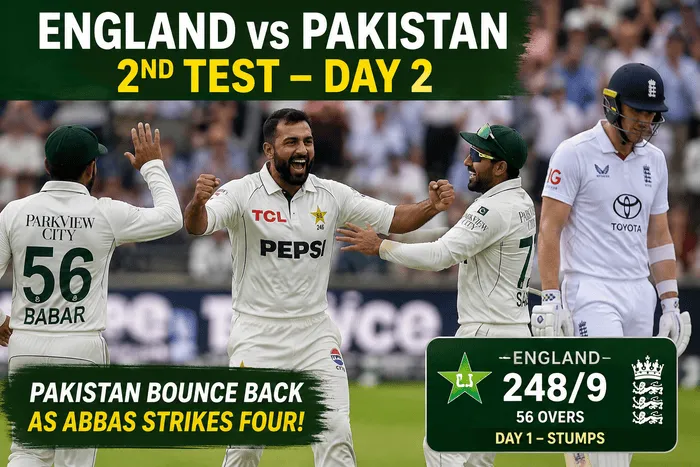
Table of Contents
- England vs Pakistan 2nd Test Day 2: Match Situation
- Mohammad Abbas Masterclass at Lord’s
- England’s Top-Order Collapse
- Jordan Cox and Jamie Smith Lead England Fightback
- Pakistan’s Bowling Response
- What to Expect on Day 2
- Key Players to Watch
- England vs Pakistan Series Context
- Frequently Asked Questions
- Conclusion
England vs Pakistan 2nd Test Day 2: Match Situation
Pakistan made a strong bowling comeback at Lord’s, reducing England to 248/9 after a rain- and bad-light-affected opening day.
Pakistan have responded strongly to their heavy defeat in the first Test, putting England under sustained pressure on the opening day at Lord’s. After winning the toss and choosing to bowl, Pakistan’s pace attack exploited the overcast conditions and reduced England to 248/9 after 56 overs.
Mohammad Abbas led the attack with 4 for 56 from 15 overs, while Mohammad Ali added three wickets. Khurram Shahzad took the other wicket, giving Pakistan eight wickets overall on a shortened day. The performance was a significant improvement from their bowling and fielding display at Headingley.
England’s top order struggled badly after the delayed start. The hosts fell to 80/4 by lunch, with Abbas removing Emilio Gay, Ben Duckett and Joe Root. Harry Brook was later dismissed by Mohammad Ali, leaving England in serious trouble before their middle order mounted a recovery.
England Still Have One Wicket in Hand
England avoided complete collapse through important contributions from Jordan Cox and Jamie Smith. Cox scored 55, while Smith top-scored with 61 from 80 balls. Gus Atkinson remained unbeaten on 34 when bad light ended play, leaving England one wicket away from being bowled out.
Day 1 at a Glance
- Toss: Pakistan elected to bowl
- England: 248/9
- Overs: 56
- Top Score: Jamie Smith — 61
- Pakistan’s Best: Mohammad Abbas — 4/56
- Play Ended: Bad light
Day 2 Starting Point
Pakistan are in the stronger position heading into Day 2 because they need only one more wicket to finish England’s innings. However, Atkinson’s unbeaten 34 means the visitors cannot afford to switch off. Removing the final wicket quickly would give Pakistan the chance to begin their own first innings while the conditions are still relatively helpful for bowling.
Mohammad Abbas Masterclass at Lord’s
Mohammad Abbas produced a disciplined four-wicket spell as Pakistan’s pace attack put England under pressure on the opening day.
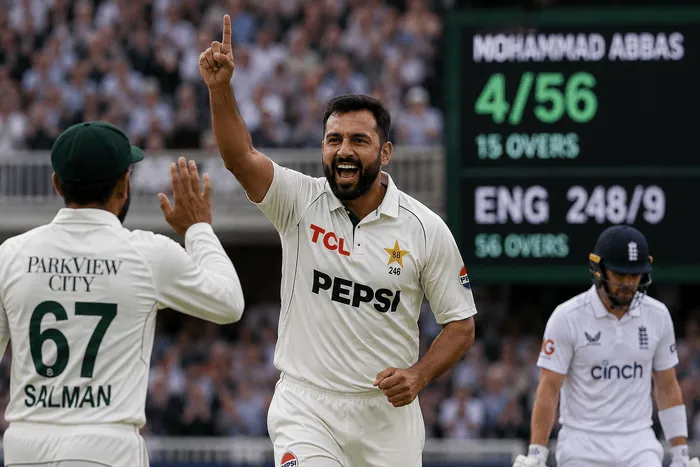
Mohammad Abbas was the standout performer for Pakistan on Day 1, producing a superb 4 for 56 from 15 overs as the visitors’ pace attack kept England under pressure throughout the shortened opening day at Lord’s.
Abbas made an immediate impact after Pakistan chose to bowl. He removed Emilio Gay, Ben Duckett and England captain Joe Root inside the first 11 overs, reducing the hosts to 36 for 3. His control around the off stump and ability to bring the ball back into the right-handers made him particularly difficult to negotiate.
The spell also produced a major personal milestone. Duckett’s dismissal gave Abbas his 900th first-class wicket, adding a landmark achievement to an already influential performance. The milestone came at a venue where Abbas made his Test debut in 2018.
Abbas Kept England’s Top Order Under Pressure
England’s early collapse showed the value of Abbas’ accuracy. Joe Root managed only four runs before being trapped lbw, while Duckett and Gay were also removed before England could establish a substantial opening partnership.
Pakistan’s other pacers then built on that pressure. Mohammad Ali claimed three wickets, while Khurram Shahzad took one, giving Pakistan eight wickets on a rain- and bad-light-affected day.
Abbas Masterclass Verdict
Abbas combined accuracy, movement and patience to give Pakistan exactly the type of opening spell they needed after the Headingley defeat. His four wickets and 900-wicket first-class milestone made him the defining figure of Pakistan’s bowling comeback, although England’s late resistance means the visitors still need one final wicket before beginning their own first innings.
England’s Top-Order Collapse
England lost their top three for just 36 runs as Pakistan’s seamers exploited the overcast conditions at Lord’s.
England’s top order struggled badly against Pakistan’s new-ball attack after the delayed start at Lord’s. The hosts slipped to 36 for 3 inside the opening 11 overs, giving Pakistan exactly the kind of start they needed after their heavy defeat at Headingley.
Mohammad Abbas was at the center of the collapse. He removed Emilio Gay and Ben Duckett before dismissing England captain Joe Root for just four. The wickets came through disciplined bowling around the stumps, with Abbas repeatedly asking England’s batters to play in difficult areas.
Harry Brook also failed to make a major contribution, falling to Mohammad Ali for 15. England had therefore lost four wickets for only 80 runs by lunch, leaving the middle and lower order with the responsibility of rebuilding the innings.
Pakistan’s Early Advantage
- New Ball: Pakistan’s seamers found movement early.
- Abbas: Three early wickets created immediate pressure.
- Root: England’s captain fell for four.
- Pressure: England were 80/4 at lunch.
Why the Collapse Matters
The early wickets showed how different the conditions were from the first Test. Pakistan’s bowlers maintained a much tighter line and made England’s batters work for every scoring opportunity. England’s eventual recovery through the middle order prevented the collapse from becoming decisive, but the top-order failures gave Pakistan control of the opening phase.
Jordan Cox and Jamie Smith Lead England Fightback
England’s middle order prevented a complete collapse as Jordan Cox and Jamie Smith produced the biggest partnership of the innings.
England’s response to the early collapse was led by Jordan Cox and Jamie Smith, who combined for a vital 67-run partnership. Their stand helped England recover from 120 for 5 and pushed the hosts toward a competitive total before Pakistan’s bowlers struck again late in the day.
Cox played the longer supporting role, making 55 from 105 balls with seven fours. He had already helped England through difficult periods earlier in the innings, first adding 41 with Harry Brook and then 43 with Dan Lawrence. His ability to absorb pressure was crucial after Pakistan’s new-ball attack had reduced England to 36 for 3.
Smith then provided the acceleration England needed. The wicketkeeper-batter scored 61 from 80 balls, hitting 10 fours before Mohammad Ali breached his defence. His innings ensured England did not surrender the initiative completely after reaching 187 for 6.
England’s Recovery
- 120/5: England were still in serious trouble.
- Cox: Built multiple important partnerships.
- Smith: Added aggression with 10 boundaries.
- 187/6: England were still searching for a competitive total.
- 248/9: Bad light ended the day before Pakistan could take the final wicket.
Why the Partnership Matters
Cox and Smith changed the shape of the innings. Without their resistance, Pakistan could have finished England well below 200. Instead, England reached 248 for nine and left Gus Atkinson unbeaten on 34. Pakistan still hold the advantage, but England’s lower order has given them something to defend with the ball when play resumes.
Jordan Cox and Jamie Smith Lead England Fightback
England’s middle order prevented a complete collapse as Jordan Cox and Jamie Smith produced the biggest partnership of the innings.
England’s response to the early collapse was led by Jordan Cox and Jamie Smith, who combined for a vital 67-run partnership. Their stand helped England recover from 120 for 5 and pushed the hosts toward a competitive total before Pakistan’s bowlers struck again late in the day.
Cox played the longer supporting role, making 55 from 105 balls with seven fours. He had already helped England through difficult periods earlier in the innings, first adding 41 with Harry Brook and then 43 with Dan Lawrence. His ability to absorb pressure was crucial after Pakistan’s new-ball attack had reduced England to 36 for 3.
Smith then provided the acceleration England needed. The wicketkeeper-batter scored 61 from 80 balls, hitting 10 fours before Mohammad Ali breached his defence. His innings ensured England did not surrender the initiative completely after reaching 187 for 6.
England’s Recovery
- 120/5: England were still in serious trouble.
- Cox: Built multiple important partnerships.
- Smith: Added aggression with 10 boundaries.
- 187/6: England were still searching for a competitive total.
- 248/9: Bad light ended the day before Pakistan could take the final wicket.
Why the Partnership Matters
Cox and Smith changed the shape of the innings. Without their resistance, Pakistan could have finished England well below 200. Instead, England reached 248 for nine and left Gus Atkinson unbeaten on 34. Pakistan still hold the advantage, but England’s lower order has given them something to defend with the ball when play resumes.
Pakistan’s Bowling Response
Pakistan’s pace attack delivered the response they needed after Headingley, taking nine England wickets on a shortened opening day at Lord’s.
Pakistan’s bowling performance was the clearest sign of a turnaround from the first Test. Their three main pacers shared the wickets effectively, with Mohammad Abbas taking four, Mohammad Ali taking three and Khurram Shahzad claiming one as England reached 248 for nine. The disciplined attack kept England under pressure despite the hosts’ late recovery.
Abbas set the tone with his movement and control, while Ali repeatedly attacked the stumps and finished with 3 for 67. Khurram also played an important role by dismissing Jordan Cox for 55 with a spectacular catch from Salman Ali Agha completing the chance at second slip.
The improvement was not limited to wicket-taking. Pakistan created pressure through tighter bowling and better fielding than they showed at Headingley. Their ability to keep taking wickets after England’s middle-order recovery prevented the hosts from turning 120 for five into a much larger total.
Pakistan Must Finish the Job Quickly
England still have Gus Atkinson unbeaten on 34 and Josh Tongue on one when play resumes. Pakistan therefore need to avoid allowing the final wicket to add unnecessary runs. Removing Atkinson early would give the visitors a chance to begin their own innings without losing further momentum.
Bowling Breakdown
- Mohammad Abbas: 15 overs, 3 maidens, 4 wickets
- Mohammad Ali: 17 overs, 2 maidens, 3 wickets
- Khurram Shahzad: 15 overs, 1 wicket
- Ali Usman: 9 overs, economical support
- Total: Nine England wickets fell
Bowling Verdict
Pakistan’s attack has given the visitors exactly the platform they wanted after the Headingley defeat. The challenge now is to complete England’s innings without conceding a late surge and then reproduce the same discipline with the bat. If Pakistan can take a first-innings lead, their improved bowling effort could become the foundation for a series-leveling performance.
What to Expect on Day 2
Pakistan need one wicket to finish England’s innings, while England will hope their lower order can add valuable runs before the visitors begin their first innings.
Day 2 begins with Pakistan in a strong position, but England still have an opportunity to improve their total. The hosts resume at 248 for nine, with Gus Atkinson unbeaten on 34 and Josh Tongue on one. Pakistan therefore need only one wicket to complete the innings, but removing Atkinson quickly will be important if they want to avoid conceding a late burst of runs.
Pakistan’s first priority will be to finish the job with the ball. Mohammad Abbas ended Day 1 with 4 for 56, leaving him one wicket short of a five-wicket haul. Another early breakthrough would allow Pakistan to take the momentum directly into their batting innings.
England, meanwhile, will hope Atkinson can extend his unbeaten contribution. His 34 came from only 27 balls, including five boundaries, and another 20 or 30 runs could make the first-innings total considerably more useful if England’s bowlers can later exploit the Lord’s conditions.
Pakistan’s Batting Becomes the Next Test
Once England are bowled out, the focus will shift to Pakistan’s batting. This is where the visitors must avoid repeating their Headingley problems. Babar Azam’s return gives Pakistan greater experience, but England’s seamers will be encouraged by the movement they found on Day 1.
Day 2 Key Battles
- Final Wicket: Pakistan need to dismiss Atkinson and Tongue quickly.
- Abbas: One wicket away from a five-for.
- Pakistan Batting: Must handle England’s new-ball attack.
- Babar Azam: Important stabilizing presence in the middle order.
- Conditions: Further weather interruptions could influence the day.
Day 2 Outlook
Pakistan have the immediate advantage because England are nine down, but their real challenge begins once they bat. If Pakistan can build a first-innings lead while avoiding another top-order collapse, they will have a genuine opportunity to turn their improved bowling performance into a series-leveling result.
Key Players to Watch
The second day could be shaped by Pakistan’s attack, England’s lower order and the response of the returning Babar Azam.
Mohammad Abbas — Pakistan
Abbas is the standout performer after Day 1. His four-wicket haul has already put Pakistan in a strong position, and he will have the chance to complete a five-wicket haul when England’s final wicket falls. His ability to maintain a disciplined line will remain important when Pakistan begin their own innings later in the match.
Babar Azam — Pakistan
Babar’s biggest challenge comes with the bat. After Pakistan’s batting struggles at Headingley, the returning captain will be expected to provide stability once England’s innings is completed. His experience against England makes his contribution particularly important in Pakistan’s attempt to establish a first-innings advantage.
Gus Atkinson — England
Atkinson is currently England’s most important lower-order batter. He finished Day 1 unbeaten on 34 from 27 balls, giving England a chance to push their total beyond 250 when play resumes. His immediate objective will be to extend the innings before Pakistan can complete the final wicket.
Jamie Smith also remains central to England’s recovery story after his 61 helped the hosts move away from their early collapse. If England can add useful runs on the second morning, their bowlers will have a better total to defend when Pakistan begin batting.
Key Player Battle
The immediate battle is between Abbas and Atkinson. Pakistan need Abbas or another seamer to finish England’s innings quickly, while Atkinson has the opportunity to add late runs. After that, the focus shifts to Babar and Pakistan’s top order against England’s seam attack.
England vs Pakistan Series Context
Pakistan’s bowling turnaround at Lord’s has given them a chance to respond after England dominated the opening Test at Headingley.
England entered the Lord’s Test with a 1–0 lead after completing an innings-and-103-run victory at Headingley. Pakistan were dismissed for 171 and 135 in that match, while England posted 409 in their first innings.
The second Test has so far followed a very different pattern. Pakistan’s seamers responded strongly after winning the toss and choosing to bowl, restricting England to 248 for nine after 56 overs on a rain- and bad-light-affected opening day.
That puts Pakistan in a position to challenge England for the first time in the series. If they can finish England’s innings quickly and build a substantial first-innings score themselves, the visitors can put the pressure back on the hosts and give themselves a realistic chance of leveling the series.
Series Equation
- Series: England lead 1–0
- First Test: England won by an innings and 103 runs
- Second Test: Lord’s, London
- Pakistan’s Target: Level the series at 1–1
- England’s Target: Secure another win and seal the series
Momentum Has Shifted
England remain ahead in the series, but Pakistan have changed the momentum at Lord’s with a much more disciplined bowling display. The next major test will be their batting. A strong first innings could turn the promising start created by Abbas and the pace attack into a genuine series-leveling opportunity.
Frequently Asked Questions
Key questions about Pakistan’s bowling comeback, Mohammad Abbas’ performance and the second Test at Lord’s.
England finished Day 1 at 248 for nine after 56 overs. Gus Atkinson was unbeaten on 34 when bad light brought the shortened opening day to an end.
Mohammad Abbas took four wickets for 56 runs from 15 overs. His performance included the dismissals of Emilio Gay, Ben Duckett, Joe Root and Jofra Archer.
Yes. Abbas reached 900 first-class wickets during his four-wicket spell against England at Lord’s, adding a major personal milestone to his strong bowling performance.
Pakistan won the toss and elected to bowl first at Lord’s. The visitors looked to use the fresh conditions and movement available to the seamers.
Rain delayed the start and bad light later brought play to an early conclusion. Only 56 overs were completed during the opening day.
England lead the three-Test series 1–0 after winning the opening Test at Headingley by an innings and 103 runs. Pakistan are looking to level the series at Lord’s.
England vs Pakistan 2nd Test Day 2: Conclusion
Pakistan have bounced back strongly at Lord’s, but the visitors still need to complete England’s innings and deliver with the bat.
Pakistan have produced the response they needed after their heavy defeat at Headingley. Their pace attack kept England under pressure throughout a shortened opening day, with Mohammad Abbas leading the way with four wickets and reaching the significant milestone of 900 first-class wickets.
England’s recovery through Jordan Cox, Jamie Smith and the lower order means the hosts remain competitive at 248 for nine. Pakistan need one more wicket when play resumes, but their bigger challenge will come with the bat. Babar Azam’s return gives the visitors additional experience as they look to avoid another batting collapse.
The weather could remain an important factor at Lord’s. After rain delayed the start and bad light ended Day 1 early, every available session becomes valuable for both teams. Pakistan will want to finish England’s innings quickly and use the momentum created by their bowlers to build a first-innings lead.
Key takeaway: Pakistan have shifted the momentum at Lord’s with an impressive bowling performance, but the match remains open. England’s final wicket and Pakistan’s first innings could determine whether the visitors can turn their Day 1 advantage into a genuine series-leveling opportunity.