
Pakistan Cricket Crisis: PCB Seizes Players’ Phones Before Final England Test
Pakistan cricket faces another major controversy ahead of the final England Test at Edgbaston, with reports that the Pakistan Cricket Board has taken players’ mobile phones into custody. Here is what we know about the latest development and the questions surrounding the move.

Table of Contents
- PCB Takes Pakistan Players’ Phones Into Custody
- Why Did the PCB Take the Players’ Phones?
- Is the Phone Move Linked to Match-Fixing Concerns?
- What ICC Rules Say About Players’ Phones
- Pakistan’s Cricket Crisis Goes Beyond the Phone Controversy
- Seven Pakistan Players Released After England Defeats
- Mike Hesson and the Latest Coaching Shake-Up
- What to Expect From the Final England Test at Edgbaston
- What We Know, What Remains Unclear and What Happens Next
- Conclusion
PCB Takes Pakistan Players’ Phones Into Custody
Pakistan’s troubled England tour has taken another unexpected turn, with reports that the Pakistan Cricket Board (PCB) has taken mobile phones belonging to members of the national team into its custody ahead of the third and final Test at Edgbaston.
The reported move comes just days after the PCB made sweeping changes to the Test setup, including sending seven players home and changing the coaching staff. According to reports from Pakistani media, the phones are expected to remain with PCB officials until the conclusion of the Birmingham Test.
Important: The PCB has not publicly explained why the phones were reportedly taken into custody. There is also no official confirmation that the move is connected to a corruption or match-fixing investigation.
The identities of the players whose phones were collected have also not been publicly disclosed. That lack of detail has naturally led to questions about the purpose and scope of the measure, particularly because the devices are reportedly being retained beyond the normal match-day restrictions that apply to mobile phones in international cricket.
What is confirmed so far?
Reports say Pakistan team members’ phones were taken into PCB custody before the Edgbaston Test and may remain there until the match ends. The board has not publicly confirmed the reason, and no Pakistan player has been publicly accused of an integrity offence.
Why Did the PCB Take the Players’ Phones?
The biggest unanswered question surrounding the latest Pakistan cricket development is why the PCB has reportedly taken players’ phones into custody for an extended period. Unlike the standard restrictions applied during an international match, this reported measure appears to cover a longer period and has therefore attracted considerable attention.
At the time of publication, the PCB has not publicly provided a detailed explanation for the decision. Reports indicate that the devices could remain with the board until the Edgbaston Test concludes, but the identities of the players involved and the exact scope of the measure have not been officially disclosed.
Why the Timing Has Raised Questions
The timing is significant because Pakistan are already dealing with major changes to their Test setup. Seven players were released after the first two Tests against England, the coaching structure was altered and Mike Hesson was brought in for the red-ball side. The phone development adds another layer of uncertainty before the final match of the series.
What is not known: There has been no public PCB explanation establishing that the phone custody is connected to match-fixing, corruption or a specific disciplinary investigation.
Until the board provides further clarification, the most accurate approach is to treat the phone custody as a reported development rather than assume a reason that has not been officially established.
Is the Phone Move Linked to Match-Fixing Concerns?
The decision to take Pakistan players’ phones into PCB custody has inevitably raised questions about whether the move could be connected to integrity or match-fixing concerns. However, it is important to separate speculation from what has actually been confirmed.
Some reports have raised the possibility of an anti-corruption angle, particularly because the phones are reportedly being retained beyond the usual restrictions that apply to mobile devices during an international match. But there is currently no official statement from the PCB confirming that the players are being investigated for match-fixing or any other corruption offence.
No Pakistan player has been publicly accused of an integrity violation in connection with this development. The identities of the players whose phones were reportedly taken have also not been officially disclosed, making it impossible to draw conclusions about the reason for the measure.
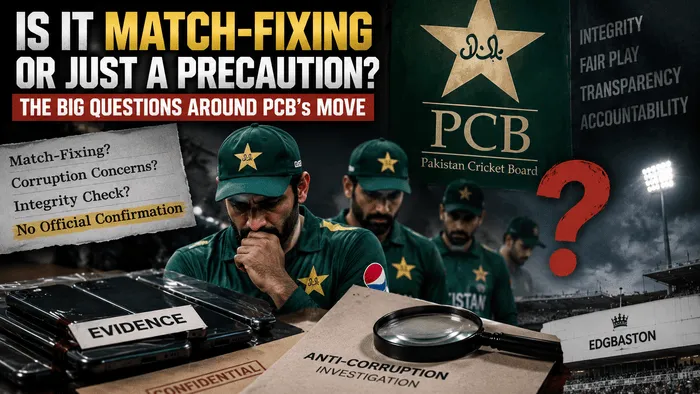
No official match-fixing link confirmed: Reports have raised questions about the reason for the phone custody, but the PCB has not publicly confirmed that the move is connected to a corruption or match-fixing investigation.
Why the Distinction Matters
Cricket’s integrity framework gives authorized officials significant powers when a formal investigation is taking place, including the ability to require relevant information or devices. That does not mean every instance of a phone being collected is evidence of wrongdoing.
For now, the most responsible reading of the situation is that the PCB has reportedly taken custody of certain players’ phones, while the reason remains unclear. Any stronger claim should wait for an official explanation from the board or a relevant integrity authority.
What ICC Rules Say About Players’ Phones
Mobile phones are tightly controlled around international cricket matches because of the sport’s integrity and communication protocols. The ICC prohibits players and match officials from using communication devices within the designated Players and Match Officials Area during a match, with devices required to be secured before entry.
These rules are primarily designed to prevent unauthorized communication and protect the integrity of international cricket. Players are therefore accustomed to handing over phones and other communication devices on match days. However, the reported PCB decision is different in one important respect: the phones are reportedly being retained for a longer period rather than simply being secured during match-related activity.
Normal ICC Restrictions Are Not an Accusation
It is important not to confuse standard ICC phone restrictions with an investigation. The existence of strict device rules does not mean a player has done anything wrong. International cricket has long used these measures as part of its broader integrity framework.
Key distinction: ICC match-day phone restrictions are standard integrity measures. They should not, by themselves, be interpreted as evidence of match-fixing or corruption.
The unanswered issue in Pakistan’s case is therefore not whether phones can be restricted around matches, but why the PCB has reportedly chosen to retain certain devices until the end of the Edgbaston Test. That explanation has yet to be made public.
Pakistan’s Cricket Crisis Goes Beyond the Phone Controversy
The reported phone custody is only the latest development in what has already been a turbulent Test campaign for Pakistan. The team arrived in England with expectations of competing in a three-match series, but two heavy defeats have left them 2-0 down heading into the final match at Edgbaston.
England won the opening Test by an innings and 103 runs before completing another convincing victory at Lord’s by 194 runs. Pakistan’s batting has been a major concern, with the team struggling to produce the kind of substantial first-innings totals required to put pressure on England.
A Major Test Setup Overhaul
The Pakistan Cricket Board responded to the poor results with sweeping changes. Seven players were released from the Test squad, while Sarfaraz Ahmed and Umar Gul were also removed from their coaching roles. Mike Hesson was brought in as the new red-ball head coach, with Ashley Noffke joining the setup as bowling coach.
The timing of those changes has added to the uncertainty around the team. Pakistan now have a significantly altered squad preparing for the final Test while also trying to recover from a series already lost.
The bigger picture: Pakistan’s phone controversy comes during a wider period of instability involving results, selection changes and a reshaped coaching setup.
That broader context is important when assessing the latest report. The phone development should be viewed as a new and unresolved issue within an already unsettled Pakistan Test campaign, rather than as confirmation of any specific wrongdoing.
Seven Pakistan Players Released After England Defeats
Pakistan’s Test squad underwent a dramatic overhaul after the first two matches of the England series. The PCB released seven players following the heavy defeats, making the selection changes one of the biggest talking points of the tour.
The players released were Mohammad Rizwan, Imam-ul-Haq, Salman Ali Agha, Ali Usman, Aamir Jamal, Muhammad Awais Zafar and Khurram Shahzad. Several replacements were subsequently added to the squad, with a number of them yet to make their Test debuts.
Why the Changes Became a Major Talking Point
The timing of the changes was unusual because they came in the middle of a Test series rather than after its completion. Pakistan had already struggled badly with the bat, and the scale of the overhaul meant the team entered the final Test with a considerably different composition.
The selection shake-up also generated criticism from former Pakistan figures and commentators. Questions were raised about the communication of the decisions and whether such extensive changes could realistically help the team regain stability before the series-ending Test.
Seven released: Mohammad Rizwan, Imam-ul-Haq, Salman Ali Agha, Ali Usman, Aamir Jamal, Muhammad Awais Zafar and Khurram Shahzad were released from Pakistan’s Test squad after the first two England Tests.
The phone controversy now arrives against that backdrop of major selection and coaching changes, adding another layer to Pakistan’s difficult tour before the final Test in Birmingham.
Mike Hesson and the Latest Coaching Shake-Up
Pakistan have also changed their coaching structure ahead of the final Test, with Mike Hesson taking charge of the red-ball setup. Former Pakistan wicketkeeper Sarfaraz Ahmed and bowling coach Umar Gul were released from their coaching positions as part of the wider overhaul.
Ashley Noffke has joined Hesson as the bowling coach, giving Pakistan a new coaching combination with very little time to prepare for the decisive final match. Hesson’s arrival comes at a difficult moment, with England already holding an unassailable 2-0 series lead.
Hesson Says He Was Not Involved in the Squad Releases
Hesson has also clarified an important point surrounding the overhaul. He said he was not involved in the decision to release the seven players, as that decision had already been made before he took charge of the red-ball team.
That clarification separates the new coaching regime from one of the most controversial decisions of the tour. Hesson’s immediate challenge is therefore to work with the reshaped squad and prepare Pakistan for a final Test in which they will be looking to restore some confidence.
Coaching context: Hesson’s priority is now the Edgbaston Test, while the seven-player release was a decision made before his involvement with the red-ball setup.
With the phone controversy now adding to the team’s off-field uncertainty, the new coaching staff will need to keep attention firmly on preparation, selection and performance when Pakistan return to action in Birmingham.
What to Expect From the Final England Test at Edgbaston
Pakistan will return to action at Edgbaston on September 9 for the third and final Test of the series. England already have an unassailable 2-0 lead, but the Birmingham match remains important for Pakistan as they look to avoid a series whitewash and give their reshaped Test side a more positive ending.
Pakistan Have a New-Look Test Squad
The final Test will feature a substantially changed Pakistan squad following the release of seven players. New faces have been brought into the group, including several players who have yet to play a Test match, while established names such as Babar Azam, Saud Shakeel and Shan Masood remain part of the setup.
The biggest challenge will be adapting quickly. England have already demonstrated that they can put Pakistan under sustained pressure, particularly with the bat. Pakistan’s new combination must therefore improve its batting resilience while making better use of its bowling opportunities.
Pakistan’s challenge: The team must adapt to the reshaped squad and new coaching setup quickly if it is to compete with an England side that has already secured the series.
For Mike Hesson and the new coaching staff, Edgbaston is the first major opportunity to establish a direction for Pakistan’s red-ball cricket after the latest overhaul. The result will matter, but so will the team’s overall response to a difficult period.
What We Know, What Remains Unclear and What Happens Next
The reported decision to take Pakistan players’ phones into PCB custody has created another layer of uncertainty around the team’s England tour. At this stage, the most important point is that the board has not publicly provided a detailed explanation for the move.
What We Know
- Reports say mobile phones belonging to Pakistan team members were taken into PCB custody.
- The devices are reportedly expected to remain with the board until the Edgbaston Test concludes.
- The identities of the players involved have not been publicly disclosed.
- Pakistan have already made major changes to their Test squad and coaching setup.
What Remains Unclear?
The central unanswered question is the reason behind the reported phone custody. There has been speculation about possible integrity concerns, but no official statement has established that the measure is part of a match-fixing or corruption investigation. There is also no public accusation against any individual player arising from the development.
What Happens Next?
The immediate focus will shift to the Edgbaston Test, which begins on September 9. Any further explanation from the PCB could clarify whether the phone measure was a precaution, an internal administrative decision or connected to a formal integrity process.
Bottom line: Until the PCB provides more information, the phone-custody story should be reported as an unresolved development. Speculation should not be presented as evidence of wrongdoing.
Conclusion
The reported decision by the Pakistan Cricket Board to take players’ phones into custody has added another unusual development to an already turbulent England tour. Pakistan are preparing for the final Test at Edgbaston after losing the first two matches and making major changes to both their squad and coaching structure.
However, the reason for the reported phone custody remains unclear. While the development has generated speculation about possible integrity concerns, there is no official confirmation that it is connected to match-fixing, corruption or an investigation involving a specific Pakistan player.
The focus will now turn to Edgbaston, where Mike Hesson will oversee a reshaped Pakistan side for the first time. The final Test gives the team an opportunity to respond on the field while the PCB faces growing questions about the decisions being made around the squad.
Key takeaway: Pakistan’s phone controversy is currently an unresolved development. Until the PCB or an authorized integrity body provides further details, speculation should not be treated as confirmation of wrongdoing.