
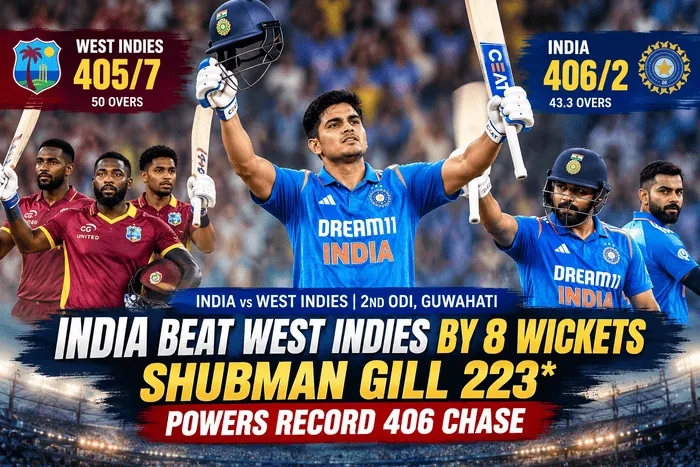
India chased down West Indies’ 405/7 with 406/2 in 43.3 overs as Shubman Gill smashed an unbeaten 223 and Rohit Sharma scored 101 in a record-breaking ODI chase.
- Match Summary
- India Beat West Indies by 8 Wickets
- Shubman Gill’s Record 223*
- Rohit Sharma’s 101 and 12,000 ODI Runs
- India Chase 406 in Record Time
- West Indies’ 405/7 and Three Centuries
- How India Chased Down 406
- Kuldeep Yadav Completes 200 ODI Wickets
- Key Records From the Guwahati ODI
- Why India Won
- Series Impact and What’s Next
- FAQs, Final Verdict and Sources
Match Summary
India produced a record-breaking chase in Guwahati to defeat West Indies by eight wickets and take an unassailable 2–0 lead in the three-match ODI series.
India completed one of the most remarkable successful chases in their ODI history on September 30, 2026, defeating West Indies by 8 wickets in the second ODI at Barsapara Cricket Stadium, Guwahati. Chasing 406 after West Indies posted 405/7, India reached 406/2 in just 43.3 overs.
The victory was built around an extraordinary unbeaten 223 from Shubman Gill. The India captain combined power with control throughout the chase and became the first batter to score an ODI double century in fewer than 120 balls. Gill reached his double century from just 117 deliveries before finishing unbeaten on 223.
Rohit Sharma provided the ideal platform at the other end, scoring 101 from 75 balls. The opening pair added 255 runs before Rohit was dismissed, putting India firmly in control of a chase that initially looked extremely difficult after West Indies crossed 400.
West Indies had earlier produced their own piece of ODI history. John Campbell, Shai Hope and Amir Jangoo all scored centuries as the visitors reached 405/7, their highest-ever total in men’s ODI cricket and their first score above 400.
India vs West Indies 2nd ODI — Quick Result
| Match Detail | Information |
|---|---|
| Match | India vs West Indies, 2nd ODI |
| Date | September 30, 2026 |
| Venue | Barsapara Cricket Stadium, Guwahati |
| West Indies | 405/7 in 50 overs |
| India | 406/2 in 43.3 overs |
| Result | India won by 8 wickets |
| Series | India lead 2–0 |
| India Top Scorer | Shubman Gill — 223* |
| West Indies Top Scorer | Amir Jangoo — 114 |
The result also sealed the ODI series for India with one match still to play. Alongside Gill’s historic innings, Kuldeep Yadav reached 200 ODI wickets, while Rohit crossed the landmark of 12,000 ODI runs during his century.
Shubman Gill’s Record 223*
Shubman Gill produced a historic unbeaten 223 to lead India’s record chase of 406 against West Indies in Guwahati.
Shubman Gill’s unbeaten 223 off 133 balls was the defining performance of India’s eight-wicket victory over West Indies in the second ODI. The India captain transformed a 406-run target into a comfortable chase, finishing with one of the most remarkable individual innings in ODI history.
Gill struck 26 fours and 8 sixes during his innings and maintained an exceptional scoring rate throughout the chase. His double century came from just 117 balls, making it the fastest ODI double century.
The innings also became the highest individual score in a successful ODI chase. Gill remained unbeaten until India completed the target at 406/2 in 43.3 overs, giving him the opportunity to finish the match with his bat still in hand.
Gill’s century had already put India in a commanding position. He reached three figures from just 62 balls, continuing the aggressive approach that had helped India keep pace with the enormous target set by West Indies.
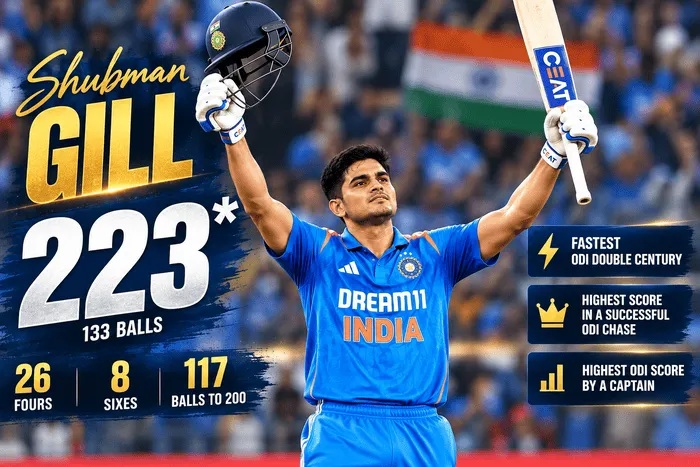
Shubman Gill 223* — Key Numbers
| Statistic | Gill’s Performance |
|---|---|
| Runs | 223* |
| Balls Faced | 133 |
| Fours | 26 |
| Sixes | 8 |
| 50 | Reached during India’s early acceleration |
| 100 | 62 balls |
| 200 | 117 balls |
| Final Score | 223* off 133 balls |
Gill Takes Control of the Chase
The pressure of chasing 406 could have forced India into a cautious start, but Gill and Rohit Sharma attacked the target from the beginning. Gill combined clean strokeplay with calculated aggression, ensuring that the required rate never became a major concern.
After Rohit reached his century and was dismissed for 101, Gill continued to dominate alongside Virat Kohli and later Ruturaj Gaikwad. He eventually finished the chase unbeaten, turning West Indies’ record-breaking 405/7 into a losing total.
The 223* also strengthened Gill’s growing record as an ODI batter and captain. It was not simply a high individual score; it directly decided the outcome of a match in which India had been set the highest target they had ever successfully chased in men’s ODI cricket.
Rohit Sharma’s 101 and 12,000 ODI Runs
Rohit Sharma gave India the perfect start with a century before reaching the landmark of 12,000 ODI runs.
Rohit Sharma scored 101 off 75 balls to provide the foundation for India’s record 406-run chase. The veteran opener attacked the West Indies bowling from the beginning and ensured India stayed ahead of the required run rate.
Rohit struck 10 fours and 6 sixes during his innings. His century was his 35th in men’s ODI cricket, adding another milestone to an already decorated international career.
The innings also took Rohit past 12,000 ODI runs. He became only the third Indian batter to reach the landmark, joining Sachin Tendulkar and Virat Kohli in the exclusive group.
More importantly for India’s chase, Rohit formed a massive opening partnership with Shubman Gill. The pair added 255 runs, completely changing the complexion of a chase that began with India needing 406 to win.
Rohit Sharma’s Innings — Key Numbers
| Statistic | Rohit Sharma |
|---|---|
| Runs | 101 |
| Balls | 75 |
| Fours | 10 |
| Sixes | 6 |
| ODI Centuries | 35 |
| ODI Runs | 12,000+ |
| Opening Partnership | 255 runs with Shubman Gill |
Rohit and Gill Put India in Control
The opening partnership was crucial because West Indies had posted 405/7, leaving India with very little room for a slow start. Rohit and Gill instead took the attack to the bowlers and kept India’s chase moving at a rate that steadily reduced the required target.
Rohit eventually fell after reaching his century, but by then the damage had already been done. Gill remained at the crease and continued the assault, eventually completing his unbeaten 223 as India crossed the 406-run target with 39 balls remaining.
India Chase 406 in Record Time
India turned West Indies’ record 405/7 into a remarkable eight-wicket defeat by reaching 406/2 in just 43.3 overs.
Chasing 406 runs, India needed a near-perfect batting performance, but the target quickly became manageable once Rohit Sharma and Shubman Gill established a dominant opening partnership. India reached the required score at 406/2 in 43.3 overs, winning with 39 balls remaining.
The successful chase became India’s highest successful ODI run chase. It was also the second-highest successful chase in men’s ODI cricket, underlining the scale of India’s batting performance against a West Indies side that had just posted its highest-ever ODI total.
India maintained an aggressive scoring rate throughout the innings. The 255-run opening partnership between Rohit and Gill removed much of the pressure from the chase, while Gill continued the acceleration after Rohit’s dismissal.
When Rohit was dismissed for 101, India still required a significant number of runs, but Gill remained unbeaten and continued to attack. His partnership with the middle order ensured that India never allowed the required rate to become a serious concern.
India’s Record Chase — Key Numbers
| Chase Detail | India |
|---|---|
| Target | 406 |
| Final Score | 406/2 |
| Overs | 43.3 |
| Winning Margin | 8 wickets |
| Balls Remaining | 39 |
| Highest Partnership | 255 — Rohit Sharma & Shubman Gill |
| Top Score | Shubman Gill — 223* |
| Second Top Score | Rohit Sharma — 101 |
A Record Target Becomes a Record Chase
West Indies had every reason to believe that 405/7 would put India under enormous pressure. Their innings contained three centuries and produced their first 400-plus total in men’s ODI cricket. Instead, India’s openers immediately shifted the pressure back onto the visitors.
The significance of the chase was not only the final margin. India completed the pursuit before the end of the 44th over, demonstrating how quickly the required rate was controlled after the opening partnership took the score forward.
Gill’s unbeaten 223 became the defining innings of the chase, while Rohit’s century supplied the early momentum. Together, they ensured that West Indies’ record total was ultimately not enough to prevent India from taking a 2–0 series lead.
West Indies’ 405/7 and Three Centuries
West Indies produced a historic batting display in Guwahati, scoring 405/7 with John Campbell, Shai Hope and Amir Jangoo all reaching centuries.
West Indies entered the second ODI looking to respond after losing the opening match, and their batting performance gave them an enormous total to defend. They finished on 405/7 in 50 overs, setting India a target of 406.
The innings was built around three centuries. John Campbell scored 101, captain Shai Hope made 104, while Amir Jangoo top-scored with 114. It was the first time West Indies had produced three individual centuries in the same men’s ODI innings.
Campbell provided the early acceleration, Hope consolidated the innings through the middle overs, and Jangoo delivered a powerful finish. Their combined contribution kept the scoring rate high throughout the 50 overs and allowed West Indies to cross the 400-run mark for the first time in men’s ODI cricket.
West Indies Batting — Key Scores
| Batter | Runs | Balls | Role in Innings |
|---|---|---|---|
| John Campbell | 101 | 68 | Explosive opening century |
| Shai Hope | 104 | 94 | Middle-order consolidation |
| Amir Jangoo | 114 | 77 | Powerful late-innings acceleration |
| West Indies | 405/7 | 50 overs | Highest ODI total |
Campbell Sets the Tone
John Campbell’s century gave West Indies the attacking start they needed. He scored 101 from 68 balls, putting India’s bowlers under pressure during the opening stages and creating the platform for the middle order.
Hope Anchors the Middle Overs
Shai Hope followed Campbell’s aggression with a century of his own. His 104 from 94 balls helped maintain the innings after the early attacking phase and ensured that West Indies had wickets available for the final overs.
Jangoo Provides the Final Surge
Amir Jangoo then produced the biggest individual score of the innings. His 114 from 77 balls provided the acceleration that pushed West Indies beyond 400 and gave India a target that appeared extremely challenging at the halfway point of the match.
Despite the historic batting display, India’s response completely changed the story of the match. The 405/7 total became the foundation for one of the biggest successful ODI chases, as India reached 406/2 with 39 balls remaining.
How India Chased Down 406
India controlled the chase from the opening over, with Rohit Sharma and Shubman Gill combining for a 255-run partnership before Gill completed the record pursuit.
Rohit and Gill Attack From the Start
India began the chase with the enormous target of 406, but there was little sign of hesitation from the opening pair. Rohit Sharma and Shubman Gill attacked the West Indies bowlers and kept India’s scoring rate high from the early overs.
The partnership quickly became the central feature of the chase. Rohit provided his usual attacking strokeplay while Gill combined timing with powerful hitting, allowing India to remain comfortably placed despite the size of the target.
255-Run Opening Partnership
Rohit and Gill added 255 runs for the first wicket. By the time the partnership ended, India had already removed much of the pressure created by West Indies’ 405/7.
Rohit eventually reached his century before being dismissed for 101 from 75 balls. His departure did not slow India’s progress because Gill was still at the crease and had moved into complete control of the chase.
Gill Takes the Chase Beyond West Indies
Gill continued attacking after Rohit’s dismissal and moved through the milestones at remarkable speed. He reached his century from 62 balls and then accelerated towards a double century, eventually completing the landmark from just 117 balls.
His unbeaten 223 off 133 balls meant India never needed to rely on the lower order. Gill stayed at the crease until the target was reached, finishing the match as the defining performer of India’s record chase.
India’s Chase Progress
| Chase Stage | Key Development |
|---|---|
| Opening Overs | Rohit Sharma and Shubman Gill attack the West Indies bowling |
| Opening Partnership | 255 runs between Rohit and Gill |
| Rohit Sharma | 101 off 75 balls |
| Shubman Gill | 223* off 133 balls |
| India Final Score | 406/2 in 43.3 overs |
| Result | India won by 8 wickets |
India Finish With 39 Balls Remaining
India completed the chase at 406/2 in 43.3 overs, leaving 39 deliveries unused. The result turned West Indies’ highest-ever ODI total into a losing score and gave India an unassailable 2–0 lead in the three-match series.
The chase was ultimately defined by the combination of Rohit’s early century and Gill’s extraordinary unbeaten double century. West Indies had produced a historic batting performance, but India’s top order delivered an even bigger response.
Kuldeep Yadav Completes 200 ODI Wickets
Kuldeep Yadav reached the 200-wicket milestone in ODI cricket during the second ODI against West Indies in Guwahati.
India’s record chase was not the only major milestone from the Guwahati ODI. Kuldeep Yadav reached 200 wickets in men’s ODI cricket, adding another significant achievement to his international career.
The left-arm wrist-spinner finished the West Indies innings with figures of 2/65. His two wickets came during an innings in which West Indies scored 405/7, but reaching the 200-wicket landmark remained an important individual achievement for the Indian spinner.
Kuldeep became the ninth Indian bowler to reach 200 ODI wickets. He also became the fastest Indian spinner to reach the milestone, completing the feat in 123 ODI matches.
Kuldeep Yadav — 200 ODI Wickets
| Milestone | Details |
|---|---|
| ODI Wickets | 200 |
| Matches | 123 |
| Second ODI Figures | 2/65 |
| Indian Spinner | Fastest Indian spinner to 200 ODI wickets |
| Indian Bowler | Ninth Indian to reach 200 ODI wickets |
Another Milestone for India’s Wrist-Spinner
The 200-wicket milestone underlined Kuldeep’s longevity and importance in India’s ODI bowling attack. His ability to take wickets through the middle overs has made him a key part of India’s limited-overs plans.
In Guwahati, however, the scale of West Indies’ batting performance meant that India’s bowlers faced a difficult afternoon. Despite Kuldeep reaching the landmark, West Indies accumulated 405 runs and became the first side to score more than 400 in a men’s ODI against India at this venue.
Kuldeep’s achievement therefore stood alongside the much bigger team story: India responded to that enormous total by completing a record 406-run chase, with Shubman Gill’s unbeaten 223 ultimately deciding the match.
Key Records From the Guwahati ODI
India’s eight-wicket victory produced a series of major batting and bowling milestones, led by Shubman Gill’s record-breaking 223*.
The second ODI between India and West Indies produced an extraordinary collection of records. West Indies scored their highest-ever men’s ODI total, while India responded by completing their highest successful ODI chase.
Shubman Gill’s unbeaten 223 was the standout individual performance. His innings included 26 fours and eight sixes, and his double century came from only 117 balls. Gill’s score also became the highest individual score in a successful ODI chase.
Major Records and Milestones
| Record / Milestone | Achievement |
|---|---|
| India’s successful ODI chase | 406 — India’s highest successful chase |
| Shubman Gill | 223* — highest individual score in a successful ODI chase |
| Gill’s double century | 117 balls — fastest ODI double century |
| Gill’s ODI century | 62 balls |
| West Indies total | 405/7 — highest-ever men’s ODI total for West Indies |
| West Indies 400-plus score | First time West Indies crossed 400 in men’s ODI cricket |
| India opening partnership | 255 runs — Rohit Sharma and Shubman Gill |
| Rohit Sharma | 35th ODI century and 12,000 ODI runs |
| Kuldeep Yadav | 200 ODI wickets |
Five Centuries in One ODI
Another unusual feature of the match was the number of individual centuries. West Indies had three centurions in their innings — John Campbell, Shai Hope and Amir Jangoo — before Rohit Sharma and Shubman Gill responded with centuries of their own.
Campbell made 101, Hope scored 104 and Jangoo produced 114 for West Indies. Rohit then made 101 for India before Gill completed his extraordinary unbeaten 223.
A Record-Breaking Response
The contrasting innings made the match particularly significant. West Indies established a new benchmark for their ODI batting with 405/7, but India produced an even bigger response by reaching 406/2 in 43.3 overs.
The result also sealed India’s three-match ODI series with one game remaining. After winning the first ODI by eight wickets, India now hold a 2–0 lead over West Indies.
Why India Won
India’s victory was built on a dominant opening partnership, Shubman Gill’s extraordinary finishing performance and a chase that stayed ahead of the required rate.
1. Rohit and Gill Destroyed the New-Ball Pressure
West Indies had scored 405/7 and needed early wickets to defend the huge target. Instead, Rohit Sharma and Shubman Gill attacked from the opening overs and built a 255-run partnership.
That opening stand immediately shifted the pressure back onto West Indies. By the time Rohit was dismissed for 101, India had already established the platform required for the chase.
2. Gill Produced a Match-Defining Innings
Shubman Gill’s unbeaten 223 was the decisive individual contribution. Rather than slowing down after reaching his century, Gill continued to attack and eventually completed a double century from just 117 balls.
His ability to remain unbeaten until the target was reached meant India did not suffer a late collapse and could complete the chase with two wickets down.
3. India Maintained the Required Scoring Rate
A target of 406 can quickly become difficult if the chasing side falls behind the required rate. India avoided that problem throughout the innings. The opening partnership gave the middle order a strong platform, while Gill maintained the acceleration after Rohit’s dismissal.
India eventually reached 406/2 in 43.3 overs, finishing the chase with 39 balls remaining. The scoring rate and lack of significant pressure were central to the eight-wicket victory.
4. West Indies Could Not Convert Their Record Total Into Early Wickets
West Indies’ batting performance gave them their highest-ever men’s ODI total, but a total above 400 still required their bowlers to make early breakthroughs. The absence of regular wickets allowed India to keep building partnerships and control the chase.
Ultimately, West Indies’ three centuries were outweighed by India’s two major contributions at the top of the order. Rohit’s 101 and Gill’s 223* combined to take India beyond the target and seal the series.
The Decisive Factors
| Factor | India’s Advantage |
|---|---|
| Opening Partnership | 255 runs between Rohit Sharma and Shubman Gill |
| Rohit Sharma | 101 off 75 balls |
| Shubman Gill | 223* off 133 balls |
| Final Chase | 406/2 in 43.3 overs |
| Winning Margin | 8 wickets with 39 balls remaining |
Series Impact and What’s Next
India’s record chase sealed the three-match ODI series with one match still remaining, while West Indies will look to finish the series with a victory.
India Take an Unassailable 2–0 Lead
India’s eight-wicket victory in Guwahati gave them an unassailable 2–0 lead in the three-match ODI series. India had already won the opening ODI by eight wickets, and the second victory means West Indies can no longer draw or win the series.
The result also gives India significant momentum heading into the final match. The team has now produced two convincing run chases in the opening two games, with the second match standing out because India successfully chased West Indies’ highest-ever ODI total.
West Indies Look to Avoid a Clean Sweep
West Indies’ 405/7 showed the potential of their batting lineup, with John Campbell, Shai Hope and Amir Jangoo all scoring centuries. However, India’s extraordinary response meant that the total was still not enough to win the match.
With the series already decided, West Indies will have the opportunity to respond in the final ODI and finish the tour with a victory. Their batting performance in Guwahati provides a positive foundation, but the bowling unit will need to find a way to restrict India’s top order.
What Happens Next?
The third and final ODI will complete the series after India secured the first two matches. For India, the final game provides an opportunity to complete a 3–0 series sweep and continue building momentum. For West Indies, it is a chance to avoid a clean sweep after producing a record-breaking batting display in the second ODI.
Series Situation After 2nd ODI
| Team | Series Position |
|---|---|
| India | Lead 2–0 |
| West Indies | Trail 0–2 |
| Matches Remaining | 1 ODI |
| Series Winner | India |
The Guwahati ODI will be remembered primarily for Shubman Gill’s unbeaten 223 and India’s record 406-run chase, but it also completed India’s series victory. The final ODI will now determine whether India finish with a 3–0 sweep or West Indies claim a consolation win.
FAQs, Final Verdict and Sources
Key questions about India’s record 406-run chase, Shubman Gill’s 223* and the second ODI result.
India chased West Indies’ 405/7 by scoring 406/2 in 43.3 overs and won the second ODI by eight wickets with 39 balls remaining.
Shubman Gill remained unbeaten on 223 from 133 balls, hitting 26 fours and eight sixes during India’s record chase.
Yes. Gill completed his double century from 117 balls, making it the fastest double century in men’s ODI cricket.
Rohit Sharma scored 101 from 75 balls, including 10 fours and six sixes. The century was his 35th in men’s ODI cricket.
West Indies scored 405/7 in 50 overs, their highest-ever total in men’s ODI cricket. John Campbell, Shai Hope and Amir Jangoo all scored centuries.
India’s successful chase of 406 against West Indies became their highest successful run chase in men’s ODI cricket.
India took an unassailable 2–0 lead in the three-match ODI series, with one match still remaining.
Final Verdict
India produced a remarkable response after West Indies posted 405/7 in Guwahati. Rohit Sharma’s 101 gave the chase its initial momentum, while Shubman Gill’s unbeaten 223 completed one of the most significant ODI run chases in India’s history.
India reached 406/2 in 43.3 overs to win by eight wickets and take an unassailable 2–0 series lead. West Indies’ three centuries and record total were ultimately overshadowed by Gill’s historic double century and India’s dominant chase.