
Australia Women Beat Bangladesh by 8 Wickets as Megan Schutt Takes 4/16
Megan Schutt ripped through Bangladesh’s top order with four wickets for 16 runs before Ellyse Perry and Annabel Sutherland guided Australia to an eight-wicket win in Brisbane. The result completed a 3–0 ODI series sweep for the hosts.
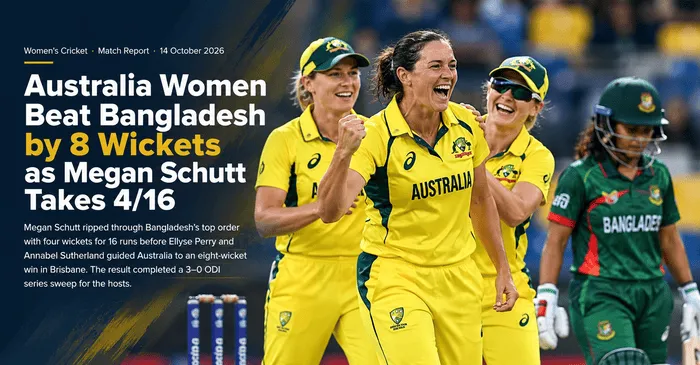
Australia Women Complete 3–0 ODI Series Sweep
Schutt’s early strikes created the pressure; Perry and Sutherland made sure Australia finished the job without complications.
Australia Women defeated Bangladesh Women by eight wickets in the third ODI at Allan Border Field in Brisbane on 14 October 2026. Bangladesh were bowled out for 172 in 49.5 overs after Megan Schutt returned figures of 4/16. Australia needed 173 to win and reached 175/2 in only 22.4 overs.
The chase was completed by Ellyse Perry, who finished unbeaten on 65 from 64 balls, and Annabel Sutherland, whose 74 not out came from 52 deliveries. Their unbroken third-wicket partnership turned an initially uncertain chase into a comfortable finish.
The victory gave Australia a 3–0 series win. It followed seven-wicket and nine-wicket victories in the first two ODIs, leaving Bangladesh without a win across the series.
Australia Women vs Bangladesh Women: Scorecard
Third ODI · Allan Border Field, Brisbane · 14 October 2026
| Team | Score | Overs | Result |
|---|---|---|---|
| Bangladesh Women | 172 all out | 49.5 | Lost |
| Australia Women | 175/2 | 22.4 | Won by 8 wickets |
Top Performers
| Player | Performance |
|---|---|
| Megan Schutt | 4/16 in 10 overs |
| Sharmin Akhter | 50 runs off 93 balls |
| Shorna Akter | 54 runs off 71 balls |
| Ellyse Perry | 65 not out off 64 balls |
| Annabel Sutherland | 74 not out off 52 balls; 2/25 with the ball |
Australia won the toss and chose to field first. Megan Schutt was named Player of the Match and Player of the Series.
Megan Schutt’s 4/16 Put Bangladesh Under Pressure
The experienced seamer struck early and never allowed Bangladesh to establish a reliable platform.
Schutt’s figures tell only part of the story. She conceded 16 runs in 10 overs and took four wickets, but her control also limited Bangladesh’s scoring options. She bowled 53 dot balls, a remarkable number in a full 50-over innings.
The opening breakthrough came when Murshida Khatun was caught by Georgia Wareham in the gully. Schutt then dismissed Sharmin Sultana, who tried to attack with a hook, before removing captain Nigar Sultana Joty. Sobhana Mostary became her fourth victim as Bangladesh struggled to rebuild.
The early damage was especially significant because Bangladesh could not counterattack at the other end. Just 23 runs came from the first 10 overs. With the scoring rate under pressure and wickets falling, the visiting batters were forced to balance survival against the need to build a competitive total.
Schutt bowled her 10 overs consecutively. That sustained spell meant Australia did not have to wait long for pressure to return after each change of end. Her accuracy, use of the bouncer and ability to find edges or mistimed shots made the innings difficult from the start.
The performance continued a strong series for Schutt. She had taken 2/19 in the opening ODI and 4/36 in the second. Her 10 wickets across the three matches earned her the Player of the Series award.
Bangladesh’s Innings: Resistance Without a Late Surge
Sharmin Akhter and Shorna Akter helped Bangladesh recover, but the innings never fully escaped the pressure of the early collapse.
Early wickets leave Bangladesh on the back foot
Bangladesh’s top order was reduced to 18/3 as Schutt found early breakthroughs. The visitors were unable to use the opening overs to build momentum, and Australia’s fielding support kept the pressure on.
Sharmin Akhter anchors the recovery
Sharmin Akhter scored 50 from 93 balls. Her innings gave Bangladesh a batter who could stay at the crease and help rebuild after the early losses. The half-century was valuable in the circumstances, although the slow scoring rate meant the recovery did not quickly turn into a threatening total.
Shorna Akter adds an important half-century
Shorna Akter contributed 54 from 71 balls, her career-best ODI score at the time. The 19-year-old showed patience and offered support through the middle overs. Her partnership with Sharmin helped Bangladesh move beyond the danger of an extremely low total.
Australia strike again at the end
Australia’s bowlers broke the developing partnerships before Bangladesh could accelerate consistently. Annabel Sutherland and Ashleigh Gardner took two wickets apiece, while Ellyse Perry and Alana King also contributed with the ball.
A late collapse of three wickets for seven runs ended the innings at 172, with Bangladesh all out after 49.5 overs. The total gave the bowlers something to defend, but Australia’s batting depth meant Bangladesh needed early wickets to make the chase competitive.
Ellyse Perry and Annabel Sutherland Finish the Chase
Australia lost two early wickets, then took control through a match-winning partnership.
Australia’s chase was not entirely trouble-free at the start. Georgia Voll was stumped for 11, and Beth Mooney was bowled for 21 by Bangladesh debutant Disha Biswas. Mooney’s dismissal came in her 100th ODI, a milestone appearance that also included sharp wicketkeeping later in the innings.
Those wickets gave Bangladesh a brief opening, but Perry and Sutherland removed any realistic chance of a comeback. Perry remained composed, rotating the strike and punishing loose deliveries, while Sutherland scored more aggressively.
Perry finished unbeaten on 65 from 64 balls. Sutherland made 74 not out from 52 balls, combining clean hitting with sensible shot selection. Their unbeaten partnership was worth 137 runs for the third wicket and carried Australia to 175/2 in 22.4 overs.
Australia completed the chase with 164 balls remaining. The speed of the finish reflected the difference between the teams’ innings: Bangladesh had needed almost 50 overs to reach 172, while Australia’s middle order reached the target in fewer than half that time.
Turning Point: Schutt’s Early Wickets
Bangladesh’s first 10 overs shaped the challenge that followed.
The decisive phase was Australia’s new-ball attack. Bangladesh were reduced to 18/3 and managed only 23 runs in the first 10 overs. That combination of lost wickets and restricted scoring forced the middle order to rebuild rather than attack freely.
Sharmin and Shorna did well to extend the innings, but their resistance could not completely repair the damage. Australia maintained enough control to take wickets late and prevent a final-overs surge.
The chase then removed any doubt. Although Australia lost two wickets, Perry and Sutherland made the target look modest. Schutt’s spell created the advantage; the batting partnership converted it into a decisive result.
Key Player Performances
Australia’s bowlers established control before the middle order finished the job with the bat.
Megan Schutt: Player of the Match
Schutt’s 4/16 was the standout bowling performance. Her early strikes exposed Bangladesh’s middle order, and 53 dot balls underlined how effectively she controlled the innings.
Annabel Sutherland: Impact with bat and ball
Sutherland took 2/25 and then scored an unbeaten 74 from 52 balls. Her contribution in both innings made her one of Australia’s most influential players on the day.
Ellyse Perry: Calm under pressure
Perry’s unbeaten 65 from 64 balls ensured Australia did not squander the early advantage. Her innings complemented Sutherland’s attacking approach and kept the chase on course.
Sharmin Akhter: Bangladesh’s leading resistance
Sharmin’s 50 from 93 balls helped steady Bangladesh after the top-order collapse. It was an important innings, even though the team could not turn the recovery into a larger total.
Shorna Akter: A promising middle-order contribution
Shorna’s 54 from 71 balls was Bangladesh’s highest individual score in the match. Her effort showed patience and composure under pressure, and it was one of the positives for the visitors.
Why Australia Won and Bangladesh Fell Short
The result came down to early wickets, control through the middle overs and a decisive response with the bat.
Why Australia won
- Early breakthroughs: Schutt removed key batters before Bangladesh could settle.
- Control of scoring: The first 10 overs produced only 23 runs, putting pressure on the visitors.
- Support from the bowling unit: Sutherland and Gardner took two wickets each.
- A strong finish with the ball: Bangladesh lost their last three wickets for seven runs.
- Composure in the chase: Perry and Sutherland added an unbeaten 137 for the third wicket.
Where Bangladesh fell short
- Top-order collapse: Losing three wickets for 18 runs left the middle order with too much repair work.
- Limited scoring in the powerplay: The slow start increased pressure to rebuild later.
- No late acceleration: The team was bowled out for 172 instead of using the final overs to add more runs.
- Unable to sustain pressure in the chase: The early wickets of Voll and Mooney were not followed by another breakthrough.
Australia Complete a 3–0 Series Sweep
Three wins in Brisbane underlined Australia’s control of the ODI series.
| Match | Result |
|---|---|
| 1st ODI — 9 October 2026 | Australia won by 7 wickets |
| 2nd ODI — 11 October 2026 | Australia won by 9 wickets |
| 3rd ODI — 14 October 2026 | Australia won by 8 wickets |
Schutt was a central figure throughout the series, taking 10 wickets across the three matches. Australia’s opening win featured Annabel Sutherland’s 4/30, while Georgia Voll’s unbeaten 131 powered the second-match chase.
For Bangladesh, Sharmin and Shorna’s resistance in the final ODI offered positives, but the team will need more consistent top-order contributions and stronger control of key phases to compete against leading sides.
Cricket Australia’s published schedule lists Australia’s next ODI assignment as a three-match tour of Sri Lanka in December 2026. The team is also scheduled to face New Zealand in three T20Is beginning on 18 October. Readers should check the official fixture list for any subsequent changes.
Australia Women vs Bangladesh Women: FAQs
Quick answers about the third ODI and Australia’s series victory.
Australia Women won by eight wickets after chasing Bangladesh’s 172 in 22.4 overs.
Megan Schutt took 4 wickets for 16 runs in 10 overs, including 53 dot balls.
Bangladesh Women were bowled out for 172 in 49.5 overs.
Shorna Akter scored 54 from 71 balls, while Sharmin Akhter made 50 from 93 balls.
Annabel Sutherland scored 74 not out from 52 balls and Ellyse Perry made 65 not out from 64 balls.
Australia Women won the three-match ODI series 3–0, with victories by seven, nine and eight wickets.
Megan Schutt received both awards after taking 4/16 in the third ODI and 10 wickets across the series.
Final Verdict: Schutt Sets Up Australia’s Dominant Win
A disciplined bowling performance and an assured chase completed Australia’s perfect ODI series.
Australia’s eight-wicket win was built on a clear sequence: Schutt struck early, the rest of the attack kept Bangladesh from accelerating, and Perry and Sutherland finished the chase with authority. Bangladesh showed resilience through Sharmin Akhter and Shorna Akter, but the early collapse left too much work to do.
Schutt’s 4/16 was the defining performance, supported by her remarkable tally of 53 dot balls. Sutherland’s all-round display and Perry’s calm unbeaten fifty then ensured the advantage was converted into a series-clinching result.
The 3–0 scoreline reflected Australia’s control across the series. For Bangladesh, the next step is to turn middle-order resilience into stronger starts and more competitive totals against high-quality bowling attacks.
Sources and Match Verification
Official and reputable match coverage used to verify the score, key performances and series result.
- ICC: Dominant Australia complete series sweep over Bangladesh
- Cricket Australia: Sensational Schutt leads Aussies to clinical series sweep
- Cricket Australia: Third ODI match centre
Match figures and series results were checked against the sources above. Any future fixture changes should be verified through the relevant cricket board before publication.