
India’s new full-time captain wants to build on the team’s existing strengths through professional standards, player-first leadership and consistent improvement across formats.
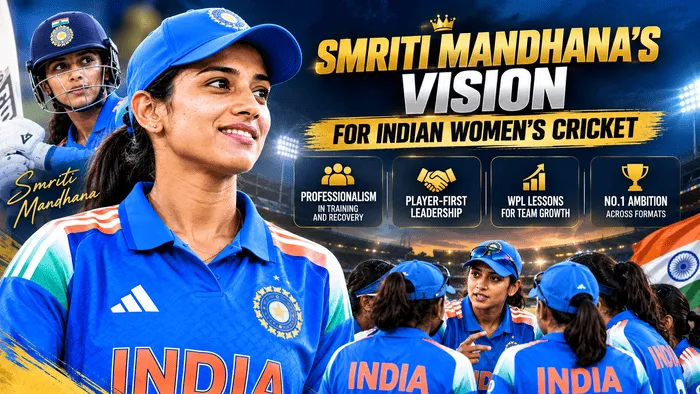
Smriti Mandhana’s first assignment as India Women’s full-time captain marks the beginning of a new leadership chapter, but her vision is not about changing everything overnight. She wants the team to become more consistent in how it trains, recovers, communicates and prepares for major competitions.
In an interview with the BCCI, Mandhana identified professionalism as a central part of the culture she wants to strengthen. She also spoke about learning from her experience leading Royal Challengers Bengaluru in the Women’s Premier League (WPL), understanding individual players and making gradual improvements rather than becoming fixated on immediate results.
Her long-term ambition is clear: take India towards the No. 1 position across all three international formats and compete for the biggest trophies. The challenge will be turning that ambition into repeatable performances against the world’s strongest teams.
The Zimbabwe series provides the first opportunity to see Mandhana lead India in this new full-time role. The wider test, however, will be how consistently the team carries her principles into the months and major tournaments ahead.
Table of Contents
What Is Smriti Mandhana’s Vision for Indian Women’s Cricket?
Her plan centres on professional standards, trust within the squad and steady improvement.
Mandhana wants India to become a more complete and consistent team. Her vision combines the standards expected in training and recovery with the ability to make good decisions under pressure. It is a long-term approach rather than a promise that a change in captain alone will immediately produce more trophies.
The distinction matters. India already have an established international squad, experienced senior players and a strong record in major competitions. Mandhana has acknowledged that the existing culture is in place. Her stated aim is to fine-tune it and make the team’s working methods more consistent.
She also wants India to compete for the top position in the ICC rankings across Tests, ODIs and T20Is. Achieving that goal requires sustained results in different conditions and formats, not simply a strong run in one series.
Mandhana’s approach puts the process before the headline. Better preparation, clearer roles and consistent execution are the habits she wants to build into the team’s everyday routine.
Building a Stronger Culture of Professionalism
Training and recovery are part of the same performance plan.
One of Mandhana’s clearest priorities is professionalism across the full working day, from training sessions and recovery to the way players prepare for the next assignment. In her BCCI interview, she explained that these practices already exist within Indian cricket. She wants to refine them and make the whole system work more smoothly.
In international cricket, small differences in preparation can become important over a long season. Players need to be ready for demanding schedules, travel, different playing conditions and the pressure of high-stakes matches. Recovery and training discipline help support that workload, although they cannot guarantee a particular result.
A consistent approach also helps players understand what is expected of them. When preparation standards are clear across the squad, the team can spend more time improving cricket-specific skills and less time adjusting to different expectations.
Mandhana has not presented professionalism as a criticism of the previous setup. Her message is about refinement: preserving what works while making good habits more consistent throughout the team.
Why Smriti Mandhana Calls Herself a Player’s Captain
Her leadership philosophy places communication and individual understanding at the centre.
Mandhana has described herself as a “player’s captain”. The phrase reflects her intention to understand the people in the squad, communicate clearly and help players contribute with confidence. It does not mean that selection, tactics or accountability become less important.
A captain has to manage different personalities, experience levels and roles. An established international player may need a different conversation from someone entering the senior team. Understanding those differences can help a captain communicate expectations more effectively.
Mandhana has also spoken about learning from senior Indian leaders. Years in the team’s leadership group have given her opportunities to observe how decisions are made and how players respond in difficult situations. She now has to apply those lessons while carrying responsibility for the side’s overall direction.
Her challenge will be to balance empathy with decisive leadership. Players need to feel supported, but they also need clarity about their roles and the standards required to perform at international level.
What the Women’s Premier League Has Taught Mandhana
Franchise leadership has given her another perspective on building a winning team.
Mandhana’s experience as captain of Royal Challengers Bengaluru has been an important part of her leadership development. She led RCB to Women’s Premier League titles in 2024 and 2026, giving her experience of managing a squad across a demanding tournament.
Franchise cricket brings together players with different backgrounds, strengths and levels of experience. A captain has to identify useful combinations, communicate a clear plan and help individuals understand how their contributions fit into the larger objective.
Mandhana has spoken about learning to identify players who can make a difference and giving them the confidence to take responsibility. Those lessons can inform international leadership, even though national-team cricket operates in a different environment from a franchise competition.
The WPL experience is a useful foundation, not a guarantee of international success. India’s opponents have their own strengths, and the captain will need to adapt her decisions to the players available, match conditions and the format being played.
India’s Ambition to Become No. 1 Across All Formats
Mandhana’s long-term target goes beyond one series or one tournament.
Mandhana has said that she wants India to reach the top of the ICC rankings across all three formats. That means building a team capable of competing consistently in Test cricket, one-day internationals and T20 internationals, each of which places different demands on players and tactics.
Test cricket rewards patience, technical discipline and the ability to sustain pressure over several days. ODIs require teams to manage innings across a longer limited-overs contest. T20Is demand quick decisions, flexible roles and the ability to respond to changing match situations in a short period.
A team aiming to lead all three formats needs depth beyond its first-choice XI. Players must be able to step into roles when combinations change, while the coaching and support staff need to help the squad prepare for different conditions and opponents.
Mandhana has emphasised gradual improvements rather than making immediate results the only measure of progress. That approach gives the team a practical way to work towards a large ambition: improve the details, assess the performances and keep building consistency.
Why the Zimbabwe Series Matters
The opening assignment gives India a chance to begin putting the captain’s principles into practice.
India’s white-ball series against Zimbabwe begins a new phase under Mandhana’s full-time captaincy. The schedule includes three T20Is in Raipur on October 16, 18 and 20, followed by three ODIs in Vadodara on October 23, 25 and 28, according to the BCCI announcement.
The series is also a chance to assess combinations, give players clear responsibilities and build familiarity with the captain’s approach. The value of the assignment will not be measured only by the final scoreline; how India handle different match situations will also matter.
Shafali Verma has spoken about playing fearless but smart cricket as India prepare for the next major phase of their campaign. That message fits alongside Mandhana’s emphasis on professionalism: attacking intent needs to be supported by sound decisions and disciplined execution.
India are also building towards the inaugural Women’s Champions Trophy scheduled for February 2027. The Zimbabwe series is one step in that preparation, not a final judgement on the new captaincy.
| Match | Date | Venue | Start (IST) |
|---|---|---|---|
| 1st T20I | October 16, 2026 | Raipur | 7:00 PM |
| 2nd T20I | October 18, 2026 | Raipur | 7:00 PM |
| 3rd T20I | October 20, 2026 | Raipur | 7:00 PM |
| 1st ODI | October 23, 2026 | Vadodara | 2:00 PM |
| 2nd ODI | October 25, 2026 | Vadodara | 2:00 PM |
| 3rd ODI | October 28, 2026 | Vadodara | 2:00 PM |
For the confirmed squads and schedule, refer to the official BCCI announcement.
The Challenges Ahead for Mandhana
A strong leadership plan will need to hold up under pressure.
India’s ambition is substantial, and reaching the top across formats will require sustained performances against teams with different strengths. A captain’s plans are tested when results turn against the side, when key players are unavailable or when conditions demand a different approach.
One challenge is balancing consistency with tactical flexibility. Clear standards can help a team prepare, but international cricket rarely follows a fixed script. The captain and coaching staff must still respond to the pitch, opposition match-ups and the flow of each game.
Another task is developing confidence throughout the squad. India need contributions from experienced players and emerging talent, particularly when a tournament schedule places demands on the team. Building that depth takes time, communication and opportunities to learn from competitive matches.
Results will remain important, but the progress of Mandhana’s approach can also be judged through more specific indicators: role clarity, fielding and bowling discipline, recovery between games, and the team’s ability to adapt when a plan does not work.
Frequently Asked Questions
Mandhana wants to strengthen professionalism across training and recovery, build a player-first team culture, make gradual improvements and take India towards the No. 1 position across all three international formats.
The BCCI announced Mandhana’s appointment as captain of the Indian women’s team on October 6, 2026, following Harmanpreet Kaur’s decision to step down from the role.
Her stated approach focuses on understanding players, communicating clearly and helping squad members contribute with confidence while maintaining clear team standards and responsibilities.
Leading Royal Challengers Bengaluru has given Mandhana experience in team-building, player roles and tournament decision-making. RCB won the WPL title under her captaincy in 2024 and 2026.
The three-match T20I series begins in Raipur on October 16, 2026. The teams are scheduled to play the second and third T20Is on October 18 and 20 before the ODI series in Vadodara.
Mandhana has said she wants India to reach the top of the ICC rankings across Tests, ODIs and T20Is and compete for major international titles. She has also emphasised steady improvement rather than expecting instant results.
The Road Ahead for Smriti Mandhana and India
Smriti Mandhana’s vision is built around a straightforward idea: strong teams are created through consistent habits, clear communication and shared responsibility. Her emphasis on professionalism, player-first leadership and lessons from the WPL gives India a defined direction as she begins her full-time captaincy.
The ambition to become No. 1 across all formats is a long-term target. Achieving it will depend on how India perform across different conditions, how well players adapt to their roles and how consistently the team executes under pressure.
The Zimbabwe series is the first step in this chapter. The more meaningful assessment will come over time, as Mandhana’s principles are tested in tougher contests and major tournaments.
Related Cricket News
Explore more India Women coverage on 99ExCh.
Sources
- BCCI — India Women’s squads and Zimbabwe series schedule
- India Today — Inside Smriti Mandhana’s player-first vision
- The Indian Express — A culture of professionalism: Mandhana’s vision
- ICC — India name new captain after Harmanpreet Kaur steps down
This article draws on public statements and published reporting available on October 16, 2026. The leadership analysis is editorial interpretation; stated ambitions and appointments are attributed to their respective sources.

1 thought on “Smriti Mandhana’s Vision for Indian Women’s Cricket: Professionalism, Leadership and No. 1 Ambition”