
Shubman Gill’s return to domestic red-ball cricket lasted just five deliveries against Chhattisgarh. While Ajay Mandal removed the India captain for one, Punjab recovered through a century from Uday Saharan and a valuable contribution from Prabhsimran Singh.
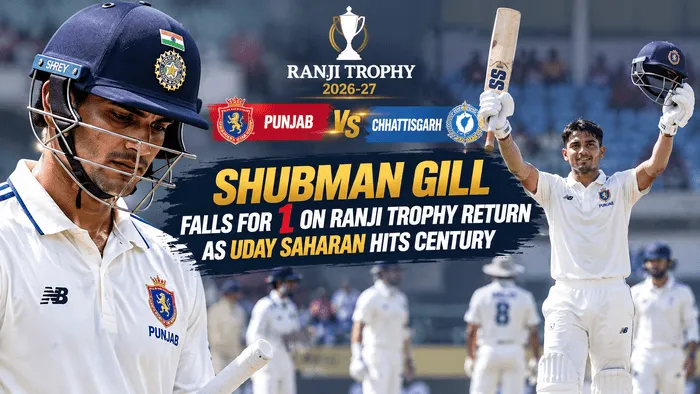
Shubman Gill had a brief and disappointing return to the Ranji Trophy, scoring just one run for Punjab against Chhattisgarh in their Elite Group B fixture at the PCA International Cricket Stadium in New Chandigarh. The India batter faced five deliveries before left-arm spinner Ajay Mandal bowled him in the 27th over on October 18.
Gill’s early dismissal came at a difficult point for Punjab, who had already lost wickets after making a steady start. However, the innings did not unravel. Captain Uday Saharan produced a composed unbeaten century, while Prabhsimran Singh contributed a half-century to help Punjab recover and finish the opening day in a stronger position.
The match attracted additional attention because Gill was using domestic cricket to get valuable red-ball time ahead of India’s upcoming Test series against New Zealand. His score of one will draw headlines, but the larger picture includes the conditions of his dismissal, the value of match practice and the performances of the players who shaped Punjab’s innings.
Punjab vs Chhattisgarh: Match Information
Key details from the Ranji Trophy Elite Group B fixture.
| Tournament | Ranji Trophy 2026–27 |
|---|---|
| Match | Punjab vs Chhattisgarh |
| Group | Elite Group B |
| Venue | PCA International Cricket Stadium, New Chandigarh |
| Match began | October 18, 2026 |
| Gill’s score | 1 run off 5 balls |
| Bowler | Ajay Mandal |
| Punjab at stumps, Day 1 | 269/4 in 90 overs |
| Uday Saharan | 106 not out off 179 balls |
| Prabhsimran Singh | 62 runs |
Score status: The figures above refer to the reported close of Day 1. Check the latest scorecard before publishing any subsequent match developments.
How Ajay Mandal Dismissed Shubman Gill
Gill’s innings ended before he could settle at the crease.
Gill came in at No. 4 after Vihaan Malhotra’s dismissal. Punjab needed him to help rebuild the innings, but he did not have much time to establish a rhythm. Mandal, a left-arm spinner for Chhattisgarh, beat the India batter’s defence and bowled him for one.
The dismissal left Punjab at 68/3, giving Chhattisgarh an opportunity to put further pressure on the middle order. Mandal had already taken the wicket of Harnoor Singh, making him an important figure in the early part of the innings.
For Gill, the most immediate disappointment was the lack of time in the middle. A batter returning to red-ball cricket often benefits from facing different spells, adjusting to the pace of the surface and finding a feel for the longer format. Gill’s five-ball stay offered little opportunity to do any of that.
It would be premature, however, to draw a broad conclusion about his form from a single dismissal. One innings is a small sample, and the context of the delivery, the bowler’s execution and the conditions all matter. The more useful question is how Gill responds in his next opportunity at the crease.
Uday Saharan’s Century Changes the Story
Punjab’s captain supplied the innings with the stability it needed.
While Gill’s early exit became the headline, Uday Saharan’s innings was central to Punjab’s recovery. The 22-year-old reached an unbeaten 106 from 179 deliveries by stumps on Day 1, striking 13 boundaries in an innings built around patience and calculated scoring.
Saharan came to the crease when Punjab needed someone to absorb pressure rather than chase quick runs. His century helped shift the focus away from the early wickets and gave the side a platform from which to build a substantial first-innings total.
His innings also demonstrated the importance of partnerships in a first-class match. When wickets fall close together, a batter must balance defence with opportunities to score. Saharan’s contribution gave Punjab that balance, allowing the innings to recover without relying on a sudden burst of attacking cricket.
At the close of the opening day, Saharan remained unbeaten alongside wicketkeeper-batter Salil Arora. Their stand helped Punjab move from a vulnerable position to a more settled one. The next phase of the innings would depend on whether they could extend that partnership and convert the recovery into a bigger total.
For Saharan, the century was a strong individual performance in a match that had attracted attention because of Gill’s return. For Punjab, it was more immediately valuable: it kept the innings moving after Chhattisgarh’s bowlers had made early inroads.
Prabhsimran Singh Adds a Valuable Half-Century
A middle-order contribution helped Punjab regain control.
Prabhsimran Singh scored 62 runs, providing another important contribution during Punjab’s recovery. His innings helped prevent the early dismissals from turning into a deeper collapse and gave Saharan support during a key period of the day.
The partnership between Saharan and Prabhsimran was particularly important because Punjab had slipped to 68/3. In that situation, another quick wicket could have handed Chhattisgarh a decisive advantage. Instead, the pair added substance to the innings and gave Punjab a route back into the contest.
After Prabhsimran’s dismissal, Saharan continued with Salil Arora, who was unbeaten on 38 at stumps according to the Day 1 report. That late partnership ensured Punjab finished the day with four wickets down rather than allowing the lower order to face the new ball or a fresh spell under pressure.
The contributions of Saharan, Prabhsimran and Arora underline a basic feature of first-class cricket: an innings is rarely defined by one player alone. Gill’s dismissal attracted attention, but Punjab’s recovery was built by batters who stayed at the crease and turned a difficult position into a more competitive one.
Why Gill’s Ranji Trophy Return Matters Before the New Zealand Tests
The value of domestic cricket goes beyond the scorecard.
Gill’s participation in the Ranji Trophy was significant because India have a two-Test series against New Zealand ahead. The series is scheduled to begin on November 19, 2026, and the domestic fixture offered Gill a chance to spend time in the middle in the longer format before the international assignment.
International players do not always have regular opportunities to play first-class cricket between tours. A Ranji Trophy match can provide useful exposure to longer spells, changes in pace and movement, and the concentration required to bat through extended sessions.
That is why the outcome of a single innings should be viewed in proportion. Gill’s dismissal meant he missed the chance to build a substantial score in this outing, but it does not erase the value of taking part in a competitive red-ball match. Nor does it guarantee that the preparation will automatically translate into success at international level.
Gill is also an important part of India’s plans in the ODI format on the New Zealand tour. The schedule requires players to manage preparation across formats, making time in the middle particularly useful for those expected to take on significant responsibilities.
The key takeaway is straightforward: this was a missed scoring opportunity, not a verdict on Gill’s ability. His subsequent performances and the way he adjusts to red-ball cricket will offer a clearer picture of his preparation for the Test series.
What Does Gill’s One-Run Score Actually Tell Us?
Separate the immediate result from the bigger picture.
A score of one is plainly disappointing for a top-order batter, particularly when the purpose of the match is to get time in the middle. But a measured assessment should distinguish between what happened and what can reasonably be inferred from it.
A missed chance to spend time at the crease
Gill faced only five deliveries. He therefore had little opportunity to work through a longer spell, build an innings or test his concentration over time. That is the clearest downside of the dismissal.
Credit to the bowler
Ajay Mandal executed the delivery that ended Gill’s innings. Cricket analysis should acknowledge the bowler’s contribution rather than treating every low score as evidence of a batter’s failure alone.
One innings is not a trend
A single dismissal cannot establish a wider pattern of poor form. A stronger assessment would require more evidence, including recent performances, the quality of opposition, conditions and how the batter responds in later innings.
Punjab’s recovery remains part of the story
Saharan’s unbeaten century and Prabhsimran’s half-century changed the context of the innings. The match report should recognise those performances rather than allowing Gill’s short stay to overshadow the rest of the team.
Key Takeaways from Gill’s Ranji Trophy Return
The main points from Punjab’s opening-day performance.
- Gill’s score: The India batter made one run from five balls before Ajay Mandal bowled him.
- Early pressure: Punjab were 68/3 after losing wickets in the first part of the innings.
- Saharan’s response: Uday Saharan scored an unbeaten 106 from 179 deliveries, including 13 boundaries.
- Prabhsimran’s support: Prabhsimran Singh added 62 runs during the recovery.
- Day 1 position: Punjab reached 269/4 in 90 overs at stumps, according to published match reports.
- International context: The match provided Gill with red-ball practice ahead of India’s upcoming Test series against New Zealand.
The Bigger Picture for Shubman Gill and Punjab
Shubman Gill would have wanted a longer stay at the crease on his Ranji Trophy return, especially with the New Zealand Tests approaching. Instead, Ajay Mandal ended his innings for one, leaving Punjab to rebuild after an early cluster of wickets.
Uday Saharan’s unbeaten century and Prabhsimran Singh’s half-century ensured the story was not simply one of Gill’s dismissal. Their contributions gave Punjab a platform at the end of Day 1 and demonstrated how quickly a first-class innings can change when batters settle in.
Gill’s one-run score is a notable result from this outing, but it should not be used on its own to judge his readiness for international cricket. The next innings and his preparation in the lead-up to the Test series will provide more meaningful evidence. For now, the balanced conclusion is that Gill missed an opportunity to spend time in the middle, while Punjab recovered through Saharan’s composed batting.
Frequently Asked Questions
Quick answers about Shubman Gill’s Ranji Trophy appearance.
Shubman Gill scored one run from five deliveries for Punjab against Chhattisgarh in the Ranji Trophy Elite Group B match.
Chhattisgarh left-arm spinner Ajay Mandal bowled Gill for one run.
Punjab recovered through Uday Saharan’s unbeaten 106 and Prabhsimran Singh’s 62. Published Day 1 reports listed Punjab at 269/4 after 90 overs.
The domestic match gave Gill an opportunity to get red-ball practice ahead of India’s upcoming Test series against New Zealand.
One innings is not enough to establish a wider form trend. His dismissal was disappointing, but a fair assessment requires more performances and match context.
The two-Test series is scheduled to begin on November 19, 2026. Check the official schedule for any subsequent changes.
Sources and Further Reading
Match facts and reporting references used for this article.
- The Indian Express: Shubman Gill out for 1 on Ranji Trophy return
- India Today: Gill falls for 1 ahead of the New Zealand Tests
- Hindustan Times: Uday Saharan’s unbeaten century anchors Punjab
- Reuters: India’s squad and upcoming New Zealand series
Editorial note: This report reflects published Day 1 coverage. The live score, final result and any later developments should be checked against an updated scorecard before the article is refreshed.