
India begin their five-match T20I tour of New Zealand at Hagley Oval, Christchurch, on October 22. Shreyas Iyer’s side will face a home team led by Mitchell Santner, with the new-ball contest and early-season conditions likely to shape the opening match.
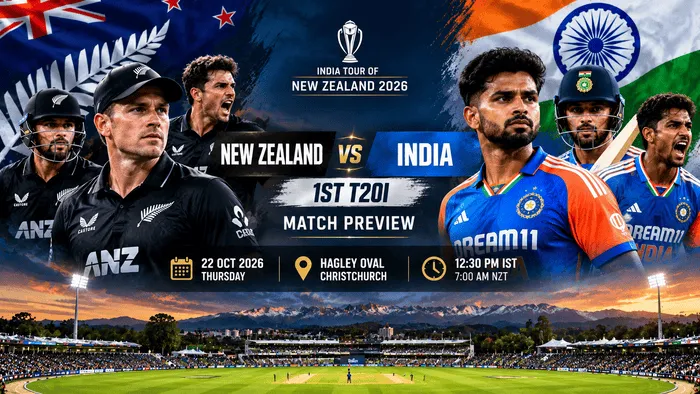
India and New Zealand open their five-match T20I series at Hagley Oval on Thursday, October 22, 2026. India arrive with a squad built around aggressive batting options and a varied bowling attack, while New Zealand will look to use home conditions to make the visitors work for every run. Shreyas Iyer leads India, and Mitchell Santner captains the Black Caps.
The match offers an early test of how quickly India can adjust to Christchurch’s conditions. The visitors have several players capable of changing the game in a short spell, but New Zealand’s seam options and familiarity with the venue could make the powerplay especially important. Neither side should assume that reputation alone will decide the opener.
The squads announced ahead of the series include experienced international players as well as younger options. Final playing XIs, however, should be checked against the official team announcement at the toss rather than treated as confirmed in advance.
New Zealand vs India 1st T20I: Match Details
The confirmed fixture information for the opening match of the 2026 India tour of New Zealand.
| Match | New Zealand vs India, 1st T20I |
|---|---|
| Date | Thursday, October 22, 2026 |
| Venue | Hagley Oval, Christchurch, New Zealand |
| Start time | 12:30 PM IST / 7:00 AM UTC / 8:00 PM local time |
| Toss | 12:00 PM IST, subject to the official match schedule |
| India captain | Shreyas Iyer |
| New Zealand captain | Mitchell Santner |
| Format | Twenty20 International |
| Series | India tour of New Zealand, 2026 |
Match timings and team information should be checked against the official BCCI match details before publication or last-minute updates.
Why the First T20I Matters
The opening game is the first step in a five-match T20I series, so the result will give one team an early advantage without deciding the contest. A win would allow the successful side to approach the second match with greater flexibility, while the team that loses will need to assess its combinations quickly.
India have named a squad featuring established T20 players and several younger options. The selection challenge is not simply choosing the biggest names; it is finding the right balance between top-order aggression, middle-order stability, seam bowling and spin.
New Zealand have a different advantage: local knowledge. Their bowlers are accustomed to conditions in which the new ball can be influential. If the surface offers movement early in the innings, disciplined lengths and good field placement could put pressure on India’s batters before they settle.
The first match should therefore be viewed as a contest of adaptation. India need to judge the conditions before committing to an all-out attacking approach, while New Zealand need to turn any early assistance into wickets rather than merely restricting the scoring rate.
India Team Analysis: Batting Depth and Bowling Variety
India’s squad gives the selectors several ways to construct a T20 lineup. Abhishek Sharma offers an attacking option at the top, while Sanju Samson and Ishan Kishan provide wicketkeeping choices and additional batting flexibility. Tilak Varma and captain Shreyas Iyer can help manage the middle overs, depending on the final batting order.
The all-round options are equally important. Axar Patel, Shivam Dube and Nitish Kumar Reddy can provide different combinations of batting and bowling. Their roles will depend on the conditions and the balance India want between specialist bowlers and players who cover more than one discipline.
With the ball, Bhuvneshwar Kumar’s return adds experience and the potential for swing with the new ball. Arshdeep Singh offers a left-arm angle, while Mayank Yadav and Prince Yadav provide pace options. Varun Chakaravarthy and Kuldeep Yadav give India specialist spin choices.
India’s selection decision could come down to conditions. If the surface appears helpful to seamers, the team may prefer additional pace. If the pitch looks slower or offers grip, a specialist spinner could become more valuable. The final combination should be confirmed only after the toss.
India’s main strengths
- Several top-order batters capable of scoring quickly.
- Multiple middle-order options to handle different match situations.
- A mix of left-arm pace, right-arm pace and specialist spin.
- All-rounders who can help the captain manage the bowling workload.
India’s key question
Can the batting lineup maintain its scoring intent without losing wickets in clusters? A fast start matters, but an early collapse could leave the middle order with too much work to do on a surface that may assist the seamers.
New Zealand Team Analysis: Home Conditions and Seam Options
New Zealand’s squad combines attacking batters with a broad group of seam-bowling options. Finn Allen can put pressure on the opposition during the powerplay, while Devon Conway offers a contrasting approach at the top. Tim Seifert adds another wicketkeeping and batting option, and the middle order includes Glenn Phillips and Daryl Mitchell.
Mitchell Santner’s role extends beyond captaincy. His left-arm orthodox bowling can help control the middle overs, and his batting gives the team flexibility when it needs late runs. Michael Bracewell also offers a useful all-round option, subject to the final XI.
New Zealand’s pace group includes experienced names such as Matt Henry, Lockie Ferguson, Kyle Jamieson and Adam Milne, alongside other options in the announced squad. The captain will need to choose a combination that suits the conditions rather than simply select every available fast bowler.
There are also squad absences to consider. The ICC reported that Mark Chapman and Zak Foulkes were ruled out of the T20I series with injuries and replaced by Josh Clarkson and Blair Tickner. Their absence reduces the available options, so New Zealand’s balance will depend on how the remaining squad members are used.
New Zealand’s main strengths
- Familiarity with the Christchurch venue and local conditions.
- Fast-bowling depth for different phases of the innings.
- Power-hitting options through the top and middle order.
- Santner’s leadership and ability to contribute with bat and ball.
New Zealand’s key question
Can the home side take wickets early enough to prevent India’s aggressive batters from controlling the innings? Restricting runs is useful, but wickets during the powerplay would create a stronger opportunity to dictate the pace of the game.
Key Players Who Could Shape the Match
Abhishek Sharma — India
Abhishek’s attacking style can put pressure on the fielding side from the opening overs. His challenge will be to identify which deliveries can be attacked and which should be respected. A controlled powerplay innings could give India’s middle order a platform to accelerate later.
Shreyas Iyer — India
As captain, Iyer must balance India’s scoring ambitions with the need to preserve wickets. His batting position and approach will be especially relevant if New Zealand strike early. His tactical choices will also be important when deciding how to use India’s bowling options.
Bhuvneshwar Kumar — India
Bhuvneshwar returns to India’s T20I setup after last appearing in the format in November 2022, according to the ICC. His experience and ability to move the new ball could be valuable against New Zealand’s attacking openers. His effectiveness will depend on the amount of movement available and his execution on the day.
Finn Allen — New Zealand
Allen is one of the players capable of changing the game quickly. If he gets through the opening overs, New Zealand could build an imposing total. India’s bowlers will need to vary their lengths and avoid offering predictable pace or width.
Glenn Phillips — New Zealand
Phillips provides New Zealand with power through the middle order. He can be especially important if the openers make a brisk start or if the innings needs rebuilding after early wickets. India’s bowlers will want to prevent him from settling into a rhythm.
Mitchell Santner — New Zealand
Santner’s influence may be felt in both innings. He can use spin to manage the middle overs and can contribute with the bat when New Zealand need to finish strongly. His bowling changes and matchups will be worth watching against India’s left- and right-handed options.
Hagley Oval Pitch Report and Christchurch Conditions
Hagley Oval can offer a useful contest between bat and ball, but the conditions on the day matter more than a generic label such as “batting pitch” or “bowling pitch.” Early-season conditions may give seamers some assistance, particularly when the ball is new. Batters who judge the bounce and movement well should have opportunities to score once they settle.
The toss could influence the decision, but it should not be treated as a guaranteed advantage. Captains will need to assess the surface, overhead conditions and the likely behaviour of the pitch before deciding whether to bat or bowl first.
Some pre-match venue analysis has placed the typical first-innings score around the 160-run mark, but that figure is only a broad guide and may include matches from different formats or competitions. It should not be treated as a confirmed par score for this men’s international fixture.
What batters should focus on
- Playing the new ball late if there is movement off the pitch.
- Rotating strike instead of relying only on boundary hitting.
- Targeting scoring areas once the ball becomes easier to judge.
- Keeping wickets in hand for the final overs.
What bowlers should focus on
- Maintaining a consistent line and length early in the innings.
- Using changes of pace only when they are well disguised.
- Protecting boundary options against the stronger hitters.
- Adapting quickly if the pitch offers less assistance than expected.
Weather forecasts can change close to the match. Check a reliable local forecast on match day rather than relying on a long-range prediction published earlier in the week.
Three Tactical Battles to Watch
1. New Zealand’s seamers against India’s top order
The opening overs could set the tone. If New Zealand find movement, India will need to avoid chasing deliveries outside the hitting zone. If India’s openers get through the initial spell with wickets intact, the visitors may be able to apply pressure through attacking shots and quick running.
2. India’s pace attack against Finn Allen and Devon Conway
India’s bowlers will need a clear plan for each opener. Allen’s power makes loose deliveries costly, while Conway can provide a different tempo. Bhuvneshwar’s movement, Arshdeep’s angle and the pace available from India’s other seamers give the captain options, but execution will matter more than the names on the team sheet.
3. The middle overs: spin, matchups and strike rotation
Santner and India’s specialist spinners could influence the phase between the powerplay and the final overs. Batters will need to find low-risk scoring options, while bowlers will aim to create pressure without offering predictable lengths. A partnership that keeps the scoreboard moving during this phase could prove decisive.
Probable Playing XIs for New Zealand vs India
These are preview estimates based on squad availability and likely team balance. They are not confirmed playing XIs.
India — possible XI
Sanju Samson (wk), Abhishek Sharma, Ishan Kishan, Shreyas Iyer (c), Tilak Varma, Shivam Dube, Nitish Kumar Reddy, Axar Patel, Bhuvneshwar Kumar, Arshdeep Singh, Varun Chakaravarthy / Prince Yadav.
India’s final choice between an additional specialist bowler and another all-round option may depend on the pitch and conditions. The opening combination and batting order should also be confirmed at the toss.
New Zealand — possible XI
Finn Allen, Devon Conway, Tim Seifert, Glenn Phillips, Daryl Mitchell, Mitchell Santner (c), Michael Bracewell, Matt Henry, Lockie Ferguson, Kyle Jamieson / Adam Milne, Jacob Duffy / Blair Tickner.
New Zealand have several seam options, so the final combination may depend on fitness, workload and the surface. Josh Clarkson is another available squad option. The official team sheet takes precedence over any predicted lineup.
Selection note: Check the official match centre after the toss for confirmed XIs. A squad announcement alone does not confirm that a player will feature in this match.
Who Has the Edge in the First T20I?
This fixture looks competitive because the teams bring different strengths. India’s batting depth and variety give them ways to recover from setbacks, while New Zealand can use home familiarity and a strong group of seamers to challenge the visitors early.
India’s prospects improve if the top order handles the new ball and gives the middle order a stable platform. New Zealand’s prospects improve if their seamers take early wickets and force India to rebuild before launching an attack. The result may hinge less on reputation than on which side executes its plans under pressure.
The toss, confirmed XIs and the actual pitch appearance should inform any final prediction. Before those details are available, naming a certain winner would overstate what can reasonably be known.
For readers following the series, the second T20I is scheduled for October 24 in Christchurch. The opening match will offer the first indication of how both teams intend to use their resources across the five-game contest.
New Zealand vs India 1st T20I: FAQs
The first T20I is scheduled for Thursday, October 22, 2026. The match is scheduled to begin at 12:30 PM IST.
The match is scheduled at Hagley Oval in Christchurch, New Zealand.
Shreyas Iyer is India’s T20I captain, while Mitchell Santner leads New Zealand. Check the official team sheet for any last-minute changes.
The probable XIs in this article are estimates, not official selections. The confirmed teams should be checked at the toss.
Abhishek Sharma, Shreyas Iyer and Bhuvneshwar Kumar are players to watch for India. Finn Allen, Glenn Phillips and Mitchell Santner could be important for New Zealand.
The match appears competitive on paper. The toss, pitch, confirmed XIs and execution during the powerplay should be considered before making a final prediction. No result is guaranteed.
The second T20I is scheduled for October 24, 2026, in Christchurch.
Final Thoughts on New Zealand vs India
India’s batting depth gives them plenty of scoring options, but New Zealand’s familiarity with Christchurch and seam-bowling resources make the home side a serious challenge. The most important early question is whether India’s top order can negotiate the new ball without losing wickets in quick succession.
The toss and confirmed playing XIs will add useful context, but the match should ultimately be decided by execution. Readers should use the latest official team information before treating any predicted combination or pre-match assessment as final.
Sources and Match Information
- BCCI — India and India A squads for the New Zealand tour
- BCCI — New Zealand vs India 1st T20I match details
- ICC — New Zealand squad injury updates
- New Zealand Cricket — 2026–27 summer schedule
This is a pre-match preview. Squad lists, probable XIs, pitch assessments and match outlooks can change as official information becomes available. Confirmed team announcements and match-day conditions should take priority over estimates.