
Dhruv Jurel Hits Second Test Century as India Dominate Sri Lanka in Colombo
Dhruv Jurel scored an unbeaten 115 to register his second Test century as India reached 503/9 declared against Sri Lanka in the Colombo Test. His landmark innings strengthened India’s position in the second Test of the series.
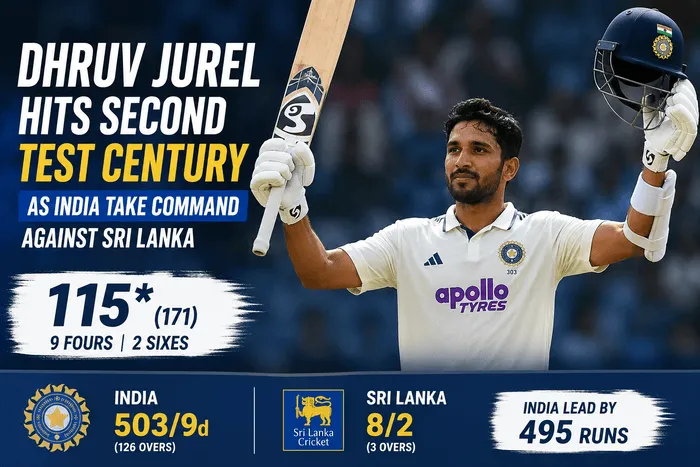
Dhruv Jurel Hits His Second Test Century
Dhruv Jurel produced the defining moment of India’s second Test against Sri Lanka in Colombo, completing his second Test century with an unbeaten 115. The India wicketkeeper-batter’s patient innings helped India turn their strong overnight position into a commanding first-innings total of 503/9 declared at the Sinhalese Sports Club.
Jurel came to the crease at No. 7 and spent close to five hours at the crease. He eventually finished on 115 not out from 177 deliveries, striking nine fours and two sixes. The innings was built around patience early on before Jurel accelerated once he moved through the nervous stages of his century.
The century was particularly significant because it was Jurel’s first Test hundred outside India. His previous Test century had come against England at Rajkot in 2024, making this Colombo performance another important step in his development as a red-ball batter.
Jurel’s contribution became even more valuable because India had already lost several established batters by the time he reached the middle. Rather than attempting to force the scoring rate immediately, he absorbed pressure, built partnerships and gradually took control of the innings.
His partnership with Rishabh Pant was particularly important. Pant returned to the crease after retiring hurt in the first Test innings and counter- attacked with a rapid 63. Together, Pant and Jurel added 112 runs, giving India the momentum needed to move beyond the 400-run mark.
| Jurel’s Innings | Details |
|---|---|
| Runs | 115* |
| Balls Faced | 177 |
| Fours | 9 |
| Sixes | 2 |
| Batting Position | No. 7 |
| Test Centuries | 2 |
| Overseas Test Centuries | 1 |
The timing of the century also added to the drama. Jurel reached 95 before rain interrupted play and then had to wait for the game to resume. Once play restarted, Sri Lanka placed pressure around him, but Jurel remained composed before completing the milestone with a risky single.
After reaching three figures, Jurel immediately showed that he was not satisfied with simply getting to the landmark. He continued attacking, eventually remaining unbeaten as India declared at 503/9. His innings therefore became more than a personal milestone: it directly contributed to India’s ability to put Sri Lanka under severe first-innings pressure.
Key Takeaway: Jurel’s unbeaten 115 was his second Test century and first overseas hundred, giving India the stability and late-innings acceleration required to reach 503/9 declared.
Jurel’s Unbeaten 115 Puts India in Command
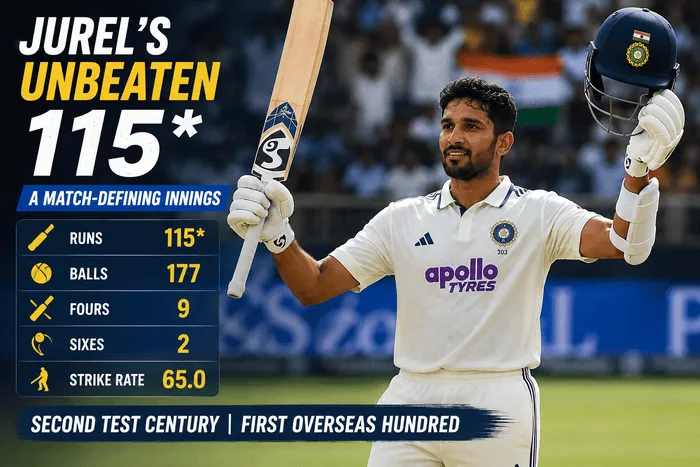
Dhruv Jurel’s unbeaten 115 was the centerpiece of India’s commanding batting performance in the second Test against Sri Lanka at the Sinhalese Sports Club in Colombo. Coming in at No. 7, Jurel stayed at the crease through a difficult phase of the innings and finished unbeaten as India declared on 503/9.
Jurel faced 177 deliveries and struck nine fours and two sixes. The innings was built on patience rather than reckless strokeplay, allowing him to absorb pressure before accelerating once India moved into a strong position. It was his second Test century and his first hundred outside India.
The century itself came with considerable drama. Jurel was stuck on 99 for 12 deliveries before finally taking a risky single towards mid-off. The fielder’s missed direct hit allowed him to complete the run and reach three figures. Rain had also interrupted play earlier when Jurel was on 95, adding to the tension around the milestone.
Once the hundred was secured, Jurel continued batting positively rather than simply protecting his score. His unbeaten finish meant India could push beyond the 500-run mark without losing their final wicket, eventually prompting the declaration at 503/9.
| Jurel’s Innings | Details |
|---|---|
| Runs | 115* |
| Balls | 177 |
| Fours | 9 |
| Sixes | 2 |
| Batting Position | No. 7 |
| Test Centuries | 2 |
| Overseas Test Centuries | 1 |
Jurel’s contribution was especially valuable because he was not batting in isolation. He shared a 112-run seventh-wicket partnership with Rishabh Pant, who scored an aggressive 63. That stand transformed India’s position and provided the platform for the lower order to take the total beyond 500.
His innings also carried historical significance. Jurel became only the second Indian batter to score a Test century in Sri Lanka while batting at No. 7 or lower, joining Hardik Pandya, who made 108 at Pallekele in 2017.
India’s strong position became even clearer when Sri Lanka began their reply. India took two wickets in only three overs before bad light ended play, leaving Sri Lanka on 8/2 and still 495 runs behind. Jurel’s unbeaten century had therefore played a direct role in giving India enormous first-innings control.
Key Takeaway: Jurel’s 115* was not only his second Test century but also his first overseas hundred, and it helped India reach 503/9 declared before Sri Lanka slipped to 8/2.
The Long Wait From 99 to 100
Dhruv Jurel’s second Test century was memorable not only because of the milestone itself but also because of the tension surrounding the final run. After building his innings patiently, Jurel found himself just one run away from three figures at 99, with the entire Indian dressing room waiting for the moment he would complete his hundred.
The wait became particularly dramatic because Jurel had already been interrupted by rain earlier in his innings. He was on 95 when the weather stopped play in Colombo. After the players returned, he moved closer to the landmark but then became stranded on 99 for another 12 deliveries.
Eventually, Jurel decided to take the opportunity himself. He punched the ball towards mid-off and set off for a single that carried an element of risk. The fielder had a chance to run him out with a direct hit, but the attempt missed and Jurel completed the run to reach his second Test century.
The century came off 171 deliveries, underlining the patient nature of Jurel’s innings. Rather than chasing the milestone with unnecessary risks, he remained composed through the long wait and then accelerated after reaching three figures. He eventually finished unbeaten on 115 from 177 balls, with nine fours and two sixes.
| Century Milestone | Details |
|---|---|
| Score During Rain Break | 95 |
| Score Before Final Run | 99 |
| Deliveries on 99 | 12 |
| Century Completed | 171 balls |
| Final Score | 115* off 177 balls |
The manner in which Jurel completed the milestone also reflected the temperament that had defined his innings. Instead of forcing a boundary to reach 100, he accepted the risk of taking a single and trusted his running between the wickets. The missed run-out attempt allowed him to complete the milestone and immediately sparked celebrations from his teammates.
Once the hundred was secured, Jurel appeared far more liberated. He added another 15 runs from the six deliveries he faced after reaching three figures, helping India move beyond 500 before declaring at 503/9.
That sequence made the century more significant than a simple statistical milestone. Jurel had spent a considerable period managing pressure at the most difficult stage of a Test hundred, then converted the opportunity into an unbeaten match-defining score.
Century Moment: Jurel waited through rain at 95 and remained on 99 for 12 deliveries before completing his hundred with a risky single. He finished unbeaten on 115.
Jurel Joins Hardik Pandya in a Rare Sri Lanka Record
Dhruv Jurel’s century in Colombo carried an additional historical significance. By reaching three figures while batting at No. 7, he joined an exclusive group of Indian batters to score a Test century at No. 7 or lower in Sri Lanka. Jurel is only the second Indian to achieve the feat, following Hardik Pandya.
Hardik Pandya previously held the distinction after scoring 108 against Sri Lanka at Pallekele in 2017. Jurel’s unbeaten 115 therefore placed his name alongside Pandya in a particularly small statistical category involving India’s lower-order batting performances in Sri Lankan Tests.
The record is notable because batting at No. 7 generally comes with different responsibilities from those of a specialist top-order batter. A player arriving that late in the innings may have limited time to establish a partnership, while the scoreboard pressure can be higher if several wickets have already fallen.
Jurel handled that situation effectively in Colombo. Rather than simply trying to survive after arriving at the crease, he built a substantial partnership with Rishabh Pant and then continued batting after Pant’s dismissal. His ability to remain at the crease until India’s declaration made the No. 7 century even more valuable to the team.
| Player | Score | Venue | Batting Position |
|---|---|---|---|
| Dhruv Jurel | 115* | Colombo | No. 7 |
| Hardik Pandya | 108 | Pallekele | No. 7 |
Jurel’s achievement also underlines the changing depth of India’s Test batting resources. A wicketkeeper-batter capable of producing a century from the No. 7 position gives the team additional flexibility, especially when the top order has already accumulated substantial runs or when the lower middle order needs to extend an innings.
The comparison with Pandya is particularly interesting because both hundreds came in different circumstances. Pandya’s 108 at Pallekele was an aggressive innings that helped India build a huge total, while Jurel constructed his 115 around patience and long partnerships before accelerating towards the declaration.
For Jurel, the record is another indication that his Test batting is developing beyond his role as a wicketkeeper. His first Test century came against England in Rajkot, and his second hundred has now arrived in overseas conditions against Sri Lanka.
Record Note: Jurel’s unbeaten 115 at No. 7 made him only the second Indian batter after Hardik Pandya to score a Test century at No. 7 or lower in Sri Lanka.
Jurel and Rishabh Pant’s Important Partnership
Dhruv Jurel’s century was built around an important partnership with Rishabh Pant, who provided the attacking counterpunch that helped India regain momentum in the second Test against Sri Lanka. The pair added 112 runs for the seventh wicket, turning a potentially difficult phase of India’s innings into a platform for a total beyond 500.
Jurel brought stability to the partnership while Pant played with his trademark aggression. Pant scored 63 and attacked the Sri Lankan bowlers whenever scoring opportunities appeared, allowing Jurel to settle into his innings without the scoreboard pressure becoming overwhelming.
The partnership was particularly valuable because it came after India had already lost several wickets. Instead of allowing Sri Lanka to regain control, Jurel and Pant kept the scoring rate moving and forced the bowlers to change their plans.
| Partnership | Details |
|---|---|
| Wicket | 7th Wicket |
| Runs Added | 112 |
| Dhruv Jurel | 115* overall |
| Rishabh Pant | 63 |
Pant’s contribution was also significant because he had returned to India’s batting after an injury scare in the previous Test. His aggressive 63 gave India a rapid boost and complemented Jurel’s more measured approach. The contrast between the two batting styles made the partnership difficult for Sri Lanka to contain.
Once Pant was dismissed, Jurel continued to take responsibility for the innings. He remained unbeaten through the final stages, eventually reaching his second Test century and carrying his score to 115 not out. India’s decision to declare at 503/9 reflected how effectively the partnership and Jurel’s subsequent batting had extended the innings.
For India, the partnership also demonstrated the value of having two wicketkeeper-batters capable of making substantial contributions in Test cricket. Pant supplied immediate momentum, while Jurel converted the foundation into a major individual score.
Partnership Impact: Jurel and Pant’s 112-run seventh-wicket stand shifted momentum back towards India and played a major role in the team’s eventual 503/9 declaration.
India Declare at 503/9
India’s lower order turned a strong batting position into a commanding first-innings total as the visitors declared at 503/9 in the second Test against Sri Lanka in Colombo. Dhruv Jurel’s unbeaten 115 was the headline contribution, while Rishabh Pant’s 63 provided the attacking momentum needed to push India beyond the 500-run mark.
Jurel’s century came at a crucial stage of the innings. After arriving at No. 7, he first concentrated on building partnerships before taking greater control of the scoring rate. His unbeaten finish meant India still had a set batter at the crease when the declaration was made.
Pant’s aggressive 63 was equally important to India’s progression. His 112-run seventh-wicket partnership with Jurel prevented Sri Lanka from putting sustained pressure on the Indian middle and lower order. Once that stand was broken, Jurel continued to anchor the innings.
| India’s Innings | Details |
|---|---|
| Total | 503/9 declared |
| Dhruv Jurel | 115* off 177 balls |
| Rishabh Pant | 63 |
| Jurel-Pant Partnership | 112 runs |
| Declaration | India declared after reaching 503/9 |
The decision to declare was designed to give India’s bowlers enough time to attack Sri Lanka before the close of play. With more than 500 runs on the board, India could immediately put pressure on the home side rather than continuing to bat simply to increase the margin.
The declaration paid off almost immediately. India’s bowlers removed two Sri Lankan batters in only three overs, leaving the hosts at 8/2 at the end of the day’s play. Sri Lanka were therefore still 495 runs behind India’s first-innings total.
That scoreboard position underlines the value of Jurel’s innings. His century did not merely add another milestone to his Test record; it helped India reach a total large enough to create maximum pressure when Sri Lanka began their reply.
India’s Position: India declared on 503/9 and then reduced Sri Lanka to 8/2, creating a 495-run first-innings deficit for the hosts at stumps.
Sri Lanka Finish Day 2 at 8/2
Sri Lanka’s reply to India’s imposing first-innings total got off to a difficult start in Colombo. After India declared at 503/9, the hosts lost two wickets in just three overs and reached 8/2 before bad light brought an early end to play.
The early strikes gave India exactly the kind of start they wanted after declaring. With more than 500 runs already on the board, India’s bowlers could attack the Sri Lankan top order without the pressure of defending a modest total.
Sri Lanka’s position was particularly challenging because they finished the day 495 runs behind India’s first-innings score. They will therefore need a substantial batting effort when play resumes to prevent India from taking complete control of the Test.
| Match Situation | Score / Status |
|---|---|
| India | 503/9 declared |
| Sri Lanka | 8/2 |
| First-Innings Deficit | 495 runs |
| Sri Lanka Wickets Lost | 2 |
| Overs Bowled | 3 overs |
| End of Play | Bad light |
The quick wickets also increased the value of India’s declaration. Rather than continuing to accumulate runs for a longer period, India gave their bowling attack an opportunity to test Sri Lanka’s top order before the close. The immediate breakthroughs suggested that the decision had worked in India’s favour.
For Sri Lanka, the priority when play resumes will be survival first. The home side must build long partnerships and reduce the enormous first-innings deficit before thinking about setting India a target. Losing another early wicket could put them under even greater pressure.
India’s position is therefore extremely strong at the end of Day 2. Jurel’s unbeaten 115 helped create the 503/9 declaration, and the bowlers then added further pressure by reducing Sri Lanka to 8/2.
Day 2 Summary: India declared on 503/9 and Sri Lanka ended the day at 8/2 after losing two wickets in three overs. The hosts remain 495 runs behind.
Jurel’s Special Century Celebration
Dhruv Jurel’s second Test century was followed by a celebration that quickly attracted attention beyond the cricket itself. After completing his hundred in Colombo, the India wicketkeeper-batter raised his bat, saluted and then revealed the tattoo on his left bicep carrying the words “Jai Jawan, Jai Kisan.”
The gesture was not simply a celebration of reaching three figures. Jurel later explained that the message represents his family roots. His grandfather was a farmer, while his father served as a soldier, and the century celebration was his way of paying tribute to both.
Jurel said he did not want to forget where he came from, making the celebration a personal moment immediately after one of the biggest milestones of his young Test career. The salute and tattoo reveal gave the unbeaten 115 an emotional dimension alongside its statistical importance.
The celebration also connected naturally with the way Jurel had built his innings. He had spent a long period constructing his score, waited through a tense spell on 99 and eventually completed his century with a risky single. The reaction that followed showed how much the milestone meant to him.
| Celebration Detail | Meaning |
|---|---|
| Gesture | Salute after reaching the century |
| Tattoo | “Jai Jawan, Jai Kisan” |
| Grandfather | Farmer |
| Father | Soldier |
| Occasion | Second Test century against Sri Lanka |
The phrase itself honours the contribution of soldiers and farmers, and Jurel’s use of it made the celebration distinctly personal rather than simply theatrical. His explanation after the day’s play clarified why the tattoo had become such a prominent part of the moment.
The celebration quickly became one of the most memorable images from India’s dominant second day in Colombo. Jurel’s unbeaten 115 had already secured his place in the match story, but the tribute to his family gave the century an additional layer of significance.
Celebration Meaning: Jurel’s salute and “Jai Jawan, Jai Kisan” tattoo were a tribute to his family roots, particularly his soldier father and farmer grandfather.
What the Century Means for Jurel’s Test Career
Dhruv Jurel’s unbeaten 115 in Colombo represents an important step in his development as a Test batter. It was his second Test century and his first hundred outside India, giving him a significant overseas innings to build on as his international career progresses.
The circumstances of the innings make the achievement even more valuable. Jurel batted at No. 7, arrived after India had lost wickets and spent a long period building his score before accelerating. His ability to remain unbeaten through India’s declaration showed both concentration and endurance in demanding Test conditions.
His first Test century came against England in Rajkot in 2024. The Colombo hundred therefore gives Jurel centuries against two different opponents and, more importantly, demonstrates that he can reproduce substantial scores outside home conditions.
| Test Career Milestone | Details |
|---|---|
| Test Centuries | 2 |
| Latest Century | 115* vs Sri Lanka |
| First Test Century | Against England in Rajkot |
| First Overseas Test Century | 115* vs Sri Lanka in Colombo |
| Batting Position in Colombo | No. 7 |
The innings also strengthens Jurel’s case as a genuine batting option alongside his wicketkeeping responsibilities. His ability to contribute a substantial score from the lower middle order gives India additional depth, particularly in matches where the top order has already done much of the scoring.
The partnership with Rishabh Pant adds another interesting dimension. With Pant providing aggressive strokeplay and Jurel anchoring the innings, India were able to combine two different approaches without sacrificing momentum. That versatility can be valuable in long Test matches where conditions and match situations change over several sessions.
It would be premature to judge a Test career on one innings, but Jurel’s second century provides another strong indication of his potential with the red ball. The next challenge will be consistency: converting these major contributions into a sustained run of performances against different bowling attacks and in different conditions.
For now, the Colombo hundred gives Jurel a significant career milestone and strengthens the impression that his batting can offer India more than lower-order support. An unbeaten overseas century at No. 7 is a particularly valuable addition to his early Test record.
Career Takeaway: Jurel’s 115* is his second Test century and first overseas hundred, providing an important early indication of his ability to make substantial contributions in challenging Test conditions.
Frequently Asked Questions
Dhruv Jurel has scored two Test centuries. His latest was an unbeaten 115 against Sri Lanka in Colombo, following his maiden Test century against England in Rajkot.
Dhruv Jurel remained unbeaten on 115 off 177 balls, with nine fours and two sixes, in the Colombo Test against Sri Lanka.
Yes. Jurel’s unbeaten 115 in Colombo was his first Test century outside India. His previous Test hundred came against England in Rajkot.
Jurel became only the second Indian batter to score a Test century at No. 7 or lower in Sri Lanka, joining Hardik Pandya, who scored 108 at Pallekele in 2017.
Dhruv Jurel and Rishabh Pant added 112 runs for the seventh wicket. Pant scored 63, while Jurel went on to finish unbeaten on 115.
India declared at 503/9 after Jurel completed his century and remained unbeaten on 115. Sri Lanka then finished the day at 8/2.
Final Thoughts
Dhruv Jurel’s second Test century was a significant moment in India’s dominant performance against Sri Lanka in Colombo. His unbeaten 115 showed patience, composure and the ability to build a major Test innings from the No. 7 position.
The century was especially important because it came in overseas conditions. Jurel had already registered his maiden Test hundred against England in Rajkot, but this innings demonstrated that he can also produce a substantial score away from home. His 115 not out helped India reach 503/9 before the declaration.
The partnership with Rishabh Pant was another major part of the story. Pant’s aggressive 63 and Jurel’s controlled batting combined for a 112-run seventh-wicket stand, giving India the momentum required to push beyond the 500-run mark.
Jurel’s achievement also placed him alongside Hardik Pandya in a rare statistical category. He became only the second Indian batter to score a Test century at No. 7 or lower in Sri Lanka, adding further significance to an already impressive individual performance.
The personal celebration made the occasion even more memorable. Jurel’s salute and his “Jai Jawan, Jai Kisan” tattoo reflected the importance of his family roots and gave the century a meaning beyond the scorecard.
India finished the day in an extremely strong position after reducing Sri Lanka to 8/2. With a 495-run first-innings lead, the hosts face a significant challenge when play resumes. For Jurel, meanwhile, the Colombo hundred represents another important step in what is still a developing Test career.
Key Takeaway: Dhruv Jurel’s unbeaten 115 was his second Test century, first overseas hundred and a major contribution to India’s 503/9 declaration against Sri Lanka.