
Why Rishabh Pant Is Not Keeping Wickets on Day 3 of India vs Sri Lanka Test
Rishabh Pant is not keeping wickets on Day 3 of the Colombo Test after his wrist injury, with Dhruv Jurel taking over behind the stumps as a precaution.
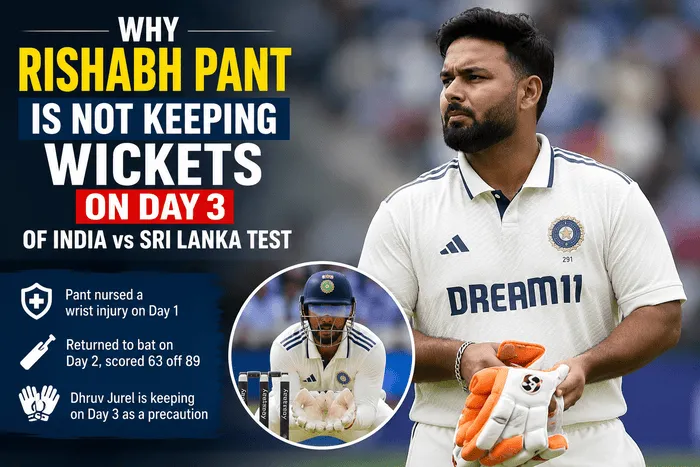
Why Rishabh Pant Is Not Keeping Wickets
Rishabh Pant did not take the field as India’s wicketkeeper on Day 3 of the second Test against Sri Lanka in Colombo. Instead, Dhruv Jurel took over the gloves after Pant’s shoulder discomfort was monitored by the Indian team management.
Pant had already experienced an injury scare earlier in the Test. On Day 1, he was struck by a short delivery from Sri Lankan fast bowler Lahiru Kumara and was forced to retire hurt. The blow affected his left arm and wrist area, although he was subsequently able to return to the match.
Pant made his return to batting on Day 2 and produced an aggressive 63 off 89 balls, hitting six fours and three sixes. His innings was particularly valuable because it came after the earlier injury scare and helped India maintain their momentum alongside Dhruv Jurel.
However, Pant did not resume wicketkeeping after India declared their first innings at 503/9. Jurel, who had just scored an unbeaten 115, continued behind the stumps as India began their bowling innings.
The decision was described as a precautionary measure to avoid aggravating Pant’s injury. Jurel had explained after Day 2 that Pant was being closely monitored by the team physio because of pain in his shoulder.
| Pant Update | Details |
|---|---|
| Initial Injury | Blow from a short delivery on Day 1 |
| Day 1 Outcome | Retired hurt |
| Day 2 Batting | 63 off 89 balls |
| India’s Declaration | 503/9 |
| Day 3 Wicketkeeper | Dhruv Jurel |
| Reason for Absence | Precautionary rest after shoulder discomfort |
Pant’s absence from wicketkeeping should therefore not automatically be interpreted as confirmation of a serious injury. The available reports point to a precautionary decision, with the medical team monitoring his condition while Jurel handles the gloves.
The timing is also significant for India. With a 495-run first-innings lead at the start of Day 3, the team has enough scoreboard control to avoid taking unnecessary risks with Pant. Keeping him away from the physically demanding wicketkeeping role gives India an opportunity to protect an important player while Jurel provides a capable replacement.
Key Takeaway: Pant is not keeping wickets on Day 3 as a precaution after his shoulder discomfort. Dhruv Jurel has taken over behind the stumps while Pant’s fitness continues to be monitored.
Pant’s Injury During the Colombo Test
Rishabh Pant’s wicketkeeping absence on Day 3 can be traced back to an injury scare on the opening day of the Colombo Test. Pant was struck on the left arm by a short delivery from Sri Lanka pacer Lahiru Kumara while batting, forcing him to leave the field and retire hurt.
The blow came during India’s first innings and initially raised concerns because Pant was visibly uncomfortable after being hit. He received medical attention before deciding that he could not continue batting at that stage. The injury was subsequently monitored by India’s medical team as the Test progressed.
Despite the setback, Pant was able to make a return to India’s batting on Day 2. His comeback was particularly encouraging because he did not simply occupy the crease defensively. Instead, he played an attacking innings and scored 63 runs from 89 deliveries, including six fours and three sixes.
Pant’s return with the bat showed that he was capable of contributing despite the earlier blow. However, wicketkeeping presents a different physical demand. Repeated squatting, diving, catching and movement behind the stumps could place additional stress on the affected area.
| Timeline | Pant’s Status |
|---|---|
| Day 1 | Struck on the left arm by a short delivery |
| Day 1 | Retired hurt after the injury scare |
| Day 2 | Returned to bat for India |
| Day 2 Score | 63 off 89 balls |
| Day 3 | Did not take wicketkeeping duties |
| Day 3 Replacement | Dhruv Jurel |
This distinction is important when assessing Pant’s current status. His ability to bat on Day 2 does not necessarily mean he was ready for the workload associated with keeping wickets for an entire innings. India’s decision to use Jurel behind the stumps therefore allowed the team to manage Pant’s recovery without removing him completely from the match.
There was also no need for India to take an unnecessary risk. The team had already reached 503/9 declared, giving them a substantial advantage before Sri Lanka began their reply. With Jurel available as a specialist wicketkeeping option, India had a practical way to reduce the physical demands on Pant.
The Day 3 decision should consequently be viewed in the context of precaution and workload management rather than automatically interpreted as evidence of a major injury. Pant’s continued involvement with the bat and the medical team’s monitoring remain important factors in assessing when he can safely resume wicketkeeping.
Injury Context: Pant was struck on the left arm on Day 1 and retired hurt, but returned to score 63 on Day 2. India subsequently chose the precautionary option of using Dhruv Jurel behind the stumps on Day 3.
Pant Returns With a Quick 63
Rishabh Pant made an encouraging return to India’s batting on Day 2 of the Colombo Test after retiring hurt following the blow to his left arm on the opening day. Rather than simply trying to survive at the crease, Pant immediately showed his attacking intent and produced a valuable 63 off 89 balls.
Pant’s innings contained six fours and three sixes, giving India a significant injection of momentum in the middle and lower order. His aggressive approach complemented Dhruv Jurel’s more controlled batting and helped India build towards their eventual first-innings declaration.
The timing of Pant’s return was important. India were already in a strong position, but the partnership between Pant and Jurel ensured that Sri Lanka could not quickly regain control with the second new ball and middle-order wickets.
| Pant’s Day 2 Innings | Details |
|---|---|
| Runs | 63 |
| Balls Faced | 89 |
| Fours | 6 |
| Sixes | 3 |
| Partnership With Jurel | 112 runs |
| India’s Final Total | 503/9 declared |
The 112-run seventh-wicket partnership with Jurel was one of the most important stands of India’s innings. Pant’s attacking strokeplay allowed Jurel to continue building his score, while Jurel’s stability gave Pant the freedom to play his natural game.
Pant eventually departed for 63, but his contribution had already changed the momentum of the innings. Jurel continued from the other end and went on to complete his second Test century before finishing unbeaten on 115.
Pant’s batting comeback is also relevant to the Day 3 wicketkeeping decision. His ability to bat through the injury scare showed that he could still contribute with the bat, but keeping for a full innings requires considerably more movement and repeated physical exertion.
India’s decision to use Jurel behind the stumps therefore allowed Pant to avoid additional workload while retaining his value as an experienced batter. With India already holding a substantial advantage, there was little reason to take unnecessary risks with Pant’s recovery.
Key Takeaway: Pant returned from his Day 1 injury scare to score 63 off 89 balls, forming a 112-run stand with Jurel before India declared at 503/9.
Why Dhruv Jurel Took the Gloves
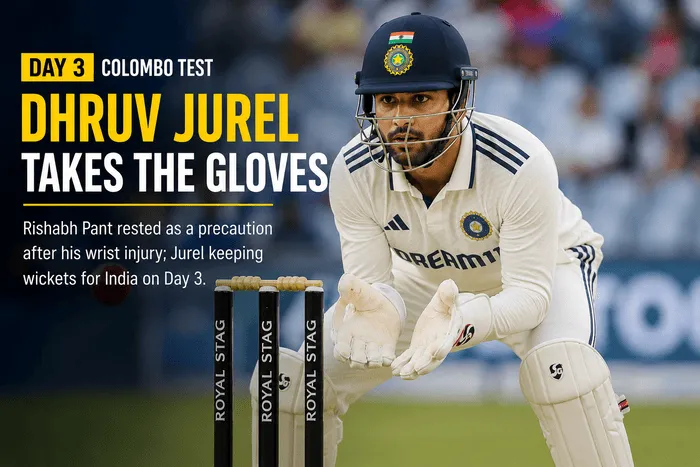
Dhruv Jurel took over wicketkeeping duties for India on Day 3 of the second Test against Sri Lanka in Colombo, with Rishabh Pant remaining off the field after the injury scare he suffered earlier in the match. The decision allowed India to manage Pant’s workload while keeping a specialist wicketkeeper behind the stumps.
Pant had been struck on his left arm by a short delivery from Lahiru Kumara on Day 1 and subsequently retired hurt. Although he returned to batting on Day 2 and scored a valuable 63 off 89 balls, wicketkeeping involves repeated squatting, movement and diving, making it a more physically demanding role while recovering from an injury.
Jurel was therefore the natural replacement. He had already played a major role in India’s first innings, scoring an unbeaten 115 from No. 7 and helping India reach 503/9 declared. His move behind the stumps on Day 3 gave India a reliable wicketkeeping option without requiring Pant to take unnecessary physical risks.
| Wicketkeeping Update | Details |
|---|---|
| Regular Wicketkeeper | Rishabh Pant |
| Day 3 Wicketkeeper | Dhruv Jurel |
| Reason | Precaution after Pant’s injury scare |
| Pant’s Day 2 Score | 63 off 89 balls |
| Jurel’s First-Innings Score | 115* off 177 balls |
| India’s Declaration | 503/9 |
The switch also highlights Jurel’s versatility within the Indian Test setup. He had just completed a career-defining innings with the bat, and within a short period he was back in his wicketkeeping role to support India’s bowling attack.
His first contribution behind the stumps came soon after India began bowling. Jurel was involved in the dismissal of Sri Lanka opener Kamil Mishara, taking the catch behind the wickets as Prasidh Krishna provided the breakthrough.
India’s decision to use Jurel also made tactical sense given the scoreboard. After declaring on 503/9, India had a substantial advantage and quickly put Sri Lanka under pressure. There was little incentive to expose Pant to additional physical workload when Jurel was available to handle the gloves.
Importantly, Jurel taking the gloves should not automatically be treated as confirmation that Pant has suffered a serious injury. The move was precautionary, while Pant’s condition continued to be monitored by the Indian team management.
Key Takeaway: Dhruv Jurel took the gloves on Day 3 so India could manage Rishabh Pant’s workload after his earlier injury scare. Jurel had already contributed an unbeaten 115 with the bat before taking over behind the stumps.
Jurel’s Role After His 115*
Dhruv Jurel’s role in the Colombo Test did not end when he completed his second Test century. After remaining unbeaten on 115 and helping India declare at 503/9, Jurel immediately returned to his wicketkeeping duties when India began bowling against Sri Lanka.
That made Jurel one of the most influential players for India across both innings. He first provided the stability required with the bat, then took responsibility behind the stumps when Rishabh Pant was unable to keep after suffering pain in his shoulder. Jurel had already taken over wicketkeeping duties late on Day 2.
Jurel’s batting performance had already transformed India’s position. His unbeaten 115 came at No. 7 and included nine fours and two sixes. He also shared a 112-run partnership with Pant before carrying his bat through the declaration.
| Jurel’s Contribution | Details |
|---|---|
| Batting Position | No. 7 |
| Score | 115* off 177 balls |
| Test Centuries | 2 |
| Partnership With Pant | 112 runs |
| India’s Total | 503/9 declared |
| Day 3 Role | Wicketkeeper |
The situation also highlights Jurel’s value as a genuine wicketkeeper- batter. He was not simply brought in as a temporary substitute after Pant’s absence; he had already demonstrated that he could make a major contribution with the bat at Test level. His ability to switch between the two roles gave India a practical solution while Pant was being monitored.
Jurel also spoke about the influence Pant has had on his own game after their century stand. He said he regularly seeks advice from Pant because both players are wicketkeepers and middle-order batters, while also acknowledging that he has his own batting method rather than trying to copy Pant’s aggressive style.
That relationship became particularly relevant in Colombo. Pant’s attacking 63 helped Jurel settle into his innings, while Jurel’s composed approach allowed India to continue building after Pant’s dismissal. The pair’s contrasting styles produced one of the most important partnerships of India’s innings.
By Day 3, Jurel’s responsibilities had therefore expanded beyond his century. He was keeping wickets while India attempted to exploit their huge first-innings advantage, with Sri Lanka beginning the day 495 runs behind. The change also allowed India to manage Pant’s physical workload without losing a specialist wicketkeeper.
Key Takeaway: Jurel followed his unbeaten 115 by taking the gloves for India, giving the team both a major batting contribution and a dependable wicketkeeping option while Pant was rested as a precaution.
What Pant’s Absence Means for India
Rishabh Pant’s absence from wicketkeeping duties gives India a different balance on the field, but it does not leave the team without a specialist option. Dhruv Jurel is an established wicketkeeper-batter and has already demonstrated his value in this Test with an unbeaten 115.
The immediate advantage for India is that Pant can avoid the repeated physical workload associated with keeping wickets while recovering from the injury scare he suffered on Day 1. Pant has already contributed with the bat, scoring 63 off 89 balls on Day 2, so managing his workload allows India to protect an important player without removing his batting contribution entirely.
Jurel’s presence behind the stumps also means India do not need to alter their bowling combination simply because Pant is unavailable as wicketkeeper. Jurel can handle the gloves while the existing bowling attack continues to operate with India holding a substantial first-innings advantage.
| India’s Situation | Impact |
|---|---|
| Pant’s Role | Available as a batter while being managed |
| Wicketkeeper | Dhruv Jurel |
| Pant’s Day 2 Score | 63 off 89 balls |
| Jurel’s Score | 115* off 177 balls |
| India’s Declaration | 503/9 |
There is also a strategic benefit in avoiding unnecessary risk. India entered Sri Lanka’s second innings with 503 runs on the board, meaning the priority was to take wickets rather than expose a key player to additional physical strain. Jurel’s ability to keep wickets gave the management that flexibility.
Pant’s experience remains valuable even when he is not wearing the wicketkeeping gloves. His aggressive batting can change the momentum of a Test match, while his understanding of wicketkeeping and opposition batters can still provide useful input from the field.
For Jurel, meanwhile, the situation represents another opportunity to demonstrate his all-round value in Test cricket. He has already scored his second Test century in this match and now has the responsibility of supporting India’s bowlers behind the stumps.
India’s strong position also means there is no immediate need to rush Pant back into wicketkeeping. The team can continue monitoring his condition and make a decision based on his fitness rather than taking an unnecessary risk during a Test that India currently control.
Key Takeaway: Pant’s wicketkeeping absence gives India an opportunity to manage his workload while Jurel provides a specialist option behind the stumps. India’s 503/9 declaration gives the team enough flexibility to take a cautious approach.
Sri Lanka’s Fightback on Day 3
Sri Lanka showed some resistance on Day 3 after India had taken complete control with a first-innings total of 503/9 declared. The hosts were reduced to 8/2 early in their reply, but Pasindu Sooriyabandara and Kamindu Mendis helped steady the innings and prevent another immediate collapse.
Sooriyabandara produced an important contribution for Sri Lanka, reaching his maiden Test fifty during the day’s play. His composed batting gave the hosts some much-needed stability after India had made two early breakthroughs.
The partnership with Kamindu Mendis was particularly important because Sri Lanka needed to absorb India’s pressure while facing an enormous first-innings deficit. Rather than attempting to match India’s scoring rate, the priority was to remain at the crease and build a platform for the lower order.
| Sri Lanka’s Day 3 Situation | Details |
|---|---|
| India’s First-Innings Score | 503/9 declared |
| Sri Lanka at Start | 8/2 |
| Key Batter | Pasindu Sooriyabandara |
| Milestone | Maiden Test fifty |
| Partnership | Sooriyabandara and Kamindu Mendis |
India continued to create pressure through Prasidh Krishna, who remained one of the key threats with the ball. His ability to take wickets at important moments prevented Sri Lanka from completely escaping India’s control.
Dhruv Jurel also had an immediate role in India’s bowling innings after taking over from Rishabh Pant behind the stumps. His wicketkeeping became particularly important as India looked to convert their huge first-innings advantage into a decisive result.
Despite the fightback, Sri Lanka still had a significant amount of work remaining. India’s 503/9 declaration created an enormous gap between the teams, meaning the hosts needed to construct a very substantial first innings before they could even begin thinking about setting India a target.
The Sri Lankan resistance nevertheless showed why India cannot afford to relax. A long partnership can change the tempo of a Test match, particularly if the pitch becomes easier for batting. India’s bowlers will therefore be looking for another cluster of wickets to prevent the hosts from building a meaningful response.
Day 3 Takeaway: Sri Lanka responded to their early setbacks through Pasindu Sooriyabandara’s maiden Test fifty and a stabilising partnership with Kamindu Mendis, but India remained in a commanding position after declaring on 503/9.
Will Rishabh Pant Return to Wicketkeeping?
Rishabh Pant’s return to wicketkeeping will depend on how his shoulder responds to recovery and medical monitoring. India did not take a risk with him on Day 3 of the Colombo Test, instead allowing Dhruv Jurel to continue behind the stumps as a precaution.
The decision came after Pant experienced pain in his right shoulder during the second Test. Jurel had already taken over the wicketkeeping duties late on Day 2, and before the start of Day 3 there was hope that Pant could return. However, the team ultimately chose the safer option of keeping him off the field.
Pant’s ability to bat on Day 2 provides some encouragement. He returned after his earlier injury scare and scored 63 from 89 balls, including six fours and three sixes. However, batting and wicketkeeping place different physical demands on the body, so his availability for keeping should be assessed separately.
| Pant Fitness Update | Current Situation |
|---|---|
| Injury Area | Right shoulder |
| Day 2 Batting | 63 off 89 balls |
| Day 2 Wicketkeeper | Dhruv Jurel |
| Day 3 Wicketkeeper | Dhruv Jurel |
| Pant’s Status | Being monitored |
| Reason for Rest | Precautionary workload management |
Before Day 3, Jurel had expressed hope that Pant would be fit enough to resume wicketkeeping, while also confirming that the team physio was monitoring him closely. That makes the situation one that can change according to Pant’s recovery rather than a permanent change in India’s wicketkeeping plans.
For India, there is little reason to rush the decision. Jurel has already shown that he can handle both responsibilities in this Test, scoring an unbeaten 115 before taking the gloves. He also completed a catch off Prasidh Krishna to dismiss Kamil Mishara on Day 3.
Pant therefore remains an important part of India’s match plans, but his immediate wicketkeeping return should depend on his fitness rather than the scoreline alone. India have a capable replacement in Jurel and can afford to take a cautious approach while protecting Pant from further aggravation.
Current Update: Pant’s return to wicketkeeping is dependent on his recovery and medical assessment. For Day 3, India opted for precaution and continued with Dhruv Jurel behind the stumps.
Frequently Asked Questions
Rishabh Pant is not keeping wickets on Day 3 as a precaution after experiencing discomfort following his injury scare. Dhruv Jurel has taken over behind the stumps while Pant’s condition is being monitored.
Pant was struck by a short delivery during the Test and initially retired hurt. He subsequently returned to bat on Day 2 and scored 63 runs from 89 balls.
Dhruv Jurel is keeping wickets for India while Pant is being rested as a precaution. Jurel had already scored an unbeaten 115 in India’s first innings.
Yes. Pant returned to India’s batting on Day 2 and scored 63 off 89 balls, including six fours and three sixes.
Jurel scored an unbeaten 115 in India’s first innings and then took over wicketkeeping duties when Pant was unavailable to keep on Day 3.
His return to wicketkeeping will depend on his recovery and medical assessment. India are taking a precautionary approach and have used Dhruv Jurel behind the stumps on Day 3.
Final Thoughts
Rishabh Pant’s absence from wicketkeeping on Day 3 of the Colombo Test is primarily a precautionary decision after his injury scare earlier in the match. Pant was struck on the arm on Day 1 and retired hurt, but returned to bat on Day 2 and scored a valuable 63 off 89 balls.
India have therefore chosen not to put additional physical demands on Pant while Dhruv Jurel provides a capable replacement behind the stumps. Jurel had already made a major contribution with the bat, remaining unbeaten on 115 as India declared their first innings at 503/9.
The situation also gives India flexibility. With a huge first-innings total and Jurel available as a specialist wicketkeeper, there is little reason to rush Pant back into a physically demanding role while his condition is being monitored.
Pant’s return to wicketkeeping will ultimately depend on his recovery and the team’s medical assessment. For now, Jurel’s presence means India can manage Pant’s workload without significantly weakening their wicketkeeping options.
Key Takeaway: Rishabh Pant is being managed cautiously after his injury scare, while Dhruv Jurel has taken the gloves on Day 3. Pant remains an important part of India’s plans, but his wicketkeeping return will depend on his fitness.