
Abhishek Sharma smashed a record 30-ball century as India posted 221/7, bowled Afghanistan out for 94 and completed a 3–0 T20I series sweep in Delhi.
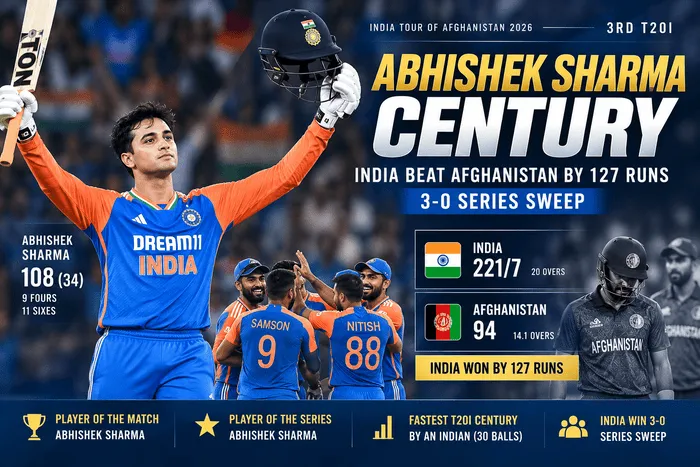
Table of Contents
- Abhishek Sharma Century Powers India to 127-Run Win
- India vs Afghanistan 3rd T20I Match Information
- India vs Afghanistan 3rd T20I Scorecard Summary
- Abhishek Sharma’s 30-Ball Century Breaks India’s T20I Record
- India Race to 100 in the Powerplay
- Sanju Samson Adds a 35-Ball Fifty
- Afghanistan Pull India Back After Abhishek Falls
- India’s Bowlers Complete the Job
- Nitish Kumar Reddy Turns the Game With Three Wickets
- Ravi Bishnoi Adds Three More Wickets
- Turning Point: Abhishek’s 30-Ball Hundred
- Abhishek Sharma’s Major Records in the 3rd T20I
- Why India Won the 3rd T20I
- Why Afghanistan Could Not Chase 222
- India Complete 3-0 T20I Series Sweep
- What Abhishek Sharma’s Century Means for India
- What’s Next for India and Afghanistan?
- Frequently Asked Questions
- Final Verdict
Abhishek Sharma Century Powers India to 127-Run Win
Abhishek Sharma produced a remarkable batting performance as India defeated Afghanistan by 127 runs in the third T20I at the Arun Jaitley Stadium in Delhi on September 17, 2026. The left-hander smashed 108 from just 34 balls, hitting nine fours and 11 sixes, to give India a dominant start in the series finale.
Sharma reached his century in only 30 balls, setting a new record for the fastest T20I century by an Indian batter. His hundred surpassed Rohit Sharma’s previous Indian record of 35 balls and became one of the fastest centuries recorded in men’s T20I cricket.
India finished their innings on 221/7 after reaching 100 without losing a wicket during the powerplay. Sanju Samson also contributed with a 35-ball fifty, while the opening partnership between Samson and Abhishek added 142 runs before Rashid Khan dismissed Sharma.
Afghanistan’s chase never gathered momentum. The visitors reached 51/4 in the powerplay and were eventually bowled out for 94 in 14.1 overs. Nitish Kumar Reddy and Ravi Bishnoi took three wickets each as India’s bowlers completed the victory.
India vs Afghanistan 3rd T20I Match Information
The third T20I was played at the Arun Jaitley Stadium in Delhi on September 17, 2026. India entered the final match with the series already in their control and completed a clean sweep with another convincing performance.
| Match | Afghanistan vs India, 3rd T20I |
|---|---|
| Date | September 17, 2026 |
| Venue | Arun Jaitley Stadium, Delhi |
| India | 221/7 in 20 overs |
| Afghanistan | 94 all out in 14.1 overs |
| Result | India won by 127 runs |
| Series Result | India won the T20I series 3–0 |
| Player of the Match | Abhishek Sharma — 108 off 34 balls |
| Player of the Series | Abhishek Sharma |
India vs Afghanistan 3rd T20I Scorecard Summary
India posted 221/7 from 20 overs before bowling Afghanistan out for 94 in 14.1 overs, securing a 127-run victory and completing a 3–0 T20I series sweep.
| Innings | Score | Top Performer | Key Bowling |
|---|---|---|---|
| India | 221/7 (20 overs) | Abhishek Sharma — 108 (34) | Rashid Khan — Abhishek’s wicket |
| Afghanistan | 94 all out (14.1 overs) | Ibrahim Zadran — 25 | Nitish Kumar Reddy 3/25; Ravi Bishnoi 3/26 |
Abhishek Sharma’s 30-Ball Century Breaks India’s T20I Record
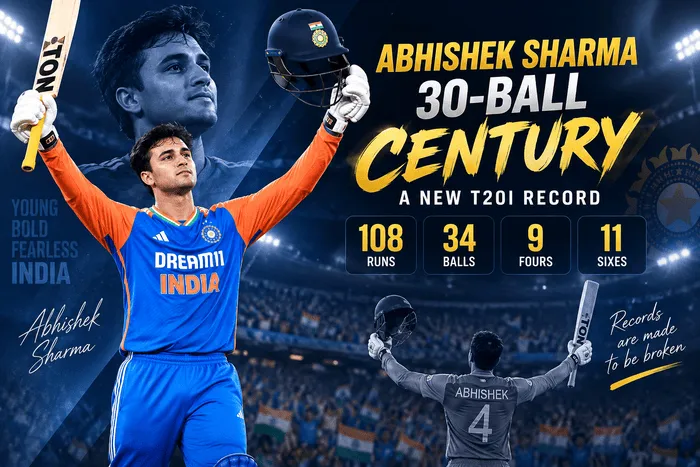
Abhishek Sharma produced the defining batting performance of the third T20I, reaching his century in only 30 balls before finishing with 108 from 34 deliveries.
Abhishek Sharma delivered a breathtaking innings in the India vs Afghanistan 3rd T20I, smashing 108 runs from just 34 balls. His knock included nine fours and 11 sixes and gave India an exceptional start after they were asked to bat first in Delhi.
The landmark moment arrived when Sharma completed his century from only 30 deliveries. The innings established a new record for the fastest T20I century by an Indian batter, surpassing the previous 35-ball mark held by Rohit Sharma.
Sharma’s approach was aggressive from the opening overs. He attacked Afghanistan’s bowlers while Sanju Samson provided support at the other end. Their opening partnership produced 142 runs before Rashid Khan dismissed Abhishek at 142/1 after 9.5 overs.
By the time Abhishek departed, the damage had already been done. His extraordinary scoring rate had put India firmly ahead and provided the platform for the middle order to push the total beyond 200.
India Race to 100 in the Powerplay
Abhishek Sharma and Sanju Samson gave India an extraordinary start, taking the score to 100 without loss inside the first six overs.
India’s innings immediately moved into a different gear during the powerplay. Abhishek Sharma’s aggressive strokeplay, combined with Sanju Samson’s attacking support, allowed India to reach 100/0 after six overs.
The opening pair put Afghanistan’s bowling attack under sustained pressure from the start. Abhishek took the lead in the scoring while Samson continued to find boundaries at the other end, giving India an exceptional platform for the remainder of the innings.
Reaching 100 in the powerplay was a major feature of India’s first-innings dominance. The score also reflected how quickly Abhishek’s innings was changing the match, with his six-hitting allowing India to maintain an unusually high scoring rate.
The opening partnership eventually reached 142 runs before Rashid Khan dismissed Abhishek at 142/1 in the 10th over. By then, India had already established the foundation for a total of 221/7.
Sanju Samson Adds a 35-Ball Fifty
Sanju Samson provided the perfect support to Abhishek Sharma during India’s explosive opening partnership, scoring a quick 50 from 35 balls.
While Abhishek Sharma dominated the scoring at one end, Sanju Samson played an important supporting role during India’s record-breaking start. The India wicketkeeper-batter remained aggressive enough to keep the pressure on Afghanistan’s bowlers without taking away from Abhishek’s attacking innings.
Samson reached his half-century from 35 balls, adding another significant contribution to India’s first-innings total. His innings became especially valuable because it allowed Abhishek to continue attacking while India maintained a strong scoring rate through the opening phase.
The pair added 142 runs for the first wicket before Rashid Khan finally broke the partnership by dismissing Abhishek at 142/1 after 9.5 overs. Samson’s contribution had already helped India establish a substantial platform by that stage.
Samson was eventually dismissed after scoring 50, but India’s opening partnership had already placed the innings in a commanding position. India went on to finish on 221/7 from their 20 overs.
Sanju Samson’s Contribution
Samson’s 35-ball fifty complemented Abhishek Sharma’s record-breaking hundred and helped India build a huge opening stand before Afghanistan finally made their first breakthrough.
Afghanistan Pull India Back After Abhishek Falls
Afghanistan finally found a way to slow India’s scoring after Abhishek Sharma was dismissed for 108, but India’s explosive opening partnership had already given them a strong platform.
Abhishek Sharma’s dismissal at 142/1 after 9.5 overs marked the first major shift in India’s innings. Rashid Khan ended the record-breaking knock after the opener had scored 108 from 34 balls, bringing an extraordinary opening assault to an end.
Afghanistan’s bowlers were able to apply more pressure once the 142-run opening partnership was broken. India lost Tilak Varma soon after, and the scoring rate became noticeably slower compared with the remarkable first half of the innings. The middle order had to rebuild while Afghanistan looked to restrict India below an even larger total.
Sanju Samson continued to contribute and reached his fifty, but he was dismissed for 50 from 35 balls. India’s wickets continued to fall during the middle and latter stages, with Afghanistan making a useful recovery after the explosive opening ten overs.
Despite the slowdown, India still finished on 221/7 from 20 overs. The early acceleration from Abhishek and Samson meant Afghanistan had a substantial target to defend, even after their bowlers had improved during the second half of the innings.
India’s Innings After the Opening Stand
India’s Bowlers Complete the Job
India’s batting had already created a huge advantage, and the bowlers turned that platform into a 127-run victory by dismissing Afghanistan for 94 in 14.1 overs.
Afghanistan needed 222 runs to win after India’s explosive first innings, but the chase never developed into a serious contest. India struck early and kept taking wickets often enough to prevent the Afghanistan batters from building a substantial partnership.
The visitors were reduced to 51/4 during the powerplay, leaving them with a steep recovery job against an Indian attack that continued to apply pressure. Ibrahim Zadran top-scored for Afghanistan with 25 runs, but no batter was able to turn a start into a significant innings.
India’s attack then tightened its grip through the middle overs. Nitish Kumar Reddy produced the key spell with three wickets, while Ravi Bishnoi also claimed three as Afghanistan’s lower order struggled to stay at the crease.
By the time Afghanistan were bowled out for 94 in 14.1 overs, India had completed one of their biggest wins of the series. The combined impact of the early wickets, middle-over control and disciplined finishing meant Afghanistan never came close to challenging India’s 221/7.
India’s Bowling Figures
Nitish Kumar Reddy Turns the Game With Three Wickets
Nitish Kumar Reddy delivered an important four-over spell, taking 3/25 as India’s bowling attack kept Afghanistan under pressure throughout the chase.
Nitish Kumar Reddy played a major role in India’s second-innings control, finishing with three wickets for 25 runs from his four overs. His spell helped India maintain the pressure after Afghanistan had already lost four wickets during the powerplay.
With 222 required for victory, Afghanistan needed a substantial partnership to keep the chase alive. Instead, wickets continued to fall and the required scoring rate became increasingly difficult to manage. Nitish’s contribution ensured India did not allow the visitors to establish the kind of middle-order partnership that could have changed the momentum.
Reddy’s three-wicket haul was also significant because India’s attack shared the workload effectively. Ravi Bishnoi matched him with three wickets, while Axar Patel added two, leaving Afghanistan without enough batting depth to mount a recovery.
Reddy eventually finished with figures of 3/25, making him one of India’s leading performers with the ball on a night dominated by Abhishek Sharma’s record-breaking century.
Nitish Kumar Reddy’s Spell
Ravi Bishnoi Adds Three More Wickets
Ravi Bishnoi matched Nitish Kumar Reddy’s three-wicket haul as India’s bowlers kept Afghanistan’s chase under control.
Ravi Bishnoi finished with 3/26, playing a key role in Afghanistan’s collapse. His wickets added further pressure during the middle overs and prevented the visitors from building a recovery after their difficult powerplay.
With Afghanistan eventually bowled out for 94 in 14.1 overs, Bishnoi’s spell became an important part of India’s comprehensive 127-run victory.
Turning Point: Abhishek’s 30-Ball Hundred
Abhishek Sharma’s record-breaking 30-ball century gave India the decisive advantage in the third T20I.
India’s defining moment came during the first innings when Abhishek Sharma reached his century from just 30 balls. The knock eventually produced 108 from 34 balls and pushed India’s scoring rate beyond Afghanistan’s ability to recover.
The century was the fastest T20I hundred by an Indian batter and the third-fastest overall in men’s T20I cricket.
Abhishek Sharma’s Major Records in the 3rd T20I
Abhishek Sharma’s extraordinary innings produced several notable milestones in Delhi.
| Record / Milestone | Abhishek Sharma |
|---|---|
| Century | 30 balls |
| Indian T20I record | Fastest century by an Indian batter |
| Final Score | 108 off 34 balls |
| Sixes | 11 |
| Fours | 9 |
His 30-ball century moved past Rohit Sharma’s previous 35-ball mark and became one of the fastest hundreds recorded in men’s T20I cricket.
Why India Won the 3rd T20I
India’s victory was built on an explosive powerplay, a record-breaking century and sustained bowling pressure.
- Explosive opening: India reached 100/0 in the powerplay.
- Record innings: Abhishek Sharma scored 108 from 34 balls.
- Strong platform: Abhishek and Sanju Samson added 142 runs.
- Bowling pressure: Nitish Kumar Reddy and Ravi Bishnoi took three wickets each.
- Early Afghanistan collapse: Afghanistan were 51/4 during the powerplay.
Why Afghanistan Could Not Chase 222
Afghanistan lost early wickets and could not build the partnerships required to chase India’s 221/7.
- Early wickets: Afghanistan slipped to 51/4 during the powerplay.
- Limited contributions: Ibrahim Zadran was their top scorer with 25.
- Indian bowling: Nitish Kumar Reddy and Ravi Bishnoi took three wickets each.
- Run-rate pressure: The required target of 222 kept increasing as wickets fell.
- No recovery partnership: Afghanistan were eventually bowled out for 94 in 14.1 overs.
India Complete 3-0 T20I Series Sweep
India finished the series unbeaten after another commanding performance against Afghanistan in Delhi.
India’s 127-run victory in the third T20I completed a 3–0 series sweep. The team combined a record-breaking batting display with disciplined bowling to close out the series in emphatic fashion.
Abhishek Sharma was named both Player of the Match and Player of the Series after his outstanding contribution in the series finale.
What Abhishek Sharma’s Century Means for India
Abhishek Sharma’s record-breaking innings highlighted India’s aggressive batting approach in the series finale.
Abhishek’s 108 off 34 balls gave India an exceptional start and showed how quickly the team’s batting can change the shape of a T20I. His 30-ball century also added a significant individual milestone to India’s 3–0 series sweep.
The combination of Abhishek’s explosive batting, Sanju Samson’s fifty and India’s bowling depth gave the team control in both innings of the Delhi T20I.
What’s Next for India and Afghanistan?
Both teams now turn their attention to the Asian Games after the T20I series in Delhi.
India’s next assignment is the 2026 Asian Games campaign. India are scheduled to face Japan in a one-off T20 match in Nagoya on September 22 before the men’s cricket quarter-finals begin on September 28.
Afghanistan will also travel to Japan for the Asian Games, with their group-stage campaign scheduled to begin against Japan on September 24.
Frequently Asked Questions
Key questions about Abhishek Sharma’s century and India’s 127-run win over Afghanistan.
Abhishek Sharma completed his century from just 30 balls against Afghanistan in the third T20I.
He scored 108 runs from 34 balls, including nine fours and 11 sixes.
India defeated Afghanistan by 127 runs after scoring 221/7 and bowling Afghanistan out for 94.
Nitish Kumar Reddy took 3/25, while Ravi Bishnoi finished with 3/26.
India completed a 3–0 series sweep against Afghanistan.
Final Verdict
Abhishek Sharma’s record-breaking 30-ball century set the tone for India’s dominant 127-run victory in the third T20I. India finished on 221/7 before dismissing Afghanistan for 94 in 14.1 overs.
The result completed a 3–0 T20I series sweep, with Sharma finishing the match as both Player of the Match and Player of the Series.
Sources
This match report is based on published match reports and scorecard information from established cricket sources.
- ICC: Match report covering Abhishek Sharma’s record-breaking century and India’s victory.
- Indian Express: Report on Abhishek Sharma’s 30-ball T20I century.
- India Today: India vs Afghanistan 3rd T20I match report and series result.
- NDTV Sports: Published scorecard and match result.
- Hindustan Times: Match scorecard and innings details.