
Cricket’s Olympic Journey Gains Momentum: Why LA 2028 Could Transform the Future of the Sport
Cricket is officially returning to the Olympic Games at Los Angeles 2028 after a 128-year absence. Featuring men’s and women’s T20 tournaments, the historic comeback is expected to expand cricket’s global reach, attract new audiences, and mark one of the biggest milestones in the sport’s modern era.

Table of Contents
- Cricket Returns to the Olympics After 128 Years
- A Brief History of Cricket in the Olympic Games
- Why the IOC Wants Cricket Back
- LA 2028 Cricket Tournament Format Explained
- How Teams Will Qualify for LA 2028
- What Cricket’s Olympic Return Means for the Sport
- Can Cricket Become a Permanent Olympic Sport?
- Frequently Asked Questions
- Final Thoughts
Cricket Returns to the Olympics After 128 Years
Cricket is officially set to make its long-awaited return to the Olympic Games at Los Angeles 2028, ending a remarkable 128-year absence from the world’s biggest sporting event.
The International Olympic Committee (IOC) has confirmed that cricket will feature at the Los Angeles 2028 Olympic Games, marking one of the most significant developments in the sport’s modern history. Cricket last appeared at the Olympic Games during the Paris Olympics in 1900, where Great Britain defeated France in what remains the only official Olympic cricket match ever played.
More than a century later, cricket is returning in a completely different form. Instead of multi-day matches, the Olympic tournament will feature the fast-paced T20 format, making the competition easier to schedule while delivering exciting, television-friendly cricket that appeals to fans across the globe.
The return of cricket is expected to attract millions of new viewers while giving emerging cricket nations an opportunity to compete on one of the world’s biggest sporting stages. Traditional powerhouses such as India, Australia, England, South Africa, Pakistan, and New Zealand are also likely to view Olympic gold as another prestigious international achievement.
For the International Cricket Council (ICC), the decision represents more than simply adding another tournament to the calendar. Olympic participation has the potential to expand cricket into new markets, increase youth participation, strengthen investment in developing nations, and further establish the sport as a truly global game.
With both men’s and women’s T20 competitions confirmed for LA 2028, cricket’s Olympic comeback is expected to become one of the defining moments in the sport’s continued international growth.
A Brief History of Cricket in the Olympic Games
Cricket’s Olympic story began more than a century ago. Although the sport disappeared from the Games for 128 years, growing global popularity and the rise of T20 cricket have paved the way for its historic return at Los Angeles 2028.
Cricket made its only official Olympic appearance during the 1900 Paris Olympic Games. Originally, several nations were expected to participate, but withdrawals meant that only Great Britain and France competed in the tournament. The single two-day match saw Great Britain emerge victorious, earning what remains the only Olympic gold medal in cricket.
Following the Paris Games, cricket disappeared from the Olympic programme for a variety of reasons. The sport’s traditional multi-day format was difficult to fit into the Olympic schedule, while its popularity remained concentrated in only a handful of countries. As the Olympic movement expanded globally, sports with broader international participation received greater priority.
Over the decades, cricket evolved dramatically. The introduction of One-Day Internationals and later the T20 format transformed the game into a faster, more television-friendly spectacle capable of attracting millions of viewers worldwide. Domestic leagues such as the Indian Premier League (IPL) further increased cricket’s global popularity and commercial appeal.
Cricket’s successful inclusion in multi-sport events like the 2022 Commonwealth Games and the 2023 Asian Games demonstrated that the modern T20 format could be successfully integrated into major international sporting events. These tournaments strengthened the case for bringing cricket back to the Olympic stage.
The International Olympic Committee eventually approved cricket’s return for the Los Angeles 2028 Olympic Games, where both men’s and women’s T20 competitions will be held. After waiting 128 years, cricket will once again become part of the world’s biggest sporting celebration, opening a new chapter in the sport’s remarkable history.
Why the IOC Wants Cricket Back
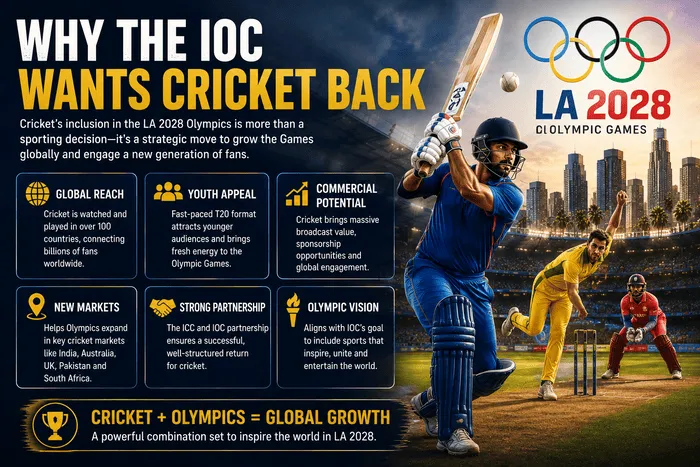
Cricket’s return to the Olympic Games is about much more than adding another sport to the schedule. For the International Olympic Committee (IOC), it is a strategic decision aimed at expanding the Games’ global reach, attracting younger audiences, and strengthening commercial value through one of the world’s fastest-growing sports.
One of the biggest reasons behind cricket’s inclusion in LA 2028 is its enormous global audience. Cricket enjoys a fan base of more than two billion people, particularly across India, Pakistan, Australia, England, South Africa, Bangladesh, Sri Lanka, and several emerging cricket nations. Bringing the sport back to the Olympics gives the Games access to millions of passionate viewers who may not traditionally follow Olympic competition.
The popularity of the T20 format also played a crucial role in the IOC’s decision. Unlike traditional Test cricket, T20 matches last only a few hours, making them perfectly suited to the Olympic schedule while delivering fast-paced entertainment for television and digital audiences worldwide.
Commercial opportunities are another major factor. Cricket attracts significant broadcasting revenue, sponsorship deals, and digital engagement, particularly in the Indian market. The IOC believes that including cricket can help increase global viewership while creating new partnerships with broadcasters and commercial stakeholders.
Cricket also aligns with the Olympic Movement’s long-term objective of appealing to younger generations. Modern leagues such as the IPL, Women’s Premier League (WPL), The Hundred, and other franchise competitions have introduced millions of young fans to the sport, making cricket one of the most marketable additions to the LA 2028 programme.
Ultimately, cricket’s Olympic return represents a partnership between the IOC and the International Cricket Council (ICC) to grow the game beyond its traditional boundaries. By combining the prestige of the Olympic Games with cricket’s worldwide popularity, both organizations hope to inspire new players, reach untapped markets, and accelerate the sport’s international expansion.
LA 2028 Cricket Tournament Format Explained
Cricket’s Olympic return will feature a streamlined T20 competition designed to fit within the Olympic schedule while delivering exciting, high-quality matches for fans around the world.
The Los Angeles 2028 Olympic Games will feature both men’s and women’s T20 cricket tournaments. The T20 format was selected because it offers fast-paced action, shorter match durations, and greater appeal to global television audiences, making it an ideal fit for the Olympic programme.
Each competition will feature six national teams, creating an elite tournament where every match carries significant importance. Although the final match schedule is yet to be released, the limited number of participating teams is expected to produce a highly competitive event featuring the world’s leading cricket nations.
Every T20 match will follow the standard international playing conditions, with each side batting for a maximum of 20 overs. This allows matches to be completed in approximately three hours, enabling multiple games to be scheduled efficiently during the Olympic competition window.
The tournament is expected to showcase many of the biggest stars in world cricket. Nations such as India, Australia, England, Pakistan, South Africa, New Zealand, Sri Lanka, Bangladesh, and several emerging cricket teams are expected to compete for qualification through the ICC’s approved pathway.
Alongside the men’s competition, the women’s T20 tournament is expected to play an equally important role in promoting the growth of women’s cricket on the global stage. The inclusion of both competitions reflects the IOC’s commitment to gender equality while giving millions of fans the opportunity to watch the sport’s best players compete for Olympic gold.
How Teams Will Qualify for LA 2028
While the International Cricket Council (ICC) has confirmed that an official qualification pathway will determine the participating teams, the final qualification format is still being finalized ahead of the Los Angeles 2028 Olympic Games.
Only six men’s teams and six women’s teams will compete in the Olympic cricket tournament, making qualification extremely competitive. With limited places available, every ICC ranking point and qualifying event is expected to carry significant importance during the build-up to LA 2028.
The ICC has confirmed that teams will not receive automatic qualification based solely on reputation or historical success. Instead, a structured qualification process will determine which nations earn the right to compete for Olympic gold. The governing body is currently working alongside the International Olympic Committee and LA28 organizers to finalize the qualification criteria.
Several qualification models remain under discussion, including ICC rankings, dedicated qualifying tournaments, and continental qualification pathways. The final system is expected to balance competitive fairness while ensuring broad international representation across different cricket regions.
Leading cricket nations such as India, Australia, England, Pakistan, South Africa, New Zealand, Sri Lanka, Bangladesh, and the West Indies are expected to be among the strongest contenders. However, emerging teams could also secure Olympic places if they perform consistently throughout the qualification cycle.
Once the qualification process is officially announced, national teams will begin planning specifically for Olympic cricket. With only a handful of places available, earning qualification could become almost as challenging as winning the tournament itself, adding even greater excitement to international cricket over the next two years.
What Cricket’s Olympic Return Means for the Sport
Cricket’s inclusion at the Los Angeles 2028 Olympic Games is expected to have a lasting impact on the sport’s global development. Beyond the battle for Olympic medals, the decision could reshape cricket’s popularity, investment, and international reach for decades to come.
One of the biggest benefits of Olympic inclusion is increased global visibility. While cricket already enjoys immense popularity in countries such as India, Australia, England, Pakistan, Bangladesh, and South Africa, the Olympic platform introduces the sport to millions of new viewers in regions where cricket is still developing.
National Olympic Committees and government sports bodies are also likely to increase funding for cricket programmes. Many countries provide additional financial support to Olympic sports, helping improve coaching, youth development, training facilities, and grassroots participation.
The Olympic spotlight could accelerate cricket’s growth in emerging nations across North America, Europe, Africa, and parts of Asia. Greater exposure may encourage new fans, attract sponsors, and inspire the next generation of players to take up the sport.
The women’s game is expected to benefit significantly as well. With men’s and women’s T20 tournaments sharing equal status at LA 2028, female cricketers will gain greater international recognition while encouraging increased investment in women’s cricket around the world.
Ultimately, cricket’s Olympic return represents more than another international tournament. It positions the sport alongside the world’s most celebrated athletic events, strengthens its global identity, and creates new opportunities for expansion beyond traditional cricket-playing nations. If LA 2028 proves successful, cricket could become a regular feature of future Olympic Games.
Can Cricket Become a Permanent Olympic Sport?
Cricket’s return at the Los Angeles 2028 Olympic Games is widely viewed as the beginning of a new era rather than a one-time appearance. If the tournament proves successful, the sport could secure a lasting place on the Olympic programme for future editions of the Games.
The success of cricket at LA 2028 will largely depend on factors such as television viewership, stadium attendance, global fan engagement, and the overall quality of competition. A well-organized tournament with exciting matches would strengthen the case for cricket’s inclusion in future Olympic Games.
The International Cricket Council (ICC) has made global expansion one of its highest priorities. Olympic participation supports that objective by introducing the sport to countries where cricket is still developing while encouraging governments and national sporting organizations to invest in new facilities, coaching programmes, and youth development.
Many experts believe Olympic exposure could help accelerate cricket’s growth in regions such as the United States, Europe, Africa, and parts of East Asia. Increased participation at the grassroots level would create stronger domestic competitions and produce a broader talent pool for international cricket in the years ahead.
The inclusion of both men’s and women’s T20 competitions also reinforces the Olympic Movement’s commitment to gender equality. Equal opportunities on one of the world’s biggest sporting stages could inspire a new generation of players while boosting investment in women’s cricket globally.
Although the International Olympic Committee reviews the sports programme for every edition of the Games, cricket now has a genuine opportunity to establish itself as a regular Olympic event. A successful debut in Los Angeles could pave the way for its continued presence at Brisbane 2032 and future Olympic Games, ensuring that cricket remains part of the world’s biggest sporting celebration for generations to come.
Frequently Asked Questions
Here are the most common questions about cricket’s return to the Olympic Games and what fans can expect from LA 2028.
Cricket will officially return at the Los Angeles 2028 Olympic Games after a gap of 128 years. The sport was last played at the Paris Olympics in 1900.
The Olympic tournament will use the T20 format for both the men’s and women’s competitions, offering fast-paced matches that fit the Olympic schedule.
Six men’s teams and six women’s teams will compete in the cricket events at the Los Angeles 2028 Olympic Games.
The ICC is expected to announce the official qualification pathway closer to the tournament. Qualification is likely to involve ICC rankings and/or dedicated qualifying events.
If cricket attracts strong global audiences, commercial success, and competitive tournaments at LA 2028, it could strengthen its case for inclusion in future Olympic Games, including Brisbane 2032.
Cricket’s Olympic Return Marks the Beginning of a New Era
Cricket’s return to the Olympic Games at Los Angeles 2028 is a landmark moment for the sport. After more than a century away from the Olympic stage, men’s and women’s T20 cricket will once again compete for Olympic glory, bringing the game to millions of new fans around the world.
The decision is expected to accelerate cricket’s global growth by increasing investment, expanding grassroots development, and creating fresh opportunities for emerging cricket nations. If LA 2028 delivers a successful tournament, cricket could become a regular feature of future Olympic Games and continue strengthening its worldwide appeal.
As excitement builds towards Los Angeles 2028, fans can look forward to one of the most historic chapters in cricket’s evolution. Stay connected with 99ExCh for the latest cricket news, Olympic updates, match previews, expert predictions, and major tournament coverage throughout the journey to LA 2028.