
England vs Pakistan 2nd Test: England Move Towards Series Win at Lord’s
England Close In on Win: England lead Pakistan by 357 runs at Lord’s after Pakistan were bowled out for 110. Follow the latest second Test update, key performances and the Day 4 outlook.
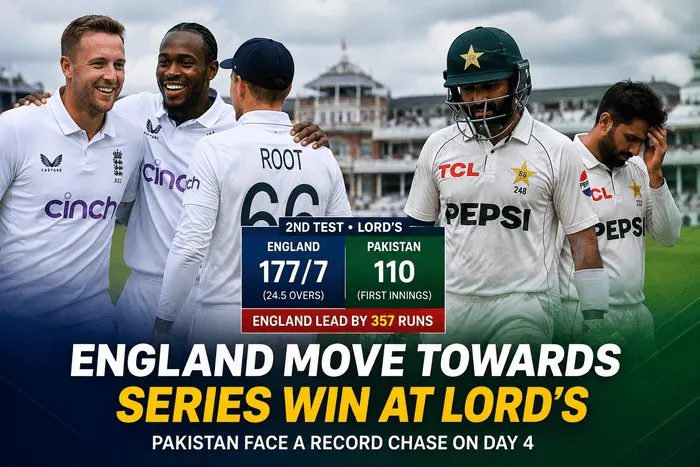
Table of Contents
- England vs Pakistan 2nd Test: Match Situation at Lord’s
- How England Took Control After Pakistan’s Collapse
- Ollie Robinson and Jofra Archer Tear Through Pakistan
- Dan Lawrence Keeps England in Command
- Mohammad Abbas Keeps Pakistan Fighting
- Pakistan’s Batting Crisis Deepens
- Lord’s Pitch and Weather Impact
- What Pakistan Need to Do on Day 4
- Key Players to Watch
- Frequently Asked Questions
- Conclusion
England vs Pakistan 2nd Test: Match Situation at Lord’s
England Close In on Win at Lord’s after bowling Pakistan out for 110 and extending their second-innings advantage to 357 runs.
England are firmly in control of the second Test at Lord’s after three rain-affected days. At stumps on Day 3, England had reached 177 for seven in their second innings, leaving Pakistan facing a deficit of 357 runs with only three wickets still standing.
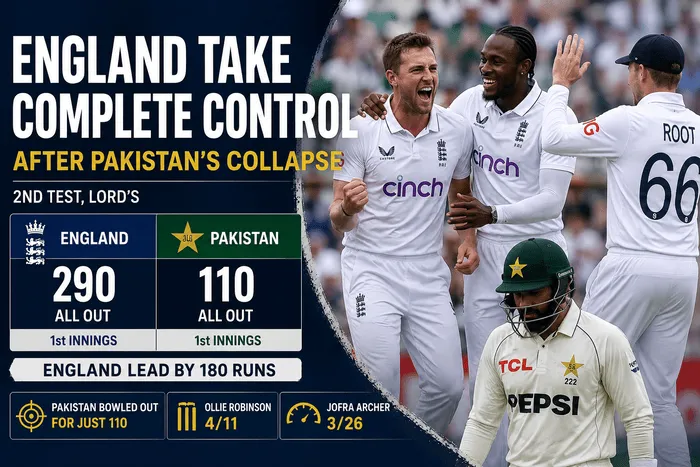
The hosts had already secured a huge advantage earlier in the match by dismissing Pakistan for just 110 in their first innings. Ollie Robinson led the attack with 4 for 11, while Jofra Archer claimed 3 for 26 as Pakistan’s batting collapsed after England had posted 290.
England’s second innings has not been completely straightforward. Pakistan’s bowlers have continued to take wickets, with Mohammad Abbas taking three wickets on Day 3 and Mohammad Ali claiming another two. Abbas now has seven wickets in the match and has remained Pakistan’s biggest threat with the ball.
Despite those breakthroughs, Dan Lawrence’s unbeaten 50 has kept England in command. Lawrence reached his half-century from 66 balls, hitting six fours and two sixes, while Ollie Robinson was unbeaten on two when rain brought the day to an early end.
Lord’s Test Scoreboard
- England 1st Innings: 290 all out
- Pakistan 1st Innings: 110 all out
- England 2nd Innings: 177/7
- Current Lead: 357 runs
- Top Score: Dan Lawrence 50*
- Pakistan’s Best Bowler: Mohammad Abbas
England Have the Advantage, but Time Matters
England have enough runs in hand to put Pakistan under enormous pressure, but the weather has become an important factor. Only 24.5 overs were bowled on Day 3, so England must balance the desire to build an imposing target with the need to leave enough time to take 10 wickets.
How England Took Control After Pakistan’s Collapse
England turned a competitive start into a commanding position after Pakistan collapsed for 110 in their first innings at Lord’s.
Pakistan had made a promising start with the ball on the opening day, but their batting collapse completely changed the direction of the second Test. England were eventually dismissed for 290 in their first innings, giving Pakistan a realistic opportunity to stay in the contest.
Instead, Pakistan’s batting failed to deal with England’s pace attack. They were bowled out for just 110 in 47.2 overs, handing England a first-innings advantage of 180 runs.
Ollie Robinson was the outstanding bowler, finishing with 4 for 11 from 13 overs. Jofra Archer added 3 for 26, while Josh Tongue claimed two wickets as England repeatedly broke through Pakistan’s batting order.
Pakistan’s last nine wickets fell for only 45 runs. Azan Awais was the only batter to offer substantial resistance, top-scoring with 46, but England’s relentless pressure prevented Pakistan from building a competitive first-innings total.
Pakistan’s First-Innings Collapse
- Total: 110 all out
- Top Score: Azan Awais — 46
- Last Nine Wickets: 45 runs
- Overs: 47.2
- Deficit: 180 runs
The Turning Point
Pakistan’s collapse was the decisive moment of the Test. England’s 180-run first-innings lead allowed them to bat again without the pressure of setting a target from scratch. Once that advantage was established, Pakistan were forced to chase the game rather than control it.
Ollie Robinson and Jofra Archer Tear Through Pakistan
England’s pace attack exposed Pakistan’s batting weaknesses and turned a competitive first innings into a major advantage for the hosts.
England’s biggest advantage at Lord’s has been the quality and variety of their pace attack. Once Pakistan began losing wickets, Ollie Robinson and Jofra Archer kept the pressure on and prevented the visitors from building meaningful partnerships.
Robinson produced the standout figures of the innings, finishing with 4 for 11 from 13 overs. His accuracy and ability to maintain pressure outside the off stump made scoring difficult, while regular wickets kept Pakistan’s lower order exposed.
Jofra Archer provided the extra pace and aggression, taking 3 for 26. His ability to attack the batters with pace complemented Robinson’s control and gave England two contrasting threats throughout the innings.
Josh Tongue also played an important supporting role with two wickets, ensuring Pakistan never found the sustained partnership they needed. The combined effort resulted in Pakistan being dismissed for just 110.
England’s Pace Attack
- Ollie Robinson: 4 wickets for 11 runs
- Jofra Archer: 3 wickets for 26 runs
- Josh Tongue: 2 wickets
- Main Strength: Pressure through accuracy and pace
- Result: Pakistan bowled out for 110
Pace Made the Difference
England’s seamers did not allow Pakistan’s middle and lower order to settle. Robinson’s control and Archer’s pace created a difficult combination, while Tongue’s contribution ensured the pressure was maintained from both ends. It was the spell of bowling that gave England the platform to take complete control of the Test.
Dan Lawrence Keeps England in Command
Dan Lawrence produced a composed unbeaten half-century to keep England moving forward on a difficult, rain-affected day at Lord’s.
Dan Lawrence emerged as England’s key batter on Day 3, producing an unbeaten 50 as the hosts extended their overall lead to 357 runs. England resumed at 81 for three after Pakistan had been dismissed for 110, but the conditions remained difficult for batting.
Pakistan’s bowlers found movement and uneven bounce, with Mohammad Abbas particularly effective. Abbas dismissed Emilio Gay and Harry Brook before Pakistan removed Jamie Smith and Gus Atkinson. Lawrence, however, refused to allow the pressure to completely dictate the tempo of his innings.
The England batter mixed patience with controlled aggression. He reached his half-century from 66 balls, striking six fours and two sixes. His willingness to attack when bowlers missed their lengths helped England continue adding runs despite regular interruptions.
The innings was particularly significant because Lawrence has returned to the England Test side after a two-year absence. He has also scored a half-century in the series opener at Headingley, making his second fifty another positive sign for England’s reshaped batting order.
Lawrence’s Impact
- Score: 50 not out
- Strike: 66 balls
- Boundaries: 6 fours and 2 sixes
- Role: Stabilized England after quick wickets
- Series: Second half-century of the series
A Timely Second Chance
Lawrence’s return is becoming one of the positive stories of England’s series. His ability to combine composure with attacking intent has given the middle order another dependable option, while his off-spin also provides an additional bowling option when conditions require it.
Mohammad Abbas Keeps Pakistan Fighting
Mohammad Abbas has been Pakistan’s most consistent threat with the ball, continuing to trouble England despite the visitors’ difficult position at Lord’s.
While Pakistan’s batting collapse has put them under enormous pressure, Mohammad Abbas has continued to give the visitors something to fight with. The experienced seamer has taken seven wickets in the match and remains Pakistan’s biggest threat with the ball.
Abbas was particularly effective during England’s second innings. He removed Emilio Gay and Harry Brook and later returned to dismiss Gus Atkinson, preventing England from turning their large first-innings advantage into an even more imposing lead without losing wickets.
His ability to maintain a probing line has been valuable in conditions where the ball has moved around. Abbas has repeatedly forced England’s batters to play, creating pressure even when Pakistan have struggled to make the most of their opportunities at the other end.
The problem for Pakistan is that Abbas needs support. England’s batting depth means one effective bowler is unlikely to be enough to prevent the hosts from setting a huge fourth-innings target.
Abbas’ Match Impact
- Total Wickets: 7 in the match
- Key Dismissals: Emilio Gay and Harry Brook
- Day 3: Continued taking wickets
- Strength: Accuracy and movement
- Pakistan Need: Support from the other bowlers
Pakistan Need More From the Attack
Abbas has done his part by repeatedly breaking England’s partnerships, but Pakistan need collective bowling pressure. If the remaining England wickets fall quickly, Pakistan could at least gain a small advantage from the time available for their chase. Otherwise, the deficit may simply become too large to overcome.
Pakistan’s Batting Crisis Deepens
Pakistan’s biggest problem at Lord’s has been their batting, with another collapse leaving them facing a huge fourth-innings challenge.
Pakistan’s batting has become the biggest concern of the England series. After struggling to post substantial totals in the first Test, they were dismissed for just 110 in their first innings at Lord’s, leaving England with a 180-run advantage.
The collapse was particularly damaging because Pakistan had already shown signs of vulnerability at Headingley. Their first-innings scores in the series have repeatedly left their bowlers with little margin for error, and England have been able to capitalize on those opportunities.
At Lord’s, Azan Awais was Pakistan’s top scorer with 46, but there was very little support around him. Once England’s seamers began taking regular wickets, Pakistan struggled to build partnerships and were eventually bowled out in only 37.2 overs.
The situation becomes even more difficult because Pakistan are now likely to face a fourth-innings target comfortably above 350. Their previous performances suggest that simply surviving England’s pace attack for long periods will be a major challenge.
Pakistan’s Batting Concerns
- Top Score: Azan Awais — 46
- First Innings: 110 all out
- Main Issue: Partnerships have been difficult to build
- Pressure: England’s pace attack
- Fourth Innings: Potentially a huge chase
Pakistan Need a Major Batting Response
Pakistan’s only realistic route back into the match is a vastly improved batting performance. Their bowlers have shown that they can trouble England, but another collapse would allow England to close out the Test and move 2–0 ahead in the three-match series.
Lord’s Pitch and Weather Impact
England have the advantage at Lord’s, but rain and lost playing time could become Pakistan’s biggest source of hope in the remaining stages of the Test.
The conditions at Lord’s have played a significant role throughout the second Test. Rain delayed the start on multiple days, while bad light also brought early finishes. Day 3 was particularly frustrating, with only 24.5 overs possible before prolonged rain ended play.
The surface has also offered enough assistance to the seamers to make batting demanding. Pakistan’s fast bowlers have found movement, while England’s attack used accuracy, pace and pressure to dismiss Pakistan for 110 in the first innings.
England’s second innings has again shown that batting is possible when players settle. Dan Lawrence reached an unbeaten 50 from 66 balls, but Pakistan’s bowlers continued to take wickets whenever they maintained disciplined lines.
With England already 357 runs ahead and only three wickets remaining, the weather is now arguably more important than the pitch itself. England need enough time to finish their innings and then bowl Pakistan out, while every lost session reduces the pressure they can apply in the fourth innings.
Conditions to Watch
- Rain: Major interruptions have already affected the Test.
- Bad Light: Has contributed to early finishes.
- Seam: Fast bowlers have found assistance.
- Batting: Settled batters can still score.
- Time: England need enough overs to take 10 wickets.
Weather Is Pakistan’s Biggest Hope
On cricketing terms, England have the advantage. The only realistic factor that can significantly reduce that advantage is lost playing time. If further rain removes large portions of the remaining schedule, Pakistan could benefit from a match that runs out of time before England can complete the victory.
What Pakistan Need to Do on Day 4
Pakistan face an enormous challenge on Day 4, while England must decide how quickly to finish their innings and maximize the time available to take 10 wickets.
Pakistan’s first priority on Day 4 will be to finish England’s second innings as quickly as possible. England resumed their position with a 357-run lead and three wickets remaining, meaning Pakistan need early breakthroughs if they are to keep the target within any realistic range.
Mohammad Abbas remains Pakistan’s most important weapon. He has already taken seven wickets in the match and has shown that he can trouble England’s batters when he maintains a consistent line and length. Pakistan will need similar pressure from the other end.
Once England declare or are bowled out, Pakistan will face the much bigger challenge of batting through a potentially long fourth innings. Their first-innings collapse to 110 showed how difficult the conditions can be against England’s pace attack.
Pakistan’s batters cannot afford another aggressive collapse. They will need to value their wickets, build partnerships and make England work for every breakthrough. Even if a victory is unrealistic, a strong fourth-innings resistance could save the Test and deny England a 2–0 series lead.
England’s calculation will be equally important. With a massive advantage already secured, Ben Stokes’ side must balance adding runs with leaving enough time to dismiss Pakistan. Further weather interruptions could make that decision even more significant.
Pakistan’s Day 4 Priorities
- Early Wickets: Remove England’s final three batters quickly.
- Abbas: Continue leading the bowling attack.
- Batting: Build long partnerships in the fourth innings.
- Patience: Avoid another early collapse.
- Weather: Hope for further interruptions if England cannot finish the game.
England’s Biggest Decision
England do not need to chase an unnecessarily large lead. Their advantage is already enormous. The key decision will be choosing the right moment to declare or accelerate the final part of the innings so they have maximum time to attack Pakistan before the weather or a stubborn fourth-innings resistance can intervene.
Key Players to Watch
England’s pace attack and Pakistan’s leading wicket-taker are likely to remain central to the outcome at Lord’s.
Ollie Robinson — England
Ollie Robinson has been one of England’s standout performers with the ball. His first-innings figures of 4 for 11 played a major role in Pakistan’s collapse for 110, and his accuracy has consistently created pressure.
With Pakistan likely to face another difficult batting assignment, Robinson’s ability to maintain a testing line will remain a major factor.
Jofra Archer — England
Jofra Archer adds a different threat to England’s attack through raw pace. His 3 for 26 in Pakistan’s first innings helped England prevent the visitors from establishing partnerships.
Archer’s pace could become especially important when Pakistan begin their fourth-innings chase, as England look to exploit pressure and force mistakes.
Dan Lawrence — England
Dan Lawrence has provided England with valuable stability in the second innings. His unbeaten 50 from 66 balls helped the hosts continue extending their lead despite Pakistan taking regular wickets.
Mohammad Abbas — Pakistan
Mohammad Abbas has been Pakistan’s most effective bowler in the match, taking seven wickets so far. His control and movement have repeatedly troubled England’s batters.
Pakistan will need Abbas to remain effective if they are to finish England’s innings quickly and create any possibility of resisting the hosts’ enormous advantage.
The Battle to Watch
The most important contest will be England’s pace attack against Pakistan’s fourth-innings batting. Robinson and Archer have already demonstrated their ability to exploit the conditions, while Abbas remains Pakistan’s best hope of giving his team enough time to mount a resistance.
Frequently Asked Questions
Key questions about the England vs Pakistan 2nd Test at Lord’s, including the current score, leading performers and Day 4 outlook.
England were 177 for seven at the end of Day 3, giving them a 357-run lead after Pakistan were bowled out for 110 in their first innings.
Pakistan were bowled out for 110 in 47.2 overs. Azan Awais was their top scorer with 46 runs.
Ollie Robinson was England’s leading wicket-taker with four wickets for 11 runs, while Jofra Archer claimed three wickets for 26 runs. Josh Tongue also took two wickets.
Mohammad Abbas has been Pakistan’s standout bowler, taking seven wickets in the match and continuing to trouble England’s batters in the second innings.
Dan Lawrence scored an unbeaten 50 from 66 balls, including six fours and two sixes, to help England extend their lead despite losing wickets.
Pakistan face a very difficult task because England already lead by 357 runs with three wickets remaining. Their best chance is to finish England’s innings quickly and then produce a much stronger fourth-innings batting performance. Further weather interruptions could also reduce the time available to England.
England vs Pakistan 2nd Test: Conclusion
England have established a commanding position at Lord’s, but Pakistan still have a narrow route to survival if they can exploit the remaining time and produce a major batting response.
England go into the next stage of the second Test with a substantial advantage. Pakistan were bowled out for 110 in their first innings, leaving England with a 180-run lead before the hosts extended their advantage to 357 runs in the second innings.
The performances of Ollie Robinson, Jofra Archer and Dan Lawrence have been among the major positives for England. Robinson and Archer dismantled Pakistan’s first innings, while Lawrence’s unbeaten half-century helped England continue building their lead despite Pakistan taking regular wickets.
Pakistan’s best hope now rests with their bowling attack finishing England’s innings quickly and their batters producing a much stronger fourth-innings effort. Mohammad Abbas has already shown that he can trouble England, but Pakistan will need contributions from across the team.
The weather remains another important factor. With rain already reducing playing time at Lord’s, England must balance adding more runs with ensuring enough overs remain to take all 10 Pakistan wickets.
Match outlook: England are in a commanding position and are strongly placed to take a 2–0 lead in the three-match series. Pakistan need an exceptional bowling and batting response, while further weather interruptions could be their biggest advantage.