
ICC Format Change: Major Changes Announced for ODI & T20 World Cup Formats
The International Cricket Council (ICC) has unveiled significant changes to the formats of the 2027 ODI World Cup and the 2028 T20 World Cup. The updated structure introduces new stages, revised qualification pathways and a stronger focus on delivering more competitive and meaningful matches for fans around the world.
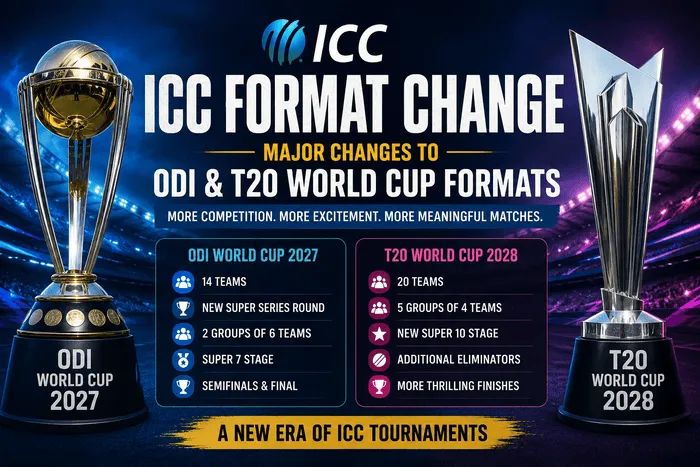
Table of Contents
- Overview of the ICC Format Change
- Why Did ICC Change the Tournament Format?
- New ODI World Cup 2027 Format Explained
- New T20 World Cup 2028 Format Explained
- Qualification Pathway and Team Structure
- How the New Format Will Impact International Cricket
- Advantages and Challenges of the New Format
- Expert Reactions and Fan Opinions
- Frequently Asked Questions
- Final Verdict
Overview of the ICC Format Change
The International Cricket Council (ICC) has announced significant changes to the formats of its flagship men’s tournaments, aiming to make global competitions more competitive, engaging and meaningful. The revised structures will come into effect with the 2027 ICC Men’s Cricket World Cup and the 2028 ICC Men’s T20 World Cup.
The latest ICC Format Change represents one of the biggest updates to international cricket tournaments in recent years. Instead of simply expanding the number of participating teams, the ICC has introduced new competition stages that are designed to increase the importance of every match while providing fans with more high-quality contests between the world’s leading cricket nations.
Under the new structure, the 2027 ODI World Cup will feature an additional qualification stage known as the Super Series, followed by group-stage matches and a newly introduced Super 7 phase before the knockout rounds. Similarly, the 2028 T20 World Cup will adopt a revised tournament format featuring five groups and a Super 10 stage to determine the semifinalists.
According to the ICC, these changes are intended to create more meaningful fixtures throughout the tournament, reward consistent performances and improve the overall viewing experience for cricket fans worldwide. The governing body also believes that the revised qualification pathway will strengthen competition among Full Members and Associate nations while maintaining the prestige of its global events.
While many cricket experts have welcomed the effort to modernize ICC tournaments, the announcement has also generated debate among players, administrators and supporters regarding qualification opportunities, scheduling and the balance between commercial interests and competitive fairness. As a result, the new tournament formats have quickly become one of the most discussed topics in international cricket.
Why Did ICC Change the Tournament Format?
The ICC believes that modern international cricket tournaments should offer greater competitiveness, more meaningful matches and improved opportunities for teams to earn their place in the knockout stages. The latest format changes are designed to achieve these objectives while keeping global events exciting for players, broadcasters and fans alike.
Over the past decade, ICC tournaments have expanded in size as more nations have qualified for global events. While expansion has helped grow the game internationally, it has also created scheduling challenges and occasionally produced one-sided matches during the opening stages. The ICC’s revised tournament structure aims to strike a better balance between inclusivity and competitive cricket.
One of the biggest motivations behind the ICC Format Change is ensuring that every match carries greater significance. By introducing the Super Series, Super 7 and Super 10 stages, teams will continue competing against opponents of similar quality after the initial group phase, reducing the number of low-impact fixtures and increasing the importance of each result.
Another important objective is to provide more high-profile contests between the world’s leading cricket nations. Fans can expect additional matches involving top-ranked teams during the later stages of the tournament, creating stronger rivalries, better television audiences and a more engaging experience throughout the competition.
The ICC has also revised qualification pathways to ensure that Associate nations continue receiving opportunities to compete on the global stage while rewarding consistent performances from Full Member teams. The governing body believes this approach will encourage long-term development across international cricket without compromising the overall quality of the World Cup.
From a commercial perspective, the updated format allows broadcasters and tournament organizers to schedule more marquee fixtures, improving global viewership and increasing fan engagement across digital platforms. At the same time, the ICC has emphasized that sporting merit remains central to the qualification process and progression through each stage of the tournament.
Overall, the revised tournament structure reflects the ICC’s long-term vision of making its flagship events more competitive, entertaining and sustainable while continuing to support the global growth of cricket.
New ODI World Cup 2027 Format Explained
The ICC Men’s Cricket World Cup 2027 will introduce a refreshed competition structure featuring multiple stages designed to keep the tournament competitive from the opening match through to the final. The revised format rewards consistency while creating more high-quality contests between the world’s leading cricket teams.
The 2027 ODI World Cup will be jointly hosted by South Africa, Zimbabwe and Namibia, marking the first time that Namibia will co-host cricket’s biggest 50-over tournament. A total of 14 teams will compete for the World Cup trophy under the newly approved ICC competition format.
Unlike previous editions, the tournament will now follow a multi-stage structure instead of relying solely on a single league phase. The ICC believes this approach will ensure that every match has greater significance while reducing the possibility of dead rubbers during the latter stages of the competition.
After the opening group stage, qualified teams will advance to the newly introduced Super Series, where they will carry forward their campaign against other top-performing nations. The best teams from this stage will then progress to the Super 7, creating another round of high-intensity matches before the knockout phase begins.
The semifinalists will be determined based on performances throughout these stages, rewarding teams that consistently perform well against quality opposition rather than relying on a limited number of league matches. The tournament will conclude with the traditional semifinals and final to crown the ODI world champion.
According to the ICC, the revised structure increases the number of meaningful fixtures between leading cricket nations while maintaining opportunities for emerging teams to compete on the global stage. Fans can also expect more blockbuster encounters as stronger teams meet more frequently throughout the tournament.
| Feature | 2027 ODI World Cup |
|---|---|
| Host Nations | South Africa, Zimbabwe & Namibia |
| Total Teams | 14 |
| Group Stage | Initial Round-Robin Groups |
| Second Stage | Super Series |
| Third Stage | Super 7 |
| Knockout Stage | Semi-finals & Final |
New T20 World Cup 2028 Format Explained
The ICC Men’s T20 World Cup 2028 will feature a redesigned tournament structure that aims to deliver more competitive cricket while ensuring every stage of the event remains meaningful. The updated format balances opportunities for emerging nations with additional high-profile clashes between the world’s strongest teams.
Scheduled to be hosted by Australia and New Zealand, the 2028 ICC Men’s T20 World Cup will include 20 participating teams. While the tournament will continue to promote global participation, the competition format has been adjusted to reward consistent performances throughout the event.
The tournament will begin with five groups of four teams. Every team will play the other three sides in its group, with valuable points determining progression to the next phase. This opening stage provides Associate nations with opportunities to compete against Full Member countries while maintaining a balanced schedule.
Following the group stage, the top-performing teams will advance to the newly introduced Super 10 round. Instead of moving directly into the knockout stage, qualified teams will continue competing against other elite nations, ensuring that more matches between top-ranked sides take place before the semifinals.
The Super 10 stage is expected to increase the overall quality of cricket by reducing one-sided knockout qualification scenarios. Every match during this phase will have a direct impact on semifinal qualification, making consistency and net run rate even more important throughout the tournament.
According to the ICC, the revised structure will create a better competitive balance while giving broadcasters and fans additional marquee fixtures featuring cricket’s biggest rivalries. The governing body also believes that the format provides greater clarity for qualification and improves the overall tournament experience.
| Feature | 2028 T20 World Cup |
|---|---|
| Host Nations | Australia & New Zealand |
| Total Teams | 20 |
| Opening Stage | Five Groups of Four Teams |
| Second Stage | Super 10 |
| Knockout Stage | Semi-finals & Final |
| Main Objective | More Competitive and Meaningful Matches |
Qualification Pathway and Team Structure
Alongside the tournament format changes, the ICC has also introduced updated qualification pathways to create a fairer and more competitive route to its global events. The revised system aims to reward consistent performances while continuing to provide opportunities for emerging cricket nations.
Qualification for both the ICC Men’s Cricket World Cup 2027 and the ICC Men’s T20 World Cup 2028 will continue to be determined through a combination of automatic qualification, ICC rankings and global qualifying tournaments. This approach ensures that the strongest teams earn direct entry while Associate Members still have a realistic pathway to compete on the biggest stage.
The ICC has emphasized that expanding the quality of international cricket remains one of its long-term objectives. Rather than relying solely on rankings, the updated qualification system encourages teams to perform consistently across bilateral series, ICC competitions and regional qualification events throughout the qualification cycle.
Associate nations will continue to compete through regional qualifiers before advancing to global qualification tournaments, where they can challenge Full Member nations for remaining World Cup places. This structure provides developing cricket countries with valuable international experience while maintaining the competitive standard expected at ICC events.
Full Member teams are also expected to benefit from the revised pathway, as regular performances across ICC competitions and ranking events will have a greater influence on qualification. The ICC believes this will encourage teams to treat every international fixture as meaningful rather than focusing only on major tournaments.
Overall, the updated qualification framework complements the new tournament formats by ensuring that every participating nation has earned its place through consistent performances, making the World Cups more competitive from the very first match.
| Qualification Component | Purpose |
|---|---|
| Automatic Qualification | Rewards top-performing teams based on ICC qualification criteria. |
| ICC Rankings | Reflects consistency across international competitions. |
| Regional Qualifiers | Provides Associate nations with a pathway to global qualification. |
| Global Qualifiers | Determines the remaining World Cup qualification spots. |
| New Tournament Structure | Ensures only the best-performing teams progress through each stage. |
How the New Format Will Impact International Cricket
The ICC Format Change is expected to influence every aspect of international cricket, from tournament scheduling and qualification to player workloads and fan engagement. While the new structure promises more competitive matches, it also introduces fresh challenges for teams preparing for global events.
One of the most significant outcomes of the revised tournament structure is the increase in high-quality contests between the world’s leading cricket nations. Instead of progressing directly from the opening group stage to the knockout rounds, teams will now face additional challenges through the Super Series, Super 7 and Super 10 phases. This means every victory becomes more valuable, and consistency throughout the tournament will be rewarded.
The updated format is also expected to improve the overall viewing experience. Cricket fans will enjoy more marquee clashes involving top-ranked teams, creating stronger rivalries and reducing the number of low-stakes matches that often occur during lengthy group stages. Broadcasters are also likely to benefit from higher television ratings and increased global interest.
For players and coaching staff, strategic planning will become even more important. Squads will need to maintain peak performance over multiple competitive stages rather than focusing only on qualifying for the semifinals. Rotation policies, workload management and tactical flexibility could play a much bigger role than in previous ICC tournaments.
Associate nations are also expected to gain valuable exposure through the revised qualification pathway. Although reaching the latter stages may become more challenging, regular participation against stronger opposition can accelerate the development of emerging cricket countries and strengthen the global game over the long term.
Overall, the ICC believes these changes will create tournaments that are more competitive, commercially attractive and entertaining while ensuring that the best-performing teams are rewarded for consistency across every stage of the competition.
| Area | Expected Impact |
|---|---|
| Match Competitiveness | More meaningful games throughout the tournament. |
| Fan Experience | Additional high-profile matches and stronger rivalries. |
| Team Strategy | Greater emphasis on consistency and squad management. |
| Associate Nations | Improved qualification opportunities and international exposure. |
| Global Cricket | Enhanced competitiveness and long-term tournament sustainability. |
How the New Format Will Impact International Cricket
The ICC’s latest tournament reforms are expected to reshape international cricket by creating more competitive matches, improving qualification pathways and enhancing the overall experience for players, broadcasters and cricket fans worldwide.
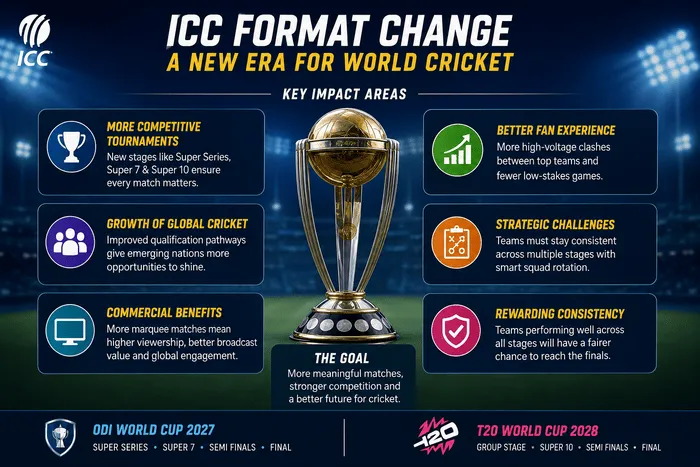
The biggest outcome of the ICC Format Change is the emphasis on rewarding consistency throughout an entire tournament rather than allowing teams to rely on a few good performances. With additional stages such as the Super Series, Super 7 and Super 10, every match carries greater importance, making qualification for the knockout rounds more challenging and more rewarding.
Fans are likely to benefit the most from the revised competition structure. The new format increases the number of high-profile matches between leading cricket nations while reducing low-stakes fixtures. As a result, viewers can expect more intense rivalries, closer contests and greater excitement from the opening match through to the final.
Teams will also need to rethink their tournament strategies. Success will depend on squad depth, player rotation and maintaining consistent performances across multiple stages. Captains and coaching staff will face more tactical decisions as workload management becomes increasingly important during longer tournaments.
Another major advantage is the continued development of Associate nations. The revised qualification pathway provides emerging teams with valuable opportunities to compete against stronger opposition, helping improve the overall standard of international cricket while maintaining a fair qualification process.
From a commercial perspective, the ICC expects stronger television audiences, increased digital engagement and more marquee fixtures that attract global sponsors. These improvements support the governing body’s long-term vision of growing cricket’s worldwide popularity while preserving the competitive integrity of its flagship tournaments.
| Impact Area | Expected Outcome |
|---|---|
| Tournament Quality | More meaningful and competitive matches. |
| Fan Experience | Additional blockbuster clashes and fewer one-sided games. |
| Team Preparation | Greater focus on consistency, squad rotation and strategy. |
| Associate Nations | Improved qualification opportunities and global exposure. |
| Commercial Growth | Higher broadcast value, sponsorship and worldwide engagement. |
Advantages and Challenges of the New ICC Tournament Format
While the ICC Format Change has been widely welcomed for making global tournaments more competitive, it also presents several operational and sporting challenges. Understanding both sides provides a clearer picture of how these reforms could shape the future of international cricket.
One of the biggest advantages of the new tournament structure is the increased number of meaningful matches. The introduction of additional stages such as the Super Series, Super 7 and Super 10 ensures that top teams continue playing high-quality cricket throughout the tournament instead of progressing directly to the knockout rounds.
The revised format also rewards consistency. Teams can no longer depend on a strong start alone, as every stage contributes to their overall campaign. This encourages better planning, stronger squad depth and improved tactical decision-making from coaching staff.
From a fan’s perspective, the updated format promises more blockbuster contests between leading cricket nations. More India vs Australia, England vs Pakistan or South Africa vs New Zealand clashes during the tournament are expected to increase excitement and global television viewership.
However, the expanded competition structure also brings new challenges. Players may face heavier workloads due to additional matches, increasing the importance of squad rotation and fitness management. Tournament scheduling could also become more complex for organizers, broadcasters and participating teams.
Some cricket experts have also questioned whether emerging Associate nations might find it harder to progress into the later stages against stronger Full Member teams. The ICC believes the revised qualification pathway balances competitiveness with opportunities for developing cricket nations, but the long-term impact will become clearer once the new formats are implemented.
| Advantages | Challenges |
|---|---|
| More competitive matches throughout the tournament. | Longer tournaments may increase player workload. |
| Rewards consistency across multiple stages. | More complex scheduling and logistics. |
| Additional marquee matches for fans. | Greater tactical pressure on teams. |
| Higher commercial and broadcast value. | Associate nations face tougher progression. |
| Improved overall tournament quality. | Success depends heavily on squad depth. |
Expert Reactions and Fan Opinions on the ICC Format Change
The ICC’s decision to revamp the formats of the ODI and T20 World Cups has generated widespread discussion across the cricketing world. While many experts have welcomed the move, others believe the success of the new system will ultimately depend on its implementation and long-term impact.
Cricket analysts generally agree that the revised tournament structure places greater emphasis on consistency rather than short bursts of good form. By introducing additional stages before the knockout rounds, the ICC aims to ensure that only the most complete teams reach the semifinals and final.
Former international players have also praised the possibility of seeing more high-profile clashes during ICC events. Instead of waiting until the knockout rounds, fans could witness multiple contests between top-ranked teams throughout the tournament, making every stage more entertaining and competitive.
Broadcasters and commercial partners are expected to benefit as well. More marquee fixtures are likely to attract larger television audiences, stronger digital engagement and increased sponsorship opportunities, helping expand cricket’s global reach.
At the same time, some experts have expressed concerns about the additional workload placed on players. Longer tournaments with more meaningful matches may require better squad rotation, careful workload management and greater emphasis on player fitness to avoid injuries during major ICC events.
Fans have largely reacted positively on social media, with many appreciating the effort to make World Cups more competitive. However, supporters of Associate nations hope the revised qualification pathway continues to provide emerging teams with realistic opportunities to compete against the world’s best sides and grow the game internationally.
Overall, the early reaction suggests that the ICC Format Change has been well received, with most stakeholders agreeing that the reforms have the potential to make future ICC tournaments more exciting, balanced and commercially successful.
| Stakeholder | General Reaction |
|---|---|
| Cricket Experts | Support stronger competition and more meaningful matches. |
| Former Players | Welcome additional high-profile contests. |
| Fans | Positive response to improved tournament excitement. |
| Broadcasters | Expect higher viewership and greater commercial value. |
| Associate Nations | Looking for fair qualification opportunities under the new system. |
Frequently Asked Questions
Find answers to the most common questions about the ICC Format Change, including the new ODI World Cup 2027 and T20 World Cup 2028 formats.
The ICC Format Change introduces new tournament structures for the 2027 ICC Men’s Cricket World Cup and the 2028 ICC Men’s T20 World Cup. The updated formats include additional competition stages to make tournaments more competitive and ensure that every match carries greater importance.
The ICC aims to improve the quality of its flagship tournaments by rewarding consistency, increasing the number of high-profile matches and providing a better experience for players, broadcasters and cricket fans around the world.
The 2027 ICC Men’s Cricket World Cup will feature 14 teams competing through multiple stages before the knockout rounds, giving every match greater significance.
The Super 10 is a newly introduced phase where the best-performing teams from the opening stage compete for qualification to the semifinals, creating more matches between top-ranked nations.
Yes. Associate Member nations will continue to qualify through ICC regional and global qualification pathways, ensuring opportunities to compete in future World Cups.
The revised ODI World Cup format will debut in 2027, while the updated T20 World Cup structure will be implemented for the 2028 tournament following the ICC’s official tournament cycle.
Final Verdict
The ICC Format Change marks a significant step in the evolution of international cricket, introducing more competitive tournaments and a structure designed to reward consistency while enhancing the experience for players and fans alike.
The revised formats for the 2027 ICC Men’s Cricket World Cup and the 2028 ICC Men’s T20 World Cup are aimed at making every match more meaningful. By adding new competition stages, the ICC has reduced the possibility of teams progressing through short bursts of form and instead placed greater importance on sustained performances throughout the tournament.
These changes are also expected to increase the number of marquee contests between the world’s leading cricket nations, creating better viewing experiences for fans while strengthening the commercial value of ICC events. At the same time, the revised qualification pathway continues to provide opportunities for emerging cricket nations to compete on the global stage.
Although the longer tournament structure may present challenges such as increased player workload and more demanding scheduling, the overall objective is to build stronger, fairer and more exciting ICC competitions for the future of the sport.
As the new formats are introduced over the coming years, cricket fans will closely watch how these reforms influence tournament quality, global participation and the continued growth of international cricket.
Stay Updated with 99ExCh
Follow 99ExCh for the latest cricket news, ICC announcements, match previews, expert predictions, playing XI updates and in-depth coverage of every major international tournament.