
India opened the five-match ODI series with a five-wicket win over New Zealand at Eden Park. Virat Kohli scored 74 from 51 balls, while Anshul Kamboj delivered a disciplined bowling spell as rain interruptions brought the DLS method into play.
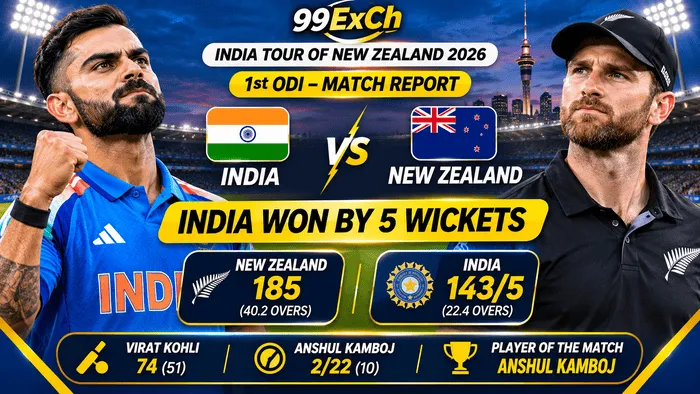
India began their 2026 ODI series against New Zealand with a five-wicket victory at Eden Park, Auckland, on November 4. After dismissing the hosts for 185 in 40.2 overs, India reached 143/5 in 22.4 overs while chasing a revised target of 143 from 32 overs under the Duckworth-Lewis-Stern (DLS) method.
Virat Kohli anchored the chase with 74 from 51 deliveries, building a crucial 113-run second-wicket partnership with captain Shubman Gill, who contributed 37. Earlier, Anshul Kamboj’s economical 2/22 earned him Player of the Match, while Arshdeep Singh and Gurnoor Brar shared seven wickets between them.
The result gives India a 1–0 advantage in the five-match series. New Zealand will now look to respond in the second ODI in Wellington.
India vs New Zealand 1st ODI: Match Summary
India controlled the contest with the ball before Kohli’s innings helped settle a rain-affected chase.
| Match | New Zealand vs India, 1st ODI |
|---|---|
| Series | India Tour of New Zealand 2026 |
| Date | November 4, 2026 |
| Venue | Eden Park, Auckland |
| Toss | India elected to field |
| New Zealand | 185 all out (40.2 overs) |
| India | 143/5 (22.4 overs) |
| DLS Target | 143 runs in 32 overs |
| Result | India won by 5 wickets (DLS method) |
| Player of the Match | Anshul Kamboj (2/22) |
| Series Score | India lead 1–0 |
India vs New Zealand 1st ODI Scorecard
The key batting and bowling contributions from both sides.
New Zealand – 185 All Out (40.2 Overs)
| Player | Runs | Balls |
|---|---|---|
| Tim Seifert | 38 | 43 |
| Blair Tickner | 34 | 23 |
| Glenn Phillips | 30 | 51 |
| Daryl Mitchell | 28 | 41 |
| Jacob Duffy | 15* | 21 |
India Bowling: Arshdeep Singh 4/70, Gurnoor Brar 3/44, Anshul Kamboj 2/22.
India – 143/5 (22.4 Overs)
| Player | Runs | Balls |
|---|---|---|
| Virat Kohli | 74 | 51 |
| Shubman Gill | 37 | 56 |
| Shreyas Iyer | 15 | 13 |
| Naman Dhir | 5* | 3 |
| KL Rahul | 3* | 5 |
New Zealand Bowling: Jacob Duffy 3/49, Nathan Smith 1/21, Kyle Jamieson 1/34.
Result: India won by five wickets under the DLS method.
New Zealand Were Bowled Out for 185
India’s pace attack kept taking wickets and prevented the hosts from building a match-defining total.
Early Wickets Put New Zealand Under Pressure
India chose to field after winning the toss, and their bowlers made the decision count. Arshdeep Singh struck early, removing Will Young and Henry Nicholls. Gurnoor Brar also made an impact by dismissing Tim Seifert, who had provided New Zealand with a useful 38 from 43 balls.
The early breakthroughs meant the hosts could not establish a settled opening platform. Daryl Mitchell tried to steady the innings with 28, but a run-out involving KL Rahul and Rohit Sharma further disrupted New Zealand’s progress.
Phillips and Tickner Offer Late Resistance
Glenn Phillips scored 30 from 51 deliveries, but New Zealand struggled to turn that contribution into a substantial partnership. India’s bowlers continued to apply pressure through the middle overs.
Blair Tickner gave the innings a late lift with 34 from 23 balls, including four sixes. His attacking approach helped New Zealand move towards 185, but Gurnoor Brar ended the resistance by dismissing him.
New Zealand were eventually all out in 40.2 overs. Arshdeep finished with four wickets, Gurnoor took three, and Kamboj added two while conceding just 22 runs in his 10 overs.
Kohli and Gill Put India in Control of the DLS Chase
A crucial second-wicket partnership gave India the platform to manage the revised target.
Early Setback, Then a Strong Response
India’s chase did not begin perfectly. Rohit Sharma was dismissed for a duck by Kyle Jamieson, giving New Zealand an early opening. However, Kohli joined Gill and the pair rebuilt the innings without allowing the required rate to become a major concern.
Gill played a measured supporting role, scoring 37 from 56 balls. Kohli was more aggressive, finding boundaries regularly and putting pressure back on the New Zealand attack.
The 113-Run Partnership Changes the Game
The second-wicket stand between Kohli and Gill was the defining batting partnership of the chase. Their 113-run association took India from an early setback to a position of control.
Kohli struck 13 fours and one six in his 74 off 51 balls. He was eventually caught by Tim Seifert off Jacob Duffy, who also removed Gill, Shreyas Iyer and Axar Patel to finish with three wickets.
Despite those late breakthroughs, India had already done enough. KL Rahul and Naman Dhir remained at the crease as India reached 143/5 in 22.4 overs, completing the chase with 56 balls remaining in the revised innings.
Turning Point: Kohli and Gill’s 113-Run Stand
India’s recovery after losing Rohit Sharma early proved decisive.
The first major challenge for India came when Rohit Sharma fell for a duck. New Zealand had an opportunity to put pressure on the visiting side, but Kohli and Gill responded with a partnership that changed the direction of the chase.
Gill kept the innings stable while Kohli took advantage of scoring opportunities. The pair added 113 runs for the second wicket, allowing India to stay ahead of the asking rate despite the rain interruptions and revised target.
By the time the partnership ended, India were close enough to the target that New Zealand’s late wickets could not turn the contest around.
Key Performances from India vs New Zealand 1st ODI
Contributions with both bat and ball shaped India’s series-opening victory.
Virat Kohli – 74 off 51 Balls
Kohli was India’s standout batter. His 74 came at a strike rate of 145.10 and included 13 fours and one six. More importantly, he scored at a tempo that helped India stay in control after the early loss of Rohit Sharma.
Anshul Kamboj – 2/22 in 10 Overs
Kamboj delivered one of the most disciplined spells of the match. His two wickets and economy of 2.20 helped restrict New Zealand’s scoring options. He was named Player of the Match for his contribution.
Arshdeep Singh – 4/70
Arshdeep led India’s wicket-taking effort with four dismissals. Although New Zealand’s lower order managed a late burst, his breakthroughs prevented the hosts from building a much bigger total.
Gurnoor Brar – 3/44
Gurnoor supported Arshdeep with three wickets, including the dismissal of Tim Seifert and the late removal of Blair Tickner. His contribution was important in keeping New Zealand below 200.
Jacob Duffy – 3/49
Duffy was New Zealand’s most successful bowler. He removed Gill, Kohli and Shreyas Iyer, but the damage from the second-wicket partnership had already left India within reach of victory.
Why India Won the First ODI
India’s victory came from a combination of bowling control and a well-managed chase.
1. Early Wickets Restricted New Zealand
Arshdeep and Gurnoor struck at important stages, preventing the home side from building a strong opening platform.
2. Kamboj Controlled the Middle Overs
Kamboj’s 2/22 was valuable because he combined wicket-taking with tight control over the scoring rate.
3. Kohli Took Responsibility in the Chase
Kohli’s attacking 74 ensured that India’s chase did not become complicated after the first wicket.
4. Gill Provided Stability
Gill’s 37 and his partnership with Kohli allowed India to absorb pressure and manage the revised target sensibly.
India Take a 1–0 Lead in the Five-Match ODI Series
The opening result gives India an early advantage, but New Zealand still have four matches to respond.
India’s win puts them ahead in the five-match ODI series. The visitors will take confidence from their bowling performance and the way Kohli and Gill handled the chase.
New Zealand, meanwhile, will need a stronger batting effort in the next game. The contributions from Seifert, Phillips and Tickner offered some resistance, but the team was unable to build the partnerships required for a competitive total.
The home side will also want a better response from its bowling unit after India’s second-wicket partnership took control of the chase.
What’s Next for India and New Zealand?
Both teams move to Wellington for the second ODI.
The second ODI is scheduled for November 7, 2026, at Wellington Regional Stadium, Wellington. New Zealand will look to level the series on home soil, while India will aim to extend their advantage to 2–0.
India’s bowling combination will be worth watching again, particularly after the impact made by Kamboj, Arshdeep and Gurnoor. New Zealand will need more substantial contributions from its top and middle order to challenge the visitors.
Follow the latest match updates and upcoming coverage on the 99ExCh Cricket News and Match Updates section.
India vs New Zealand 1st ODI FAQs
Quick answers about the first ODI result, score and leading performers.
India defeated New Zealand by five wickets using the DLS method in the first ODI at Eden Park, Auckland, on November 4, 2026. India took a 1–0 lead in the five-match series.
New Zealand were bowled out for 185 in 40.2 overs. Tim Seifert top-scored with 38 runs, while Blair Tickner contributed 34.
India reached 143/5 in 22.4 overs while chasing a revised DLS target of 143 runs in 32 overs.
Anshul Kamboj was named Player of the Match for his disciplined bowling performance of 2 wickets for 22 runs in 10 overs.
Virat Kohli scored 74 runs from 51 balls, including 13 fours and one six. His innings played a major role in India’s successful chase.
The second ODI is scheduled to take place at Wellington Regional Stadium in Wellington on November 7, 2026.
Final Verdict: India Start the ODI Series with a Convincing Win
India earned a five-wicket DLS victory after restricting New Zealand to 185 and then relying on Kohli’s 74 and his 113-run partnership with Gill to control the revised chase. Kamboj’s disciplined bowling earned him Player of the Match, while the result gives India a 1–0 lead ahead of the Wellington fixture.
Sources and Match References
Match result, scorecard and post-match details cross-checked against cricket coverage.
- ICC – New Zealand vs India, 1st ODI
- Cricbuzz – Match Scorecard and Commentary
- Reuters – Kohli’s 74 Leads India to First ODI Win
- CricTracker – Full Scorecard
Match information and statistics are based on the available scorecard and post-match reporting.

1 thought on “India Beat New Zealand by 5 Wickets as Virat Kohli’s 74 Seals Rain-Hit 1st ODI”