
India Bring in Four Uncapped Spinners for Sri Lanka Test Series Preparation
India step up their spin preparation ahead of the 2026 Test series in Sri Lanka
India have brought Harsh Dubey, Shivang Kumar, Tanush Kotian and Vipraj Nigam into their preparation group ahead of the Sri Lanka Test series, giving the batters four different types of spin to face before a challenging assignment in turning conditions.

India’s Sri Lanka Test Preparation: What Happened?
India have strengthened their preparation for the 2026 Sri Lanka Test series by taking four specialist spin net bowlers with the squad, giving the batters exposure to different styles of spin before the two-Test assignment.
India have added an extra layer to their preparation for the upcoming Test series in Sri Lanka. Harsh Dubey, Shivang Kumar, Tanush Kotian and Vipraj Nigam have travelled with the team as specialist net bowlers ahead of a two-match series that begins in Galle on August 15.
The distinction is important. The four spinners have not been added to India’s official Test squad. Instead, they have been brought into the touring setup to help the batters prepare in the nets for the variety of spin they could encounter in Sri Lankan conditions.
The group gives India four different spin profiles during training. Harsh Dubey bowls slow left-arm orthodox, Shivang Kumar offers left-arm wrist-spin, Tanush Kotian is a right-arm off-spinner, and Vipraj Nigam provides right-arm leg-spin.
That variety should allow India’s batters to work against different trajectories, angles, releases and directions of turn rather than repeatedly facing one type of slow bowling during practice. It is a targeted preparation move for a tour where spin is expected to play a significant role.
India have already arrived in Sri Lanka under captain Shubman Gill. The two-Test series starts at Galle on August 15, before the second Test is played later in the month. The squad is also scheduled to play a four-day warm-up match before the Test series begins.
Bringing four specialist net spinners is particularly notable because India’s challenge will not simply be about selecting its own best spin attack. The batting group also needs to prepare for long periods against slow bowling on surfaces that can become increasingly demanding as a Test progresses.
The move therefore provides an early indication of how seriously the team management is treating the spin challenge. Instead of waiting until the first Test to adjust, India are attempting to recreate several different spin matchups during their preparation period.
For readers following the latest cricket news, the key point is that these four players should be viewed as preparation specialists rather than new members of the official Test squad. Their role is to give India’s batters additional high-quality practice before the competitive part of the tour begins.
| Net Bowler | Bowling Style | Role on Sri Lanka Tour |
|---|---|---|
| Harsh Dubey | Slow Left-Arm Orthodox | Specialist Net Bowler |
| Shivang Kumar | Left-Arm Wrist Spin | Specialist Net Bowler |
| Tanush Kotian | Right-Arm Off-Spin | Specialist Net Bowler |
| Vipraj Nigam | Right-Arm Leg-Spin | Specialist Net Bowler |
Why This Development Matters
The selection of four different spin styles suggests that India want their batters to face as much variety as possible before the Tests begin. With the opening match scheduled for Galle, preparing thoroughly against spin could be one of the most important parts of India’s pre-series work.
Important: Harsh Dubey, Shivang Kumar, Tanush Kotian and Vipraj Nigam are travelling as net bowlers for India’s preparation. They should not be described as four new selections in the official Test squad.
Who Are the Four Uncapped Spinners India Have Taken to Sri Lanka?
Harsh Dubey, Shivang Kumar, Tanush Kotian and Vipraj Nigam give India’s batters four contrasting spin styles to work against during preparations for the Sri Lanka Tests.
India’s decision to take four additional spinners to Sri Lanka is primarily about variety. The training group includes slow left-arm orthodox, left-arm wrist-spin, right-arm off-spin and right-arm leg-spin, allowing the batters to prepare against significantly different methods of spin bowling.
Harsh Dubey provides the conventional left-arm orthodox option. That style can challenge right-handed batters with deliveries turning away while also testing their judgment against changes in pace, trajectory and angle.
Shivang Kumar gives the preparation group a less common variation through left-arm wrist-spin. The different release and direction of turn create a distinct challenge compared with conventional left-arm finger spin.
Tanush Kotian brings right-arm off-spin and considerable domestic red-ball experience. His presence gives India’s batters an opportunity to prepare against an orthodox off-spinner capable of maintaining pressure across longer spells, an important requirement when training for Test cricket.
Vipraj Nigam completes the quartet with right-arm leg-spin. Facing a leg-spinner during training gives the batting group another opportunity to work on reading variations, using the crease and deciding when to attack or defend against wrist-spin.
Together, the four bowlers allow India to create a more varied practice environment than would be possible by relying only on the specialist spinners selected in the Test squad. That is the real significance behind the India uncapped spinners Sri Lanka Test series story: the additional players are there to strengthen preparation rather than compete as newly selected members of the official squad.
The arrangement could also help manage the workload of India’s frontline bowlers. Specialist net bowlers can deliver extended spells during practice sessions without requiring the Test attack to shoulder every part of the batting group’s preparation.
More importantly, the batters can repeatedly train against particular styles. If the coaching staff wants a batter to spend an extended session against left-arm spin or wrist-spin, the presence of dedicated net bowlers makes that type of targeted preparation easier.
Harsh Dubey
Slow left-arm orthodox spinner who gives India a conventional left-arm finger-spin option during training.
Shivang Kumar
Left-arm wrist-spinner whose release and direction of turn provide a different challenge from orthodox left-arm spin.
Tanush Kotian
Right-arm off-spinner and experienced domestic all-rounder who can provide sustained red-ball practice in the nets.
Vipraj Nigam
Right-arm leg-spinner who adds another wrist-spin variation to India’s preparation group in Sri Lanka.
Four Bowlers, Four Different Challenges
The key is not simply that India have taken four extra spinners. It is that each bowler offers a different style. That gives the batting group more opportunities to practice reading spin from the hand, adjusting footwork, rotating strike and responding to changes in trajectory and turn before the Test series begins.
Selection Clarification: The four spinners are specialist net bowlers travelling with the Indian team for preparation. They have not been added to India’s official Test squad.
Why India Added Four Spinners to Training Ahead of Sri Lanka Tests
India’s decision is a targeted preparation move designed to expose the batting group to different forms of spin before a Test series where handling slow bowling could be decisive.
Taking four specialist net spinners to Sri Lanka gives India something particularly valuable before the Test series: repetition against different types of slow bowling. Rather than asking the batters to prepare against only one or two spin styles, the team management can create a broader range of challenges during training.
That matters in Sri Lanka because conditions can place a premium on footwork, patience and the ability to read spin early. Batters may have to defend for extended periods before identifying safe scoring opportunities, especially as surfaces begin to wear during a Test.
The opening Test at Galle makes the preparation even more relevant. The venue has a strong association with spin bowling, and matches there can become increasingly demanding for batters as the surface deteriorates. India therefore have a clear incentive to arrive with their methods against spin already tested.
Harsh Dubey, Shivang Kumar, Tanush Kotian and Vipraj Nigam allow the coaching staff to vary those practice scenarios. A batter can move from conventional left-arm orthodox spin to left-arm wrist-spin, then face off-spin or right-arm leg-spin without the session becoming dependent on one bowling style.
The approach can also help India’s right-handed and left-handed batters prepare for different angles. A delivery turning away from one batter may turn into another, while wrist-spin introduces different release points and variations. That forces batters to make repeated decisions about footwork, line and shot selection.
Another advantage is the ability to run longer, more specialized net sessions without placing unnecessary workload on the frontline Test bowlers. Ravindra Jadeja, Kuldeep Yadav and India’s other selected spin options can focus on their own match preparation rather than being required to provide every over needed by the batting group.
This makes the decision more than a simple addition of practice bowlers. The India uncapped spinners Sri Lanka Test series preparation gives the coaching staff greater control over how specific batting situations are recreated before the first Test.
For example, India can ask batters to spend extended periods defending against spin, practice rotating strike when boundaries are difficult to find, or simulate attacking fields where a mistake against turn could immediately create a wicket-taking opportunity.
Those scenarios could be especially useful for players who have limited Test experience in Sri Lanka. Reading the length quickly, committing to forward or backward movement and avoiding indecisive footwork will become important if the pitches provide significant turn.
The preparation also reflects the difference between facing spin in a conventional net session and preparing specifically for Test cricket. In the longer format, surviving pressure matters alongside scoring runs. A spinner who delivers consistent spells can force a batter to maintain concentration and technique for a much longer period.
India’s strategy should therefore be viewed as proactive rather than reactive. The team is attempting to address the expected conditions before the series begins instead of waiting to discover problems during the first Test.
Readers following our latest India cricket news should also keep the distinction between training preparation and squad selection clear. The four net bowlers strengthen India’s practice resources, but they do not automatically become eligible members of the playing XI.
Different Spin Styles
Four contrasting bowling styles allow India’s batters to prepare against finger spin and wrist-spin from both right-arm and left-arm angles.
Galle Preparation
With the opening Test scheduled at Galle, preparing thoroughly for potentially demanding spin conditions becomes a major part of India’s pre-series work.
Targeted Net Sessions
Dedicated net bowlers allow coaches to recreate specific situations and give individual batters extended practice against particular types of spin.
Workload Management
Additional bowlers reduce the need for India’s frontline Test spinners to deliver every practice over required by the batting group.
What India Want to Achieve
The objective is not simply to face more spin in the nets. India want their batters to encounter different releases, angles and directions of turn before the competitive cricket begins. Better preparation should make it easier to identify scoring options while maintaining the defensive discipline required on turning Test pitches.
Key Takeaway: India’s four additional spinners are part of a specialized preparation strategy. Their value lies in creating varied and repeatable spin-bowling scenarios for the batting group ahead of the Sri Lanka Tests.
Harsh Dubey: Left-Arm Orthodox Option for India’s Test Preparation
Harsh Dubey gives India a specialist slow left-arm orthodox option in the nets as the batting group prepares for the challenges expected during the Sri Lanka Test series.
Harsh Dubey’s inclusion among India’s specialist net bowlers gives the team a conventional left-arm spin option during its Sri Lanka preparations. That style is particularly relevant because left-arm orthodox bowling can create different problems for right-handed and left-handed batters on surfaces offering turn.
For right-handers, Dubey can repeatedly challenge the outside edge with deliveries turning away, while changes in trajectory and pace can make committing to the front foot difficult. Against left-handers, the angle and possibility of the ball turning back into the batter create a different set of decisions.
His role is not simply to deliver practice overs. Long spells from a left-arm spinner can help India’s batters work on using their feet, getting to the pitch of the ball and rotating the strike when boundary opportunities are limited.
Dubey also brings substantial domestic red-ball experience into the training setup. He has developed his reputation through first-class cricket, where the ability to maintain control across long spells is especially valuable. That makes him a useful bowler for recreating the sustained pressure batters can face during a Test innings.
The tactical relevance becomes greater with the first Test scheduled at Galle. Sri Lanka have historically been able to use left-arm spin effectively at the venue, and India’s preparation against that type of bowling could become an important part of their work before the series opener.
Prabath Jayasuriya is the obvious threat India will have to prepare for. His ability to maintain accuracy and extract assistance from Galle surfaces means Indian batters may need to spend long periods making disciplined decisions against left-arm orthodox spin.
Dubey cannot perfectly replicate another bowler, nor is that the purpose of bringing him into the nets. His value is in allowing the batting group to repeatedly train against the same broad bowling style and refine the methods they intend to use once the Test series begins.
Within the wider India uncapped spinners Sri Lanka Test series preparation plan, Dubey therefore fills a clearly defined role. Alongside the other three net bowlers, he helps ensure India’s batters do not arrive at Galle without extensive practice against multiple forms of spin.
Bowling Style
Slow left-arm orthodox, providing conventional left-arm finger-spin during India’s training sessions.
Training Value
Dubey can help batters work on footwork, strike rotation and defensive methods against sustained left-arm spin.
Why It Matters at Galle
Preparing against left-arm orthodox bowling is particularly relevant before facing a Sri Lankan attack that can use spin aggressively in home conditions.
Harsh Dubey’s Role in the Nets
Dubey gives India a repeatable left-arm orthodox challenge during practice. The objective will be to help the batters develop clear methods against turn rather than attempting to imitate one specific Sri Lankan bowler.
Role Clarification: Harsh Dubey is travelling as a specialist net bowler for India’s preparation and has not been added to the official Test squad.
Shivang Kumar: Left-Arm Wrist-Spin Challenge for India
Shivang Kumar adds an unusual left-arm wrist-spin option to India’s training group, giving the batters another variation to prepare against before the Sri Lanka Tests.
Shivang Kumar brings a different dimension to India’s preparation because left-arm wrist-spin is significantly different from conventional left-arm orthodox bowling. His release, angles and direction of turn give the batting group another problem to solve during practice.
That distinction is one of the main reasons India’s four-net-bowler strategy is useful. Harsh Dubey can provide orthodox left-arm spin, while Shivang allows the same batters to immediately switch their methods and judgment against wrist-spin.
Facing wrist-spin also tests a batter’s ability to read the ball from the hand. Picking the variation early, judging length quickly and committing to the correct footwork become particularly important when the surface offers assistance.
For India’s batters, these sessions can be used to practice more than defensive technique. They can also work on rotating strike, using the crease and identifying safer attacking options against a bowler capable of turning the ball in different directions.
Shivang’s inclusion therefore fits naturally into the wider India uncapped spinners Sri Lanka Test series preparation. The objective is to expose the batting group to as many different spin profiles as possible before the first Test rather than relying on a narrow range of practice bowling.
As with the other additional spinners, his presence should be understood as part of India’s preparation strategy. Shivang is travelling as a specialist net bowler and has not been added to the official Test squad.
Bowling Style
Left-arm wrist-spin, giving India’s batters a different release and turning angle from conventional left-arm orthodox bowling.
Main Training Benefit
His bowling can test how quickly batters read variations, adjust their footwork and make decisions against wrist-spin.
Preparation Role
Shivang expands the variety available in India’s nets and helps create more specialized spin-focused practice sessions.
Why Shivang Kumar Adds Useful Variety
The value of Shivang’s presence is the contrast he creates. Moving between orthodox left-arm spin and left-arm wrist-spin during training forces India’s batters to continually adjust their reading of length, turn and release instead of becoming comfortable against one bowling style.
Tanush Kotian: Experienced Domestic All-Rounder in India’s Training Group
Tanush Kotian brings right-arm off-spin and substantial first-class experience to India’s preparation group ahead of the Test series in Sri Lanka.
Tanush Kotian is one of the more experienced red-ball players among the four specialist net spinners travelling with India. The Mumbai all-rounder bowls right-arm off-spin and has built a strong domestic reputation through his ability to contribute with both ball and bat.
His off-spin gives India’s batters another conventional but important challenge in training. Against left-handed batters in particular, an off-spinner can attack with the ball turning away, while right-handers must manage deliveries coming into them along with changes in pace and trajectory.
Kotian’s first-class background also makes him useful for Test-specific preparation. Red-ball training requires more than facing a few attacking deliveries. Batters may need to spend long periods against a bowler capable of maintaining a consistent line, building pressure and repeatedly testing defensive technique.
According to reports surrounding India’s Sri Lanka preparation, Kotian had taken more than 130 first-class wickets before this tour while also scoring more than 2,000 runs. That all-round record underlines the amount of domestic red-ball cricket he brings into the training environment.
His presence complements the other spin styles available to India. Harsh Dubey provides slow left-arm orthodox bowling, Shivang Kumar offers left-arm wrist-spin and Vipraj Nigam brings right-arm leg-spin. Kotian fills the right-arm off-spin role within that group.
That variety is central to India’s approach. As part of the wider India uncapped spinners Sri Lanka Test series preparation, Kotian can help the batting group work specifically on methods against off-spin before moving immediately to a completely different type of slow bowling in the same session.
For batters, the objective will be to develop clear scoring and defensive options. Using the feet, rotating the strike and avoiding prolonged periods of dot-ball pressure could become particularly important if Sri Lanka are able to control the tempo of an innings through spin.
Bowling Style
Right-arm off-spin, adding a traditional finger-spin option to India’s varied group of specialist net bowlers.
Red-Ball Experience
Kotian’s substantial first-class experience makes him well suited to delivering the longer, controlled spells required for Test-match preparation.
All-Round Background
His domestic record includes meaningful contributions with both bat and ball, making him one of the more established players in the four-man training group.
Why Tanush Kotian Is Useful for India’s Preparation
Kotian’s value comes from combining conventional off-spin with significant first-class experience. He can provide sustained red-ball spells in the nets and help India’s batters rehearse the patience, footwork and strike rotation required when an off-spinner is able to settle into a long spell.
Role Clarification: Tanush Kotian is part of India’s specialist net-bowling group for the Sri Lanka preparation period. His presence should not be confused with a new selection in the official Test squad.
Vipraj Nigam: Leg-Spin Option for India’s Sri Lanka Test Preparation
Vipraj Nigam completes India’s four-man specialist net-bowling group by providing right-arm leg-spin, adding another wrist-spin challenge for the batters before the Sri Lanka Tests.
Vipraj Nigam gives India’s training group a right-arm leg-spin option, completing the range of spin styles available during the team’s preparation in Sri Lanka. His wrist-spin provides a different challenge from the finger-spin of Harsh Dubey and Tanush Kotian.
Leg-spin can test a batter’s ability to read the ball from the hand and make quick decisions about length. On a surface offering turn, uncertainty over the direction and amount of movement can make footwork particularly important.
Nigam’s presence allows India’s batters to practice those decisions repeatedly before the Test series begins. They can work on getting forward decisively, using the depth of the crease when the ball is shorter and identifying opportunities to rotate the strike rather than becoming trapped in a defensive pattern.
He also brings recent experience in Sri Lankan conditions. That familiarity adds value to his role as a net bowler because the purpose of the training group is not simply to increase the number of deliveries available in practice, but to make India’s preparation more relevant to the conditions they are about to face.
Within the wider India uncapped spinners Sri Lanka Test series preparation, Nigam provides the fourth distinct bowling profile. India can move between left-arm orthodox spin, left-arm wrist-spin, right-arm off-spin and right-arm leg-spin during the same training period.
That constant change can prevent batters from becoming too comfortable against one style. It forces them to keep reading the bowler, adjusting their setup and choosing scoring options according to the type of spin they are facing.
Readers following the latest Team India cricket news should again note that Nigam is travelling as a specialist net bowler. His role is centered on preparation rather than a new place in India’s official Test squad.
Bowling Style
Right-arm leg-spin, giving India’s batting group another wrist-spin variation during its Test preparation.
Main Challenge
His leg-spin can test a batter’s ability to read variations, judge length early and make decisive movements against turning deliveries.
Sri Lanka Experience
Recent exposure to Sri Lankan conditions makes Nigam a particularly relevant addition to India’s specialist training group.
What Vipraj Nigam Adds to India’s Nets
Nigam completes the spin-variety strategy. With four different styles available, India’s batters can repeatedly switch between finger spin and wrist-spin from different angles, creating a more demanding preparation environment ahead of the Test series.
Role Clarification: Vipraj Nigam is travelling with India as a specialist net bowler for the Sri Lanka Tests preparation and is not an additional member of the official Test squad.
Why India’s Batting Against Spin Matters
India’s preparation is not only about adapting to Sri Lankan pitches. The batting group also needs clear methods against quality spin if it wants to control long periods of the upcoming Test series.
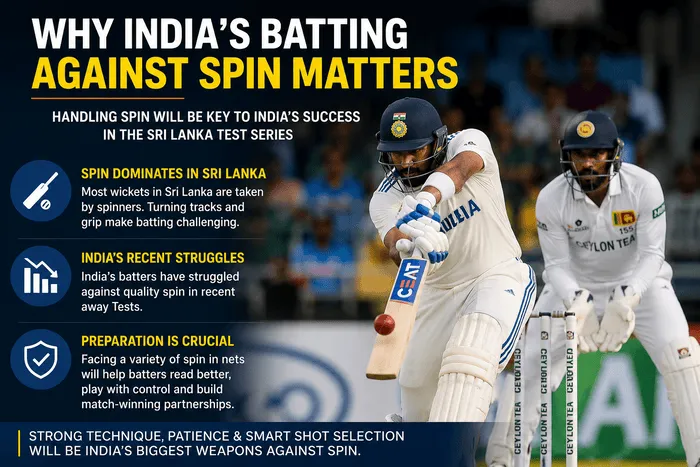
India’s decision to strengthen its net sessions with four different types of spin becomes more significant when viewed against the batting challenge awaiting the team in Sri Lanka. Conditions can reward accurate slow bowling, and a batter who becomes uncertain against turn can quickly find scoring opportunities disappearing.
Recent Test cricket has also provided reminders that India cannot treat playing spin as an automatic strength. Quality spinners who combine accuracy with changes of pace and trajectory have been able to create sustained pressure, particularly when surfaces begin offering greater assistance.
That makes preparation against spin a technical and tactical issue. India’s batters need to judge length early, commit to their footwork and avoid getting caught between playing forward and going back. Indecision can become especially costly when the ball is turning sharply.
Strike rotation will be equally important. On spin-friendly surfaces, boundaries may not always be readily available. Batters who can use the crease, find gaps and turn good deliveries into singles can prevent a spinner from settling into a prolonged period of control.
Patience is another major factor. Test batting against spin is not simply about attacking a bowler before conditions deteriorate. There will be periods when India must absorb pressure, trust its defensive technique and wait for safer scoring opportunities.
This is where the additional net bowlers can make a practical difference. Harsh Dubey, Shivang Kumar, Tanush Kotian and Vipraj Nigam give the batting group repeated exposure to different releases, angles and directions of turn before the competitive cricket begins.
Facing that variety should force batters to continually adjust rather than become comfortable against one type of bowling. The switch from left-arm orthodox spin to wrist-spin or off-spin can test how quickly a batter reads the ball and changes the method being used.
The challenge becomes even more important with the opening Test scheduled at Galle. If the surface begins to deteriorate as the match progresses, batting against spin could become progressively harder and first-innings runs may carry additional value.
Sri Lanka also have bowlers capable of exploiting those conditions. Prabath Jayasuriya’s record at Galle makes him an obvious threat, particularly if India allow him to settle into long, controlled spells and attack with close catchers around the bat.
For India, the objective therefore goes beyond simply surviving spin. The batting group needs a method that combines solid defense with enough strike rotation and controlled aggression to prevent Sri Lanka’s spinners from dictating entire sessions.
Decisive Footwork
India’s batters need to commit clearly forward or backward rather than getting trapped in uncertain positions against turning deliveries.
Strike Rotation
Singles and smart placement can disrupt a spinner’s rhythm and reduce the pressure created by consecutive dot balls.
Reading Variations
Identifying changes in release, pace and direction of turn will become increasingly important as conditions begin assisting spin.
Controlled Aggression
India cannot defend indefinitely. Choosing the right deliveries and areas to attack will be essential to prevent Sri Lanka from controlling the game.
Why the Four Net Spinners Matter
The four-bowler training group gives India an opportunity to rehearse these methods before the Tests begin. The real benefit is not simply facing more spin; it is repeatedly making technical and tactical decisions against four contrasting styles in conditions relevant to the upcoming series.
Key Challenge: India’s success against spin will depend on a combination of decisive footwork, patience, strike rotation and disciplined shot selection rather than one single batting approach.
Galle and the Sri Lankan Spin Challenge
The opening Test at Galle places even greater importance on India’s spin preparation, with the surface capable of becoming increasingly demanding for batters as the match develops.
Galle is one of the major reasons India have placed such a strong emphasis on facing spin before the series. The first Test begins there on August 15, giving the visitors an immediate examination of their technique and decision-making against Sri Lanka’s slow bowlers.
The challenge at Galle is not necessarily identical from the first session to the final day. As the surface wears, spinners can find greater assistance, while variable bounce and increasing turn can make previously comfortable scoring areas much harder to access.
That puts additional value on first-innings batting. If conditions become progressively more difficult, India will want their top and middle order to capitalize whenever the pitch is at its most manageable rather than leaving too much work for later in the match.
Prabath Jayasuriya stands out as one of the biggest threats. The Sri Lankan left-arm spinner has built an impressive record at Galle and understands how to use the surface across long spells. His accuracy can create pressure even before significant turn enters the equation.
That is where India’s work against Harsh Dubey becomes particularly relevant. Dubey is not being asked to replicate Jayasuriya delivery for delivery, but repeated practice against slow left-arm orthodox bowling can help India’s batters refine the broader methods they will need against that style.
India must also be prepared for Sri Lanka to attack through sustained spin rather than isolated wicket-taking deliveries. Close catchers, consecutive dot balls and changing trajectories can force batters into mistakes if they allow pressure to build over several overs.
The answer cannot simply be aggressive batting. Sweeps, use of the feet and other attacking options can disrupt a spinner, but those shots need to be selected according to length and match situation. Poorly controlled aggression on a turning surface can quickly expose the lower order.
Equally, excessive defense carries its own risk. Allowing a quality spinner to bowl repeatedly at the same batter without rotating the strike can make field settings increasingly aggressive and leave very little margin for technical error.
India therefore need a balanced method: defend confidently when required, rotate the strike whenever possible and attack only when the delivery and field provide a calculated opportunity.
The four specialist net spinners give the team an opportunity to rehearse those decisions before arriving in a high-pressure Test situation. That preparation could become particularly valuable if Galle begins offering substantial turn during the second half of the match.
First-Innings Runs
Building a substantial first-innings total could become especially valuable if batting conditions deteriorate as the Test progresses.
Prabath Jayasuriya Threat
Sri Lanka’s left-arm spinner has extensive experience at Galle and can create pressure through accuracy, control and assistance from the surface.
Footwork Against Turn
Batters will need decisive movements and a clear understanding of when to play forward, use the crease or advance down the pitch.
Pressure Management
Strike rotation could be critical to preventing Sri Lanka’s spinners from settling into long spells against one batter.
What Galle Means for India
India’s four-spinner training strategy makes particular sense with Galle hosting the opening Test. The venue can reward disciplined spin bowling, so India’s batters need established methods against turn before the match begins rather than trying to develop them during the Test itself.
Key Factor: The amount of turn will depend on the actual surface and how it develops during the Test. India’s preparation should therefore focus on adaptability rather than assuming every session at Galle will produce identical conditions.
India’s Spin Options in the Test Squad
While four additional spinners are helping in the nets, India already have several slow-bowling options in the official Test squad for the two-match series against Sri Lanka.
The distinction between India’s net bowlers and its Test squad becomes important when assessing the team’s plans for the series. Harsh Dubey, Shivang Kumar, Tanush Kotian and Vipraj Nigam are helping with preparation, while the official squad contains the players India can select in the playing XI.
Ravindra Jadeja gives India their most experienced spin-bowling all-round option. His left-arm orthodox bowling can provide control while attacking the stumps, and his batting adds valuable depth to the lineup. In Sri Lankan conditions, that two-way contribution could make him particularly important.
Kuldeep Yadav provides a completely different threat through left-arm wrist-spin. His ability to beat batters in the air and off the surface gives India a genuine wicket-taking option, particularly if the pitches begin offering substantial turn.
Manav Suthar adds another left-arm spin option to the squad. His presence gives the selectors greater flexibility if they believe conditions justify using an additional specialist spinner during the series.
Saransh Jain also strengthens India’s slow-bowling depth. The off-spinning all-rounder earned his place after strong domestic performances and gives the team another right-arm finger-spin option alongside useful lower-order batting ability.
India therefore have multiple ways to structure their attack. They could choose a more conventional balance of seam and spin, or increase the number of slow bowlers if the surface strongly favors turn. The final combination should depend on the pitch rather than reputation alone.
The four specialist net bowlers complement these options rather than compete directly with them. Their job is to provide India’s batters with additional practice while allowing Jadeja, Kuldeep and the other squad members to manage their own preparation and workloads.
That separation also explains why describing the four net bowlers as new Test squad call-ups would be misleading. They are an important part of the preparation group, but India’s selectable spin resources come from the official touring squad.
| Player | Spin Style | Squad Role |
|---|---|---|
| Ravindra Jadeja | Slow Left-Arm Orthodox | Spin-Bowling All-Rounder |
| Kuldeep Yadav | Left-Arm Wrist Spin | Specialist Wicket-Taking Spinner |
| Manav Suthar | Slow Left-Arm Orthodox | Spin Option |
| Saransh Jain | Right-Arm Off-Spin | Spin-Bowling All-Rounder |
Ravindra Jadeja
Experience, control and batting depth make Jadeja one of India’s most valuable options if the Sri Lankan surfaces favor spin.
Kuldeep Yadav
Kuldeep provides attacking wrist-spin and could become a major wicket-taking threat if the pitches offer significant turn.
Manav Suthar
Suthar gives India additional left-arm spin depth and another possible selection if conditions encourage a spin-heavy attack.
Saransh Jain
Jain offers right-arm off-spin along with lower-order batting, adding another potential all-round combination for the selectors.
How India Could Use Their Spin Depth
India do not need to select every available spinner simply because the series is being played in Sri Lanka. The stronger approach is to assess each surface and build an attack with enough wicket-taking variety while maintaining batting depth and sufficient pace options.
Important Distinction: Ravindra Jadeja, Kuldeep Yadav, Manav Suthar and Saransh Jain are part of India’s Test squad. Harsh Dubey, Shivang Kumar, Tanush Kotian and Vipraj Nigam are specialist net bowlers assisting the team’s preparation.
What This Preparation Could Mean for the Test Series
India’s decision to expand its spin-focused training gives the batting group more opportunities to develop clear methods before facing Sri Lanka in conditions where slow bowling could influence key phases of the series.
Bringing four specialist spin net bowlers to Sri Lanka does not guarantee India success against spin, but it gives the team more control over its preparation. Harsh Dubey, Shivang Kumar, Tanush Kotian and Vipraj Nigam allow the coaching staff to expose batters to contrasting styles before the pressure of the Test series begins.
That preparation could become especially valuable in the opening Test at Galle. If the pitch begins to offer greater turn as the match develops, India’s ability to build a strong first-innings total and manage long spells of spin could have a major influence on the result.
The benefit should also extend beyond technique. Repeated sessions against different types of spin can help batters clarify their individual plans. One player may rely more heavily on using the crease, another may look to advance down the pitch, while others could use sweeps and strike rotation to disrupt the bowler’s rhythm.
Having those methods established before the series is preferable to searching for solutions after wickets begin falling. Test cricket often gives batters very little time to correct a technical or tactical problem once an opposition spinner has identified it.
India’s own spin resources add another dimension to the series. Ravindra Jadeja, Kuldeep Yadav, Manav Suthar and Saransh Jain provide different options if conditions encourage the visitors to build their attack around slow bowling.
That means spin could influence both sides of India’s challenge. The batters must find ways to limit Sri Lanka’s slow bowlers, while India’s own attack needs to exploit the same conditions when the hosts are batting.
The presence of four additional net bowlers can also help protect the workload of the frontline Test attack. India’s selected spinners can focus on their own match preparation while the batting group still receives the volume and variety of practice it requires.
Ultimately, the value of the strategy will be measured by how well India transfer their preparation into match situations. Nets can reproduce bowling styles and specific scenarios, but Test cricket adds scoreboard pressure, aggressive fields and the consequences of every mistake.
India’s decision nevertheless shows a clear understanding of the challenge ahead. Rather than treating reputation against spin as sufficient preparation, the team has created a more specialized training environment for conditions it expects to encounter in Sri Lanka.
Better Preparation Against Variety
Facing four contrasting spin styles gives India’s batters an opportunity to test and refine their methods before the competitive cricket begins.
Clearer Individual Batting Plans
Specialized practice can help each batter determine which defensive, strike-rotation and attacking options are most reliable against different types of spin.
More Flexible Bowling Strategy
India’s official squad contains several spin options, allowing the team management to adjust the attack according to the conditions presented by each Test pitch.
Reduced Practice Workload
Specialist net bowlers can provide extended batting practice without requiring India’s frontline Test spinners to deliver every training over.
Preparation Is Only the First Step
India’s expanded spin preparation should improve the quality and variety of its practice, but execution during the Tests will remain decisive. Batters will still need to read conditions quickly, manage pressure and adapt their methods as surfaces change across five days.
Bottom Line: The four net spinners give India a more specialized preparation environment rather than an automatic advantage. How effectively the batters apply those sessions against Sri Lanka’s attack will determine the real impact of the strategy.
India’s Sri Lanka Test Preparation FAQs
Key questions about India’s four specialist spin net bowlers, their roles and the team’s preparation ahead of the 2026 Test series in Sri Lanka.
Harsh Dubey, Shivang Kumar, Tanush Kotian and Vipraj Nigam are travelling with India as specialist net bowlers for the Test series preparation in Sri Lanka.
No. Harsh Dubey, Shivang Kumar, Tanush Kotian and Vipraj Nigam are specialist net bowlers assisting India’s preparation. They have not been added to the official Test squad.
India want their batters to prepare against different types of spin before the Test series. The four bowlers provide left-arm orthodox spin, left-arm wrist-spin, right-arm off-spin and right-arm leg-spin during training.
Harsh Dubey bowls slow left-arm orthodox spin. His presence gives India’s batters extended practice against conventional left-arm finger-spin before the Sri Lanka Tests.
Shivang Kumar is a left-arm wrist-spinner. His bowling gives India a different release, angle and direction of turn compared with conventional left-arm orthodox spin.
Galle hosts the opening Test and can become increasingly challenging for batting as a match develops. India therefore want their batters to arrive with clear methods against spin rather than adjusting only after the series begins.
India’s official Test squad includes spin options such as Ravindra Jadeja, Kuldeep Yadav, Manav Suthar and Saransh Jain. They are separate from the four specialist net bowlers assisting the team’s preparation.
Final Thoughts on India’s Spin Preparation for Sri Lanka Tests
India’s decision to bring four specialist spin net bowlers to Sri Lanka shows how seriously the team is approaching one of the biggest challenges of the upcoming Test series.
Harsh Dubey, Shivang Kumar, Tanush Kotian and Vipraj Nigam have not been added to India’s official Test squad, but their role during the preparation period could still be valuable. Together, they provide four contrasting spin styles and allow the batting group to work against a wider range of angles, releases and variations.
The strategy becomes particularly relevant with the opening Test at Galle. India’s batters may have to deal with long periods of spin, changing surfaces and a Sri Lankan attack capable of building sustained pressure in familiar conditions.
India therefore need more than a reputation for playing spin well. Decisive footwork, patience, strike rotation and disciplined shot selection will all matter. The additional net bowlers give the team an opportunity to sharpen those methods before the pressure of the Test series begins.
India also have significant spin resources within the official squad. Ravindra Jadeja and Kuldeep Yadav provide experience and wicket-taking ability, while Manav Suthar and Saransh Jain give the team management additional options when selecting an attack according to the conditions.
Ultimately, the four-bowler training plan should be viewed for what it is: targeted preparation rather than four new Test selections. The real test will come when India’s batters have to transfer their work in the nets into runs against Sri Lanka’s spinners under match pressure.
Follow the latest cricket news and Team India updates on 99ExCh as the series approaches and the final playing combinations become clearer.
99ExCh Takeaway
India’s decision to travel with four contrasting specialist net spinners is a deliberate attempt to improve the quality of their preparation. It does not guarantee success against Sri Lanka, but it gives the batting group a broader and more relevant spin challenge before the first Test begins.
Explore 99ExCh
For easier access to 99ExCh on your device, read our 99ExCh App Download guide for complete access and installation information.
New users can also follow our How to Create a 99ExCh ID guide for step-by-step account setup information.