
India vs Sri Lanka 2nd Test: How Colombo Draw Impacts India’s WTC Final Hopes
India remain fifth in the WTC standings after the Colombo draw. Here’s how Sri Lanka’s resistance impacts India’s qualification hopes and remaining Tests.

Table of Contents
- Colombo Draw: What Happened?
- How the Draw Impacts India’s WTC Hopes
- India’s Current WTC Position
- Why India Need Six Wins From Seven Tests
- Sonal Dinusha’s Match-Saving Resistance
- India’s Missed Opportunity After the Follow-On
- India’s Remaining WTC Tests
- India’s WTC Qualification Equation
- Frequently Asked Questions
- Conclusion
Colombo Draw: What Happened?
India dominated most of the Colombo Test but could not force a result after Sri Lanka produced a remarkable final-day resistance.
India looked firmly on course for a second consecutive victory in Sri Lanka after dominating the early stages of the Colombo Test. The visitors made 503 for nine declared, with Devdutt Padikkal and Dhruv Jurel scoring centuries, while Shubman Gill and Rishabh Pant also made important contributions.
Sri Lanka were then bowled out for 290, leaving India with a first-innings lead of 213 runs. India chose to enforce the follow-on, putting Sri Lanka back into the middle with the expectation of completing a series sweep.
That decision appeared to be working when Sri Lanka were reduced to a difficult position late in the match. But Sonal Dinusha produced another outstanding innings and, together with the lower order, frustrated India’s bowlers for much of the final day. Dinusha had already scored 103 in Sri Lanka’s first innings and followed it with an unbeaten 133 in the second.
Sri Lanka eventually declared at 429 for nine with the match heading towards a draw. India could not take the remaining wicket in time, ending the Test without a winner and the two-match series with India ahead 1–0.
Colombo Test at a Glance
- India First Innings: 503/9 declared
- Sri Lanka First Innings: 290 all out
- Follow-On: India enforced it
- Sri Lanka Second Innings: 429/9 declared
- Result: Match drawn
- Series: India won 1–0
A Missed Clean-Sweep Opportunity
The draw does not change the fact that India won the series, but it does change the WTC equation. India were unable to collect the 12 points that a Test victory would have provided, leaving them fifth in the standings with a 51.52% points percentage after the Colombo result.
How the Colombo Draw Impacts India’s WTC Hopes
India won the series 1–0, but the drawn Colombo Test cost them an opportunity to strengthen their position in the World Test Championship race.
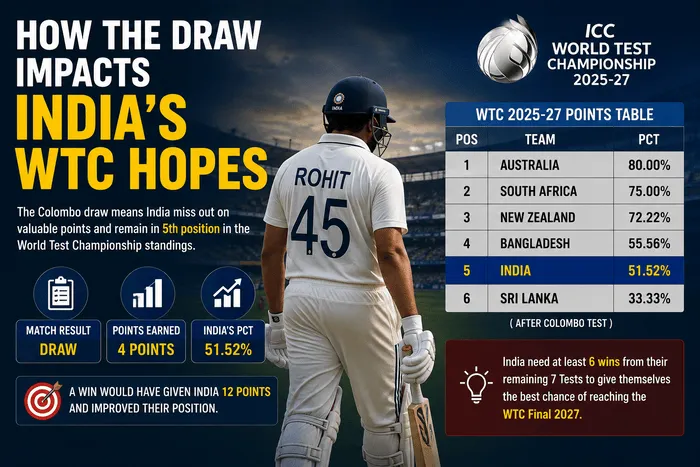
The Colombo draw was a mixed result for India. They completed the two-Test series with a 1–0 victory, but the failure to take the second Test means they missed the chance to collect the full points available from another win.
India remain in the middle of a competitive WTC 2025–27 qualification race. After the Colombo result, India sit fifth with a points percentage of 51.52%. That leaves little room for dropped points during the remainder of their campaign.
The draw also highlights the importance of India’s upcoming assignments. Their remaining schedule includes a challenging away series against New Zealand followed by a five-Test home series against Australia. According to the current qualification projections, India may need to win at least six of their remaining seven Tests to give themselves a strong chance of reaching the 2027 WTC Final.
Why Every Test Matters Now
India are still firmly in the qualification race, but their margin for error has become smaller. A strong run in the remaining seven Tests would put them back in contention, while further draws or defeats could make qualification considerably more difficult. The Colombo result therefore matters less as a series setback and more as a reminder of how valuable every WTC point has become.
India’s Current WTC Position
The Colombo draw leaves India fifth in the World Test Championship standings with 68 points and a 51.52% points percentage.
India remain in fifth place in the WTC 2025–27 standings after the drawn second Test in Colombo. Their current record is five wins, four defeats and two draws from 11 Tests, giving them 68 points and a 51.52% points percentage.
The position shows why the Colombo result matters. India did not fall dramatically down the table, but they missed an opportunity to improve their percentage and move closer to the leading teams. Bangladesh currently occupy fourth place on 55.56%, while New Zealand, South Africa and Australia are positioned above them.
India’s qualification challenge is therefore less about their current fifth position and more about the results they produce from here. The WTC standings are based on points percentage, so winning Tests consistently is crucial as the cycle moves towards its final stages.
WTC Standings Snapshot
- 1. Australia: 80.00%
- 2. South Africa: 75.00%
- 3. New Zealand: 72.22%
- 4. Bangladesh: 55.56%
- 5. India: 51.52%
- 6. Sri Lanka: 33.33%
India Still Have a Path to the Final
Fifth place does not eliminate India from the WTC race. However, the margin for error is now small. Current scenario calculations show that India need a strong finish across their remaining seven Tests, with six wins and one loss taking them to about 64.81% PCT. Even that would not mathematically guarantee a final place because rival results will also matter.
Why India Need Six Wins From Seven Tests
India’s path to the WTC Final has become much tighter, making their remaining seven Tests increasingly important.
The Colombo draw has left India with very little room for error in the remainder of the World Test Championship cycle. India currently have 68 points and a 51.52% points percentage, meaning their qualification hopes depend heavily on winning a large majority of their remaining matches.
Current scenario calculations indicate that India would need to win at least six of their remaining seven Tests to give themselves a strong chance of reaching the 2027 WTC Final. A six-win finish would take India to around 64.81% PCT, although that figure would not automatically guarantee qualification because rival teams will also continue collecting points.
The challenge is particularly significant because India’s remaining schedule includes a difficult away assignment against New Zealand followed by a five-Test home series against Australia. Winning six out of seven would therefore require sustained performance across different conditions and against two strong Test sides.
India’s Remaining Challenge
- Tests Remaining: 7
- New Zealand: Away series
- Australia: Five-Test home series
- Required Run: Around six wins
- Qualification: Depends on India and rival results
Six Wins Is a Target, Not a Guarantee
The six-win benchmark should be viewed as a qualification target rather than a guaranteed route to the final. The WTC uses points percentage to rank teams, so India’s final position will also depend on how the other contenders perform. The clearest strategy for India is therefore simple: maximize wins, minimize dropped points and build a strong finish to the cycle.
Sonal Dinusha’s Match-Saving Resistance
Sonal Dinusha produced a remarkable second-innings century to help Sri Lanka survive India’s follow-on and force a draw in Colombo.
Sonal Dinusha became the central figure in Sri Lanka’s remarkable escape at Colombo. After making 103 in the first innings, the left-hander returned to the crease in the second innings and produced an unbeaten 133 to frustrate India’s bowlers and keep the match alive.
Dinusha’s second-innings century was particularly important because Sri Lanka were batting again after India enforced the follow-on. Rather than allowing the visitors to complete a straightforward victory, he absorbed pressure, built partnerships and steadily moved Sri Lanka towards a position where defeat was no longer inevitable.
His performance also created a rare piece of Test history. Dinusha became only the third player in men’s Test cricket to score a century in both innings of a match after his team was asked to follow on.
Sri Lanka eventually declared at 429 for nine, leaving India without enough time to take the final wicket and complete a series sweep. Dinusha’s unbeaten century was therefore the defining innings of the match and the foundation of Sri Lanka’s successful resistance.
Dinusha’s Historic Match
- First Innings: 103 runs
- Second Innings: 133* runs
- Situation: Sri Lanka followed on
- Second-Innings Total: 429/9 declared
- Impact: India could not force victory
The Innings That Changed the Result
India had created the conditions for a victory by taking a 213-run first-innings lead, but Dinusha’s extraordinary resistance changed the outcome. His 133 not out transformed Sri Lanka from a team facing defeat into a side capable of declaring safely and securing a draw.
India’s Missed Opportunity After the Follow-On
India created a dominant position in Colombo but could not complete the final step after Sri Lanka fought back in the second innings.
India’s decision to enforce the follow-on reflected how strongly they believed they could finish the Test. After making 503 for nine declared and dismissing Sri Lanka for 290, India had a first-innings lead of 213 runs and put the hosts straight back into bat.
The strategy initially gave India a clear opportunity to force a result. Their bowlers had already taken all ten Sri Lankan wickets once, and another successful innings would have allowed India to chase a manageable target. Instead, Sri Lanka’s batters showed considerably greater resistance during the second innings.
The biggest setback came from India’s inability to remove the final wickets quickly enough. Sonal Dinusha’s unbeaten 133 anchored the resistance, while Sri Lanka’s lower order continued to extend the innings. By the time Sri Lanka declared at 429 for nine, the available time had effectively disappeared.
India therefore walked away with a draw despite having dominated the match for long periods. The result is not a failure in the series context—India still won the two-Test series 1–0—but it was a missed opportunity to add another Test victory to their WTC campaign.
Where India Lost the Advantage
- First Innings: India built a 213-run lead.
- Follow-On: India chose to enforce it.
- Resistance: Sri Lanka rebuilt through the second innings.
- Final Total: Sri Lanka reached 429/9 declared.
- Outcome: India could not force the win.
A Valuable Lesson for India
The Colombo result underlines the importance of converting dominant positions into wins in the WTC cycle. India did almost everything required to put themselves ahead, but Sri Lanka’s prolonged resistance meant the visitors had to settle for a draw. With a demanding schedule still ahead, those missed opportunities could become increasingly significant in the qualification race.
India’s Remaining WTC Tests
India still have seven Tests remaining in the current WTC cycle, with challenging assignments against New Zealand and Australia ahead.
India’s WTC campaign now moves into a demanding phase. After the Colombo draw, the team has seven Tests remaining in the 2025–27 cycle. Those matches will determine whether India can recover enough points percentage to challenge for a place in the WTC Final.
The first challenge comes against New Zealand away. Playing Test cricket outside home conditions presents a different challenge, particularly against a side capable of making the most of seam-friendly conditions. India will need consistency from both their batting and bowling units to avoid another costly loss of points.
India will then face Australia in a five-Test home series. The length of that series gives India more opportunities to collect points, but it also means every result will have a substantial effect on their final percentage.
The qualification equation is straightforward in principle: India need to win as many of the remaining seven Tests as possible. Current projections suggest that six victories would put them in a much stronger position, although qualification will ultimately depend on how the other WTC contenders perform.
Remaining WTC Schedule
- New Zealand: Away assignment
- Tests vs New Zealand: 2
- Australia: Five-Test home series
- Total Remaining: 7 Tests
- Qualification Goal: Maximize wins
No Room for Another Major Slip
India’s current position means the remaining schedule cannot be treated as a series of isolated matches. Every Test contributes directly to the final points percentage. A strong run against New Zealand and Australia could transform India’s position, while further dropped points would make the route to the WTC Final increasingly difficult.
India’s WTC Qualification Equation
India remain in contention for the WTC Final, but their route now depends on a strong winning run and the results of the teams around them.
India’s qualification equation is becoming clearer after the Colombo draw. With 68 points and a 51.52% points percentage, India cannot afford to rely on results elsewhere. Their most effective route is to collect as many wins as possible from the seven Tests still available in the cycle.
A scenario of six wins from the remaining seven Tests would take India to approximately 64.81% PCT. That would represent a significant improvement from their current position and would put India firmly back into the qualification conversation.
However, six wins would not automatically guarantee a place in the WTC Final. The championship is decided by points percentage, so India’s final position will also depend on how Australia, South Africa, New Zealand, Bangladesh and other contenders perform in their remaining matches.
The key for India is therefore consistency. The upcoming Tests against New Zealand and Australia will carry considerable weight, and avoiding unnecessary draws or defeats will be crucial if India are to finish the cycle with a competitive percentage.
What India Need
- Win: Maximize victories from seven remaining Tests.
- Avoid: Costly defeats and unnecessary dropped points.
- Benchmark: Six wins would lift India to around 64.81% PCT.
- Watch: Results of competing WTC teams.
- Final Position: Determined by points percentage across the cycle.
India’s Route Is Difficult, Not Closed
The Colombo draw has made the road harder, but India remain very much alive in the WTC race. A dominant finish across the remaining seven Tests can significantly change the standings. The immediate priority is to turn strong performances into wins and build enough points percentage to compete with the leading teams when the cycle reaches its final stages.
Frequently Asked Questions
Key questions about the Colombo draw, India’s WTC position and their path toward the 2027 WTC Final.
The second Test in Colombo ended in a draw. India won the two-Test series 1–0 after winning the opening Test.
India enforced the follow-on after taking a 213-run first-innings lead. Sri Lanka had been dismissed for 290 after India declared at 503 for nine.
India remained fifth in the WTC 2025–27 standings with 68 points and a 51.52% points percentage. The draw meant India missed an opportunity to improve their percentage with another Test victory.
India have seven Tests remaining in the current WTC cycle, including an away assignment against New Zealand and a five-Test home series against Australia.
Current qualification scenarios indicate that six wins from seven would give India a strong chance of reaching the WTC Final. However, it would not guarantee qualification because the final standings also depend on results from other teams.
Sonal Dinusha was the key figure for Sri Lanka. After scoring 103 in the first innings, he made an unbeaten 133 in the second innings to help Sri Lanka reach 429 for nine declared and secure the draw.
India vs Sri Lanka 2nd Test: WTC Impact Conclusion
India won the series in Colombo, but the draw has made their path to the 2027 WTC Final considerably more demanding.
India will leave Sri Lanka with a 1–0 series victory, but the drawn Colombo Test represents a missed opportunity in their World Test Championship campaign. After taking a 213-run first-innings lead and enforcing the follow-on, India were unable to remove Sri Lanka’s final wickets.
Sonal Dinusha’s unbeaten 133 was central to Sri Lanka’s resistance, allowing the hosts to declare at 429 for nine and secure the draw. The result leaves India fifth in the WTC standings with a 51.52% points percentage.
The qualification race is therefore entering a crucial phase. India have seven Tests remaining, including matches against New Zealand and a five-Test home series against Australia. Winning around six of those seven Tests would significantly strengthen their position, although India’s final qualification will also depend on how competing teams perform.
Key takeaway: The Colombo draw has not ended India’s WTC Final hopes, but it has reduced their margin for error. India now need a strong winning run in their remaining Tests to push their points percentage into genuine qualification territory.