
India Women Beat Pakistan by 7 Wickets in Asia Cup 2026 After Pakistan Collapse for 55
India Women delivered another dominant performance at the Women’s Asia Cup 2026, defeating Pakistan Women by seven wickets in Dubai after bowling them out for just 55 runs.
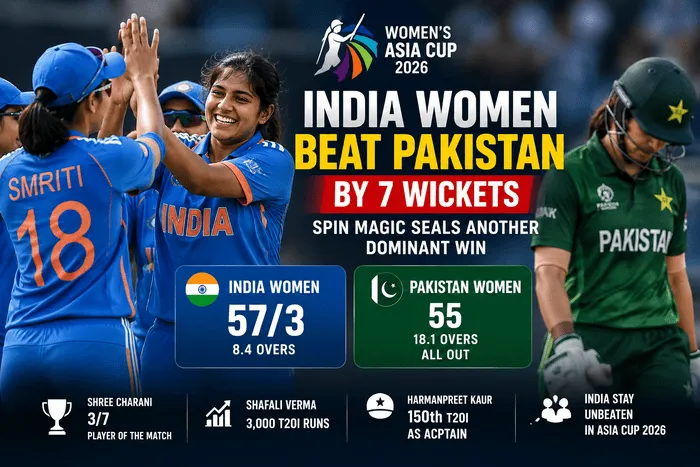
Table of Contents
- Match Summary
- Pakistan Collapse to Their Lowest-Ever T20I Total
- Shree Charani Leads India’s Spin Attack
- India Chase Down 56 in Just 8.4 Overs
- Shafali Verma Reaches 3,000 T20I Runs
- Harmanpreet Kaur Reaches Another Captaincy Milestone
- Fatima Sana Gives Pakistan Something to Take Forward
- India Stay Unbeaten and Top Group A
- Pakistan Face Hong Kong in Their Next Match
- India Still Have Areas to Improve
- Key Records and Numbers From India vs Pakistan
- Conclusion
India Women Beat Pakistan by 7 Wickets: Match Summary
India Women continued their unbeaten run in the Women’s Asia Cup 2026 with a comfortable seven-wicket victory over Pakistan Women at the Dubai International Cricket Stadium. The match was decided largely by India’s disciplined bowling, which reduced Pakistan to just 55 runs before the chase was wrapped up in only 8.4 overs.
Pakistan won the toss and elected to bat first, but the decision did not produce the start they would have wanted. India’s bowlers kept the pressure on throughout the innings, particularly through the middle overs, where Pakistan struggled to rotate the strike and lost wickets at regular intervals.
Shree Charani led the attack with three wickets, while Prema Rawat also picked up three. Deepti Sharma added two more wickets as India’s spin options repeatedly exposed Pakistan’s difficulty against slower bowling. Pakistan eventually folded for 55 in 18.1 overs.
The chase looked straightforward, although Pakistan captain Fatima Sana briefly gave her side some encouragement by removing three of India’s top-order batters. India were 29/3 at one stage, but the target was too small to create sustained pressure.
Harmanpreet Kaur and Deepti Sharma finished the job without taking unnecessary risks. India reached 57/3 in 8.4 overs, sealing a seven-wicket win with plenty of deliveries remaining.
Pakistan Collapse to Their Lowest-Ever T20I Total
Pakistan Women never managed to settle after choosing to bat first against India in the Women’s Asia Cup 2026. What began as a manageable start quickly turned into a major batting collapse, with India’s spinners finding enough assistance to keep the Pakistan batters under constant pressure.
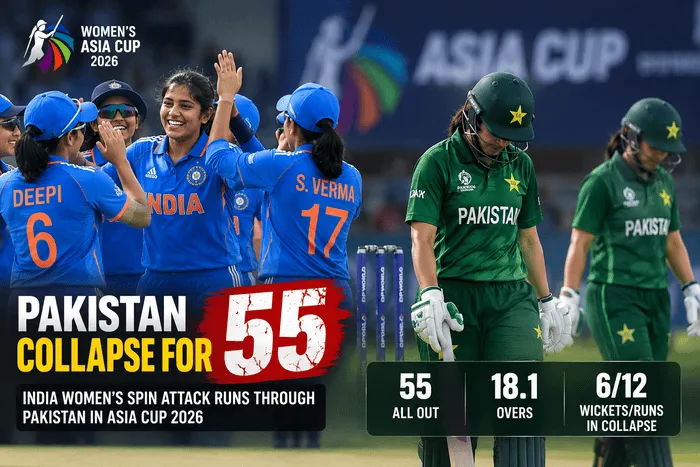
Pakistan were eventually bowled out for just 55 in 18.1 overs. It was their lowest-ever total in Women’s T20I cricket and left India with a target of only 56 runs to win. The lack of partnerships was a major reason behind the collapse, as Pakistan repeatedly lost wickets just when they needed to rebuild.
Muneeba Ali scored 13 from 15 balls, while Shawaal Zulfiqar made 14 from 14. Those were the only two Pakistan batters to reach double figures. Once that pair was dismissed, the innings lost whatever stability it had managed to find.
India’s Spinners Take Complete Control
India’s spin attack was the biggest difference between the two sides. Shree Charani led the way with three wickets, while Prema Rawat also picked up three. Deepti Sharma added two wickets, leaving Pakistan’s middle order with very little room to recover.
Charani’s spell was particularly important during the first major collapse. She dismissed Gull Feroza and Shawaal Zulfiqar in quick succession before adding Ayesha Zafar to her tally. Her accuracy meant Pakistan could not score freely and were forced to take risks to keep the innings moving.
Prema Rawat then continued the pressure by removing Sadaf Shamas, while Deepti Sharma accounted for Pakistan captain Fatima Sana. The wickets kept coming, and Pakistan eventually lost six wickets for only 12 runs.
Pakistan Could Not Build a Partnership
The most damaging part of Pakistan’s innings was the absence of a meaningful partnership. Muneeba Ali and Shawaal Zulfiqar briefly offered resistance, but once they departed, India’s bowlers were able to attack the lower order without allowing the batting side to regain momentum.
Pakistan’s batters also struggled to rotate the strike against India’s slower bowlers. With boundaries difficult to find, the pressure gradually increased. India did not need to chase wickets recklessly; instead, they maintained tight lines and waited for Pakistan to make mistakes.
Tuba Hassan helped Pakistan move beyond the 50-run mark, but there was no late surge to change the complexion of the innings. India wrapped up the innings in the 19th over, with Pakistan finishing on 55 all out.
For Pakistan, the biggest concern is not simply the final score but how quickly the innings fell apart once the first few wickets were taken. Against a strong Indian side, that lack of batting resistance made the contest heavily one-sided before India’s chase even began.
Shree Charani Leads India’s Spin Attack
If there was one bowler who set the tone for India’s dominant performance, it was Shree Charani. The left-arm spinner kept Pakistan’s batters under pressure throughout her four-over spell and finished with excellent figures of 3/7.
Charani’s impact came at an important stage of Pakistan’s innings. After Pakistan had managed to put together a small partnership, she struck twice in quick succession to bring India firmly back into control. Gull Feroza and Shawaal Zulfiqar were among her wickets, while Ayesha Zafar also fell to the spinner later in the innings.
What made Charani’s spell particularly effective was her ability to maintain a tight line without giving the batters many scoring opportunities. Pakistan were already struggling to find boundaries, and the pressure created by India’s spinners eventually forced them into mistakes.
Prema Rawat Keeps the Pressure On
Prema Rawat provided the perfect support at the other end. Her leg-spin created another challenge for Pakistan’s batters, and she finished with 3/9 from her four overs.
Rawat’s control was just as important as her wickets. With Charani operating effectively and Deepti Sharma also keeping things tight, Pakistan never had an easy over to target. The scoreboard pressure continued to grow as the required run rate failed to move at a healthy pace.
Deepti then added two wickets for only five runs, completing an outstanding combined performance from India’s spin trio. Between them, Charani, Rawat and Deepti accounted for eight Pakistan wickets while conceding very few runs.
For India, the performance will be especially encouraging ahead of the knockout stage. The side already possesses plenty of batting firepower, but an attack capable of controlling a T20 innings this effectively gives them another major strength.
India Chase Down 56 in Just 8.4 Overs
With only 56 runs needed for victory, India Women had a straightforward chase in front of them. Pakistan did manage to create a brief opening by taking three early wickets, but the target was simply too small to put India under sustained pressure.
Shafali Verma immediately showed India’s intent. She opened the chase with a six and reached an important personal milestone in the process, moving beyond 3,000 runs in Women’s T20I cricket. Her aggressive start put Pakistan on the back foot, although Fatima Sana soon struck back.
Fatima dismissed Shafali for 12 from six balls and then removed Pratika Rawal. Smriti Mandhana was the Pakistan captain’s third wicket, leaving India at 29/3. For a moment, Pakistan had something to celebrate after a difficult innings with the bat.
Harmanpreet Kaur and Deepti Sharma Finish the Job
Once Mandhana was dismissed, Harmanpreet Kaur and Deepti Sharma took a sensible approach. There was no reason to chase the target aggressively, and the pair focused on rotating the strike and picking off the remaining runs.
Harmanpreet remained unbeaten on 18 from 18 balls, while Deepti Sharma finished not out on 12 from 14 deliveries. Their partnership removed any remaining doubt about the result and allowed India to complete the chase comfortably.
India reached 57/3 in just 8.4 overs, winning by seven wickets with 68 balls still unused. Considering Pakistan had managed only 55 runs, the chase was always likely to favor India, even after the three early wickets.
A Comfortable Finish Despite the Early Wickets
The three wickets Pakistan took were a positive sign for their bowling unit, particularly after their disappointing batting effort. Fatima Sana showed that disciplined bowling could still trouble India’s top order, but the lack of runs meant Pakistan needed almost everything to go their way.
India, meanwhile, avoided unnecessary risks once the pressure moment arrived. Harmanpreet’s experience and Deepti’s composure ensured that the chase did not become more complicated than it needed to be.
The seven-wicket win completed another convincing result for India in the Women’s Asia Cup 2026. More importantly, it showed that even after losing three wickets early, India’s batting depth was strong enough to close out a very small target without panic.
Shafali Verma Reaches 3,000 T20I Runs
India’s chase may have been short, but it still produced a significant milestone for Shafali Verma. The opener crossed 3,000 runs in Women’s T20I cricket during the first over of India’s chase against Pakistan.
Shafali reached the landmark with the aggressive approach that has become a familiar part of her game. She smashed the opening delivery for six, immediately putting India’s chase on the front foot and taking herself past the 3,000-run mark.
The milestone came at just 22 years of age, adding another notable achievement to Shafali’s international career. She did not stay at the crease for long after reaching the mark, however, as Pakistan captain Fatima Sana dismissed her for 12 from only six deliveries.
Another Milestone in an Already Remarkable Career
Reaching 3,000 T20I runs is a significant achievement in its own right, particularly for a player who has built her reputation around attacking cricket from the top of the order. Shafali’s ability to score quickly has made her an important part of India’s T20 setup.
Her milestone also came at a useful moment for India. The first-ball six immediately put Pakistan under pressure, even though Fatima Sana responded with the wicket soon afterward. With India chasing only 56, Shafali’s short stay was enough to make an impact on both the scoreboard and the match narrative.
India did not need a long innings from their opener because their bowlers had already done most of the hard work. Pakistan’s total of 55 meant the rest of India’s batting lineup had a very manageable task.
While the milestone was overshadowed by India’s dominant bowling display and seven-wicket victory, it remains one of the individual highlights from the match. Shafali’s next challenge will be to turn these milestones into bigger match-winning innings as India move toward the knockout stage of the Asia Cup.
Harmanpreet Kaur Reaches Another Captaincy Milestone
India’s win over Pakistan also marked a special moment for Harmanpreet Kaur. The India captain led the side in her 150th T20I as captain, adding another major milestone to an international career that has already spanned more than a decade.
The occasion was not simply about the number. Harmanpreet had an important role to play when India’s chase briefly became less comfortable. After Pakistan were bowled out for 55, India lost three wickets while trying to collect the remaining runs, leaving Harmanpreet and Deepti Sharma to finish the job.
Harmanpreet stayed composed in that situation. Rather than trying to finish the chase in a hurry, she played according to the size of the target and kept the scoreboard moving. Her unbeaten 18 from 18 balls helped India reach the finish line without allowing Pakistan another opening.
Experience Matters When the Chase Gets Tight
Pakistan’s three early wickets could have created unnecessary pressure, but Harmanpreet’s experience helped India avoid that situation. With only 27 runs required after Smriti Mandhana’s dismissal, there was no need for aggressive stroke-making.
Deepti Sharma provided steady support at the other end, and the pair gradually took India closer to the target. Their approach was simple and effective: minimize risk, rotate the strike and wait for the winning runs to arrive.
Harmanpreet eventually remained unbeaten as India completed a seven-wicket victory in 8.4 overs. It was a fitting contribution on a milestone night, even though India’s outstanding bowling performance remained the biggest reason for the result.
For India, having an experienced leader capable of controlling these small but potentially awkward moments will be valuable when the tournament moves into the semi-finals. The margins become smaller in knockout cricket, making calm decision-making just as important as individual brilliance.
Fatima Sana Gives Pakistan Something to Take Forward
Pakistan’s batting performance made the result difficult to change, but captain Fatima Sana still provided one of the few bright spots for her team. With India chasing only 56, she kept Pakistan in the contest for a short period by taking three important wickets.
Fatima removed Shafali Verma after the India opener had started the chase with a six and crossed the 3,000-run mark in Women’s T20Is. She then dismissed Pratika Rawal before getting the big wicket of Smriti Mandhana.
Pakistan’s Bowling Created a Brief Opening
After India’s quick start, Fatima’s spell gave Pakistan a small window of opportunity. Removing three of India’s top-order batters for 29 runs was a meaningful response after Pakistan had struggled badly with the bat.
The problem was that Pakistan had almost no runs to defend. Even after the three wickets, India needed only 27 more runs, and Harmanpreet Kaur and Deepti Sharma had enough experience to avoid giving the bowlers another chance.
Fatima’s performance nevertheless showed that Pakistan could trouble India’s batting when their bowlers hit the right areas. The bigger issue for Pakistan was the lack of support at the other end and, more importantly, the extremely small total created by their own batting collapse.
Pakistan Must Improve Quickly
Pakistan will need to put this defeat behind them quickly because their next Asia Cup assignment comes against Hong Kong. The batting unit will be under particular scrutiny after being dismissed for just 55.
Fatima can take confidence from her individual bowling effort, but Pakistan need contributions from several players rather than relying on their captain to create pressure on her own. Building partnerships and avoiding clusters of wickets will be the immediate priorities.
India Stay Unbeaten and Strengthen Their Asia Cup Campaign
The win over Pakistan was more than another victory for India Women. It completed a third straight win in the Women’s Asia Cup 2026 and kept their unbeaten record intact. India had already put themselves in a strong position with wins over Thailand and Hong Kong, and the seven-wicket result against Pakistan added another convincing performance to that run.
What stands out about India’s campaign so far is that different parts of the team have stepped up at different times. Their batting produced a big total against Hong Kong, while the bowlers took center stage against Pakistan. That balance gives India plenty of confidence heading into the knockout phase.
India’s Campaign Is Showing More Than One Winning Formula
India’s opening match against Thailand highlighted their batting depth, with Shafali Verma playing an aggressive role at the top of the order. Against Hong Kong, the batting unit went a step further and posted a huge total before completing a convincing victory.
Pakistan presented a different challenge, but India adapted well. Instead of relying on their batters to win another high-scoring game, the bowling attack took control from the start. Shree Charani, Prema Rawat and Deepti Sharma combined to pick up eight wickets and restricted Pakistan to their lowest-ever Women’s T20I total.
That ability to win in different ways can become particularly valuable once the tournament reaches the semi-finals. Knockout matches rarely follow a fixed script, and India’s recent performances suggest they have enough options to adjust to the conditions and the opposition.
Momentum Builds Ahead of the Knockout Stage
The biggest benefit of the Pakistan victory may be the confidence it gives India’s bowling group. Keeping a quality opponent to 55 is a strong statement, particularly when the attack includes several players who can influence the game with spin.
India will still want to sharpen a few areas before the semi-finals. Their fielding can be cleaner, and losing three wickets during a very small chase showed that Pakistan’s bowlers could create pressure when they found the right lengths.
Even so, India remain in an excellent position. Three wins from three matches, strong performances from both the batting and bowling units, and contributions from experienced players as well as younger options give the team a solid platform for the next stage of the Asia Cup.
Pakistan Face Hong Kong in a Crucial Asia Cup Match
Pakistan Women now have very little time to reflect on their heavy defeat to India. Their next Women’s Asia Cup 2026 match is against Hong Kong, China on September 7 at the Dubai International Cricket Stadium, and the result will have a direct impact on their hopes of progressing to the knockout stage.
Pakistan had opened their campaign with a 35-run win over Thailand, but the seven-wicket loss to India exposed serious problems with their batting. Being dismissed for just 55 leaves the team with plenty to address before the next game.
Batting Recovery Is Pakistan’s Biggest Priority
The first thing Pakistan need is a much stronger batting performance. Against India, only Muneeba Ali and Shawaal Zulfiqar reached double figures, while the middle order could not build the partnerships needed to take the innings beyond a competitive score.
The conditions against Hong Kong may provide a chance to rebuild confidence, but Pakistan cannot afford to assume the next game will be straightforward. A better start, improved strike rotation and fewer wickets in clusters will be essential.
Fatima Sana Can Lead the Response
Captain Fatima Sana remains one of Pakistan’s most important players. Her three wickets against India showed that she can make an impact with the ball even when the team is under pressure.
Pakistan will need a more complete contribution from the rest of the squad, though. Fatima cannot be expected to create the winning moments with both bat and ball every time. Players around her will need to turn starts into partnerships and give the bowling attack enough runs to defend.
The defeat to India was a major setback, but Pakistan’s tournament is not defined by one poor batting display. Their response against Hong Kong will reveal whether they can quickly recover and remain in contention for a place in the semi-finals.
India Still Have a Few Areas to Improve
A seven-wicket win over Pakistan and a third straight victory make the overall picture very positive for India, but the performance was not completely flawless. With the semi-finals approaching, the team will know that stronger opponents can punish even small mistakes.
Fielding is one area India will want to sharpen. Pakistan were given a few opportunities early in their innings, and those chances could have become costly in a closer match. Against a bigger target or a stronger batting lineup, India may not get the same margin for error.
Top Order Can Be More Consistent
India’s chase also showed why there is still room for improvement with the bat. Chasing just 56, India lost Shafali Verma, Pratika Rawal and Smriti Mandhana before reaching the target. Fatima Sana’s three wickets demonstrated that disciplined bowling can still create pressure against India’s top order.
The difference this time was the size of the target. With only 27 runs required after Mandhana’s dismissal, Harmanpreet Kaur and Deepti Sharma could afford to play patiently and avoid unnecessary risks.
India’s Spin Depth Is a Major Strength
If there was one part of the performance India can be particularly pleased with, it was the depth of their spin attack. Shree Charani and Prema Rawat each took three wickets, while Deepti Sharma added two more as Pakistan were restricted to 55.
Having multiple bowlers capable of controlling the middle overs gives India useful flexibility. It also means the team does not have to rely on one player to provide every breakthrough, which can become important during the knockout stage.
India have already shown during this tournament that they can win through their batting or their bowling. If they clean up the smaller mistakes while maintaining that balance, they will enter the semi-finals as a difficult team to beat.
Key Records and Numbers From India vs Pakistan
India Women’s seven-wicket victory produced a number of notable figures, but Pakistan’s batting collapse remains the biggest statistic from the match. Their total of 55 was not just a low score on the day; it became their lowest-ever total in Women’s T20I cricket.
Pakistan’s Lowest Women’s T20I Total
Pakistan’s 55 all out was the clearest indication of how dominant India’s bowling performance was. The innings lasted 18.1 overs, but Pakistan never found the sustained scoring burst needed to put India under pressure.
Muneeba Ali and Shawaal Zulfiqar were the only Pakistan batters to score more than 10 runs. Once their wickets fell, India’s bowlers were able to attack the remaining batters and finish the innings without allowing a late recovery.
India’s Spinners Share Eight Wickets
India’s spin trio produced remarkable figures. Shree Charani took three wickets for seven runs, Prema Rawat claimed three for nine, and Deepti Sharma returned two for five.
Together, the three spinners accounted for eight of Pakistan’s ten wickets. More importantly, they kept the scoring rate under control throughout the middle and later stages of the innings, leaving Pakistan with no realistic opportunity to post a competitive total.
India Complete Another Comfortable Win
India’s chase also underlined the size of their advantage. They needed only 8.4 overs to reach 57/3, leaving 68 deliveries unused and completing the seven-wicket victory.
Shafali Verma’s 3,000 T20I-run milestone and Harmanpreet Kaur’s 150th T20I as captain added further significance to an already memorable result. For India, the match combined team success with several individual milestones.
With three wins from three matches, India now carry strong momentum into the knockout stage. Pakistan, meanwhile, will have to produce a much stronger all-round performance in their next match if they are to keep their campaign moving forward.
Conclusion
India Women produced another clinical performance at the Women’s Asia Cup 2026, beating Pakistan Women by seven wickets after bowling them out for just 55. The result was set up by India’s bowlers, with Shree Charani and Prema Rawat taking three wickets each and Deepti Sharma adding two more.
Pakistan’s batting never really recovered once the wickets started falling. Their final score became their lowest-ever total in Women’s T20I cricket, while India’s chase was completed in only 8.4 overs despite Fatima Sana taking three wickets.
The match also delivered important individual milestones. Shafali Verma crossed 3,000 Women’s T20I runs, while Harmanpreet Kaur led India in her 150th T20I as captain and finished the chase unbeaten alongside Deepti Sharma.
India now move forward with three wins from three matches and plenty of confidence heading into the knockout stage. Pakistan, meanwhile, will need a strong response against Hong Kong after a batting performance they will want to put behind them quickly.