
Pakistan Women Beat Thailand by 35 Runs: Muneeba Ali Fifty Sets Up India Clash
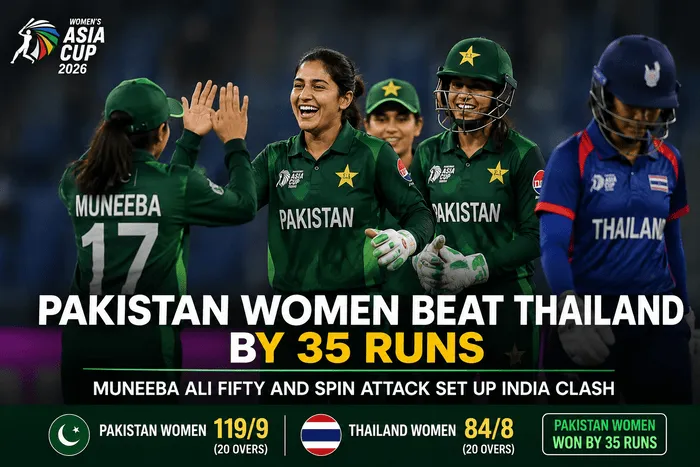
Pakistan Women opened their Women’s Asia Cup 2026 campaign with a 35-run win over Thailand in Dubai. Muneeba Ali’s composed 54 and a disciplined spin attack led by Sadia Iqbal helped Pakistan defend 119 and build momentum ahead of their India clash.
Pakistan Women vs Thailand: Match Summary
Pakistan Women began their Women’s Asia Cup 2026 campaign with a 35-run victory over Thailand in Dubai.
Pakistan Women produced a disciplined all-round performance to defeat Thailand Women by 35 runs in their opening match of the Women’s Asia Cup 2026 at the Dubai International Cricket Stadium. After winning the toss, Pakistan chose to bat first but were immediately put under pressure by Thailand’s bowlers.
Pakistan lost Shawaal Zulfiqar for 1 and Gull Feroza for a duck, leaving the team at just 6 for 2. Ayesha Zafar then fell for 9, and Pakistan were reduced to 23 for 3 in the fifth over. With the top order struggling, Muneeba Ali took responsibility for rebuilding the innings.
Muneeba combined patience with controlled strokeplay and formed a crucial 54-run partnership with Sadaf Shamas. The stand helped Pakistan recover from their difficult start and gave the lower order an opportunity to push the total towards a defendable score.
Muneeba eventually completed her half-century before being dismissed for 54 from 52 balls, including four boundaries. Sadaf Shamas contributed 20 from 20 deliveries, while useful runs from the lower order helped Pakistan finish on 119/9 in 20 overs.
Thailand therefore needed 120 runs to record an upset, but Pakistan’s bowlers quickly changed the complexion of the chase. Sadia Iqbal struck twice in an early double-wicket maiden, leaving Thailand under immediate pressure.
Thailand never managed to establish a substantial partnership. Chanida Sutthiruang top-scored with 25 from 24 balls, while captain Naruemol Chaiwai made 17. Pakistan’s spinners consistently restricted the scoring rate and kept taking wickets at important moments.
Sadia Iqbal finished with excellent figures of 3/11 from four overs, while Tuba Hassan claimed 2/17. Nashra Sundhu was also highly economical, conceding only six runs from her four overs.
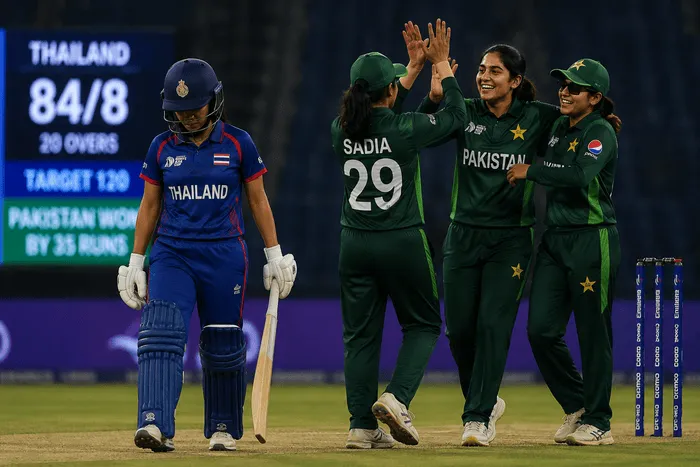
Thailand eventually reached only 84/8 in 20 overs, giving Pakistan a comfortable 35-run victory. Muneeba Ali was named Player of the Match for her important half-century.
Match at a Glance
| Venue | Dubai International Cricket Stadium |
|---|---|
| Pakistan Women | 119/9 (20 overs) |
| Thailand Women | 84/8 (20 overs) |
| Result | Pakistan won by 35 runs |
| Top Score | Muneeba Ali — 54 |
| Best Bowling | Sadia Iqbal — 3/11 |
| Player of the Match | Muneeba Ali |
Key Turning Point
Pakistan’s recovery after losing three early wickets and Sadia Iqbal’s double-wicket maiden were the two major turning points of the match.
Muneeba Ali’s Fifty Gives Pakistan the Platform
Muneeba Ali’s composed half-century provided the stability Pakistan needed after an early batting collapse.
Muneeba Ali’s 54 was the defining batting performance of Pakistan’s innings. Coming into the match, Pakistan needed someone to absorb the pressure after losing three wickets inside the first five overs, and Muneeba responded by building the innings around controlled strokeplay.
Pakistan were reduced to 6 for 2 before Ayesha Zafar’s dismissal left them struggling at 23 for 3. Instead of taking unnecessary risks, Muneeba focused on rotating the strike and finding boundaries when Thailand’s bowlers offered scoring opportunities.
Her partnership with Sadaf Shamas became the turning point of Pakistan’s innings. The pair added 54 runs for the fourth wicket, giving Pakistan the chance to recover from their difficult start and establish a total that could be defended.
Muneeba eventually reached her half-century and was dismissed for 54 from 52 balls, with four fours. Her innings was not built around a high strike rate, but its value came from the situation in which it was produced.
Muneeba Ali’s Match Impact
Muneeba’s fourth T20I half-century helped Pakistan recover from 23/3 and provided the foundation for a defendable total.
A rapid cameo would not have solved Pakistan’s early collapse. Muneeba’s ability to stay at the crease and build a partnership gave the lower order a platform to contribute and ensured Pakistan reached 119/9.
Pakistan’s Spin Attack Turns the Match
Pakistan’s spinners made the difference in the chase, turning a modest target into a difficult challenge for Thailand.
Pakistan’s defence of 119 was built around disciplined spin bowling. With Thailand needing 120 to win, Sadia Iqbal immediately put the chasing side under pressure by taking two wickets in a double-wicket maiden.
That early spell changed the nature of Thailand’s chase. Instead of attacking the target from the beginning, Thailand had to focus on rebuilding after losing two wickets for only six runs. Pakistan’s spinners continued to maintain a tight line and made it difficult for the batters to rotate the strike freely.
Sadia returned later in the innings to claim her third wicket and finished with 3/11 from four overs. Tuba Hassan added two wickets for 17 runs, while Nashra Sundhu produced one of the most economical spells of the match, conceding only six runs from her four overs.
The combined pressure from Pakistan’s spin unit prevented Thailand from establishing the partnerships required for a successful chase. With wickets falling and the run rate remaining under control, Pakistan were able to defend their relatively low total comfortably.
Pakistan Spin Figures
| Sadia Iqbal | 3/11 |
|---|---|
| Tuba Hassan | 2/17 |
| Nashra Sundhu | 1 wicket, 6 runs |
Pakistan’s ability to combine early wickets with economical middle-overs bowling meant Thailand never gained enough momentum to threaten the 120-run target.
Thailand’s Chase Never Gets Going
Pakistan’s disciplined bowling attack kept Thailand under pressure throughout the chase and restricted them to 84/8.
Thailand needed 120 runs to win after Pakistan finished on 119/9, but their chase never developed the momentum required to challenge the target. Pakistan made an immediate impact with the ball, putting Thailand on the back foot during the opening overs.
Sadia Iqbal was the biggest early threat. Her double-wicket maiden reduced Thailand to 6 for 2 and forced the batting side to shift from an attacking approach to rebuilding the innings.
Thailand struggled to produce the partnerships needed to keep the required run rate under control. Chanida Sutthiruang top-scored with 25 from 24 balls, while captain Naruemol Chaiwai contributed 17, but neither innings developed into a match-changing partnership.
Pakistan’s spinners maintained pressure through the middle overs by limiting easy scoring opportunities. Sadia Iqbal eventually finished with 3/11 from four overs, while Tuba Hassan took two wickets for 17 runs.
Nashra Sundhu was particularly economical, conceding only six runs from her four-over spell. The combined pressure meant Thailand could not find the boundaries or consistent strike rotation needed to mount a serious chase.
Thailand eventually finished on 84/8 after 20 overs, leaving Pakistan with a 35-run victory and two important points to begin their Asia Cup campaign.
Thailand Chase at a Glance
| Target | 120 runs |
|---|---|
| Final Score | 84/8 |
| Top Scorer | Chanida Sutthiruang — 25 |
| Best Bowler | Sadia Iqbal — 3/11 |
| Result | Pakistan won by 35 runs |
Pakistan’s Batting Still Has Room to Improve
The 35-run win was convincing, but Pakistan’s batting performance showed areas that need attention before the India clash.
Pakistan will be pleased with the result, but their batting unit cannot overlook the difficult start against Thailand. Losing three wickets for 23 runs placed the innings under immediate pressure and left Muneeba Ali and Sadaf Shamas with the responsibility of rebuilding.
Muneeba’s half-century provided the stability Pakistan needed, but the team struggled to turn that recovery into a significantly higher total. Pakistan eventually finished on 119/9 in 20 overs, meaning the bowlers had to produce an excellent performance to defend the score.
Against India, Pakistan are likely to face a much tougher challenge. India’s opening match showed how quickly their batting can put pressure on an opposition bowling attack, making a strong start particularly important for Pakistan.
The top order will therefore need to give Muneeba and the middle order more support. Pakistan’s ability to preserve wickets during the powerplay while maintaining a healthy scoring rate could have a major influence on how competitive they are against India.
The finishing phase is another area where Pakistan can improve. Once Muneeba had established the platform, the lower order managed to add useful runs, but a stronger final few overs would have given the bowlers an even larger total to defend.
Batting Areas to Improve
- Powerplay: Avoid losing early wickets and build a stable foundation.
- Middle Overs: Rotate the strike consistently while limiting dot balls.
- Partnerships: Give key batters greater support at the crease.
- Death Overs: Convert established partnerships into additional runs.
India vs Pakistan: A Much Bigger Test Awaits
Pakistan’s opening win has set up a much tougher Group A contest against India on September 5 in Dubai.
Pakistan will now turn their attention to India after beginning the Women’s Asia Cup 2026 with a 35-run win over Thailand. Their second Group A match is scheduled for September 5 at the Dubai International Cricket Stadium, giving Pakistan a quick opportunity to test their progress against one of the tournament favourites.
India also started their campaign with a convincing performance, defeating Thailand by 94 runs. Shafali Verma scored 64 from 36 balls as India posted 159/9, while their bowlers dismissed Thailand for 65. Deepti Sharma produced a remarkable 3/0 spell and Nandani Sharma also took three wickets.
The contrast between the two opening matches is clear. Pakistan had to fight back from 23/3 before reaching 119/9, while India made a rapid start and crossed 100 inside the first half of their innings. Pakistan’s bowlers then defended their modest total, whereas India’s attack secured a much larger margin of victory.
Pakistan’s biggest challenge will therefore be to improve their batting without losing the discipline that produced their opening win. Muneeba Ali’s ability to anchor the innings and the spin attack’s control will remain important, but the top order will need to provide a stronger platform against India.
With both teams entering the contest after wins, the September 5 fixture promises to be a significantly stronger test of Pakistan’s tournament credentials.
India vs Pakistan: Key Numbers
| Match | India Women vs Pakistan Women |
|---|---|
| Date | September 5, 2026 |
| Venue | Dubai International Cricket Stadium |
| Pakistan’s Last Result | Beat Thailand by 35 runs |
| India’s Last Result | Beat Thailand by 94 runs |
Muneeba Ali vs India’s Bowling Attack
Muneeba Ali’s ability to handle pressure could become important when Pakistan face India’s stronger bowling unit.
Muneeba Ali’s fifty against Thailand showed why her role can be important for Pakistan’s batting lineup. After three early wickets had fallen, she stayed at the crease and rebuilt the innings rather than allowing the collapse to continue.
The challenge against India will be considerably greater. India’s bowling attack has already shown its ability to take wickets and maintain pressure, meaning Muneeba may again have to combine patience with controlled scoring if Pakistan lose early wickets.
Her experience as an opening batter and wicketkeeper also gives Pakistan an important stabilising option. If she can survive the initial phase and build a partnership, Pakistan’s middle order will have a better opportunity to accelerate later in the innings.
At the same time, Muneeba cannot be expected to carry the entire batting responsibility. Pakistan’s other top-order batters will need to contribute so that India’s bowlers cannot concentrate their plans around one player.
Why Muneeba Matters
- Stability: She can absorb pressure when Pakistan lose early wickets.
- Partnership Building: Her Thailand innings helped create a 54-run fourth-wicket stand.
- Experience: Her ability to bat deep gives Pakistan an anchor during difficult phases.
- India Challenge: She will need support from the top order against India’s stronger attack.
Sadia Iqbal Could Be Pakistan’s Biggest Threat
Sadia Iqbal’s three-wicket spell against Thailand showed how Pakistan can use spin to put pressure on India’s batting lineup.
If Pakistan are to challenge India, Sadia Iqbal could have a major role to play with the ball. Her performance against Thailand was one of the biggest reasons Pakistan were able to defend a target of only 120.
Sadia made an immediate impact with a double-wicket maiden, leaving Thailand at 6/2 early in the chase. She continued to control the scoring rate and eventually finished with 3/11 from four overs.
That combination of early wickets and economy is particularly valuable in T20 cricket. By removing batters while conceding very few runs, Sadia forced Thailand into a defensive approach and allowed Pakistan to maintain pressure from one end.
Against India, the challenge will be much greater, but the same principle could work in Pakistan’s favour. If Sadia can take an early wicket or restrict India’s scoring during the middle overs, Pakistan’s other spinners will have an opportunity to build further pressure.
Sadia Iqbal vs Thailand
Her double-wicket maiden at the start of Thailand’s chase immediately shifted the pressure onto the opposition.
Sadia’s accuracy, combined with the control provided by Tuba Hassan and Nashra Sundhu, gives Pakistan a spin combination capable of slowing India’s scoring during crucial middle overs.
Dubai Conditions Could Influence the India-Pakistan Match
Both teams have already played at the Dubai International Cricket Stadium, giving them useful insight into the conditions ahead of their September 5 meeting.
The Dubai International Cricket Stadium will host the India-Pakistan contest, making familiarity with the venue an important factor for both teams. Pakistan have already played Thailand at the ground, while India also opened their campaign at the same venue.
Pakistan’s 119/9 against Thailand and India’s 159/9 in their respective opening matches show that the surface can produce different batting challenges depending on how the innings is approached. Pakistan’s bowlers were particularly effective when they maintained accuracy and built pressure through spin.
For Pakistan, the key will be finding the right balance between attacking India’s batters and protecting their own bowling resources. Their spinners could become especially important during the middle overs if the surface continues to reward changes of pace and controlled bowling.
Batters from both sides will also need to value partnerships. Rather than relying solely on boundary hitting, the ability to rotate the strike and avoid extended periods of dot balls could prove important in determining the final score.
Dubai Match Factors
- Venue Familiarity: Both teams have already played at the Dubai International Cricket Stadium.
- Spin Bowling: Pakistan’s spinners could play an important role through the middle overs.
- Partnerships: Batters will need to combine strike rotation with controlled boundary hitting.
- Wicket Management: Losing early wickets could make building a competitive total difficult.
Pakistan’s Group A Position Improves
The win over Thailand gives Pakistan two valuable points and a positive start to their Women’s Asia Cup 2026 campaign.
Pakistan’s 35-run victory gives them an important two points in Group A and provides a strong foundation for the remainder of their Women’s Asia Cup 2026 campaign. After the opening win, Pakistan can now approach their next fixture against India with confidence rather than having to recover from an early defeat.
India have also started the tournament with a win, defeating Thailand by 94 runs in their opening match. As a result, the India-Pakistan contest becomes particularly important for the group standings, with both sides entering the fixture having already collected points.
The result against India will not decide qualification on its own, but a second consecutive victory would put Pakistan in a stronger position for the remaining group-stage matches. The team will therefore want to carry the confidence from their Thailand performance into the next game.
Pakistan’s Group A Snapshot
Pakistan’s opening victory gives them early momentum before their high-profile meeting with India.
What Pakistan Can Take From the Thailand Win
Pakistan’s opening victory delivered several positives that can strengthen their campaign before the India clash.
Pakistan’s win over Thailand was valuable not only because it delivered two points, but also because the team showed that it could recover from a difficult batting situation and defend a modest total.
The biggest positive was Muneeba Ali’s ability to absorb pressure. With Pakistan three wickets down for 23 runs, her partnership with Sadaf Shamas gave the innings stability and allowed Pakistan to reach 119/9.
The bowling performance was another major takeaway. Sadia Iqbal’s three wickets and the economy of Pakistan’s spin unit prevented Thailand from building momentum during the chase. That ability to control the middle overs could become particularly useful against India.
Pakistan also showed resilience. Rather than allowing the early batting collapse to determine the result, the team recovered and then produced enough pressure with the ball to win comfortably.
Three Major Positives
- Muneeba’s Composure: Her 54 provided stability after the early wickets.
- Spin Control: Pakistan’s spinners restricted Thailand and kept the chase under pressure.
- Defending 119: The bowling unit successfully protected a modest total.
Pakistan now have confidence from an opening win, but the India match will reveal whether these strengths can translate against a considerably stronger opponent.
What Needs to Improve Before India
Pakistan have momentum after beating Thailand, but their batting and fielding will need to be sharper against India.
Pakistan can take plenty of confidence from their opening victory, but the performance also highlighted areas that need attention before the India clash. The most obvious concern is the start with the bat, as Pakistan lost three wickets for only 23 runs against Thailand.
Muneeba Ali’s 54 prevented the early collapse from becoming decisive, but Pakistan cannot rely on one batter to repeatedly rescue the innings. The top order will need to spend more time at the crease and give the middle order a stronger platform.
Pakistan also need greater efficiency in the closing overs. Once the innings had been rebuilt, converting that platform into additional runs would have reduced the pressure on the bowling attack.
Fielding is another area where Pakistan can improve. Against a stronger batting lineup, missed opportunities can quickly change the momentum of a T20 match. Clean catching and sharper work in the field will therefore be important against India.
Pakistan’s Priorities
- Stronger Start: Protect wickets while maintaining a healthy scoring rate.
- More Batting Support: Reduce the dependence on Muneeba Ali for recovery innings.
- Better Finish: Make greater use of the final overs after establishing partnerships.
- Sharp Fielding: Take chances and avoid giving India’s batters extra opportunities.
India vs Pakistan: Key Battle Areas
The September 5 contest could be shaped by how both teams handle the powerplay, middle overs and pressure situations.
The India-Pakistan fixture is likely to be decided by a few critical phases rather than one individual matchup. Both teams have already opened their Asia Cup campaigns with wins, but their routes to victory against Thailand were very different.
Pakistan’s first priority will be surviving India’s early bowling pressure. After losing three wickets inside the first five overs against Thailand, Pakistan cannot afford another slow or unstable start. A solid powerplay would give Muneeba Ali and the middle order greater freedom later in the innings.
The middle overs could provide Pakistan with their biggest bowling opportunity. Sadia Iqbal, Tuba Hassan and Nashra Sundhu were highly economical against Thailand, and maintaining that control against India’s batters could prevent India from building a dominant platform.
The final battle will be about handling pressure. India have the ability to score quickly, while Pakistan have shown that they can defend a modest total. Whichever side executes its plans more cleanly during the decisive phases should gain the advantage.
Three Key Battles
Pakistan need to avoid another early collapse and establish a competitive powerplay.
Sadia Iqbal and the supporting spin attack will look to control India’s scoring through the middle overs.
The team that converts its platform into runs or wickets during the closing phase could determine the result.
Pakistan Women vs Thailand Women: Full Scorecard
Pakistan posted 119/9 before their bowlers restricted Thailand to 84/8 in a controlled 35-run victory.
Pakistan Women — 119/9
| Batter | Runs |
|---|---|
| Muneeba Ali | 54 |
| Sadaf Shamas | 20 |
| Umm-e-Hani | 17 |
| Tuba Hassan | 12* |
Thailand’s bowling attack picked up nine wickets, with Suleeporn Laomi and Thipatcha Putthawong taking three wickets each.
Thailand Women — 84/8
| Batter | Runs |
|---|---|
| Chanida Sutthiruang | 25 |
| Naruemol Chaiwai | 17 |
| Natthakan Chantham | 14 |
| Aphisara Suwanchonrathi | 13 |
Sadia Iqbal led Pakistan’s defence with 3/11, while Tuba Hassan added two wickets.
Pakistan vs India Women’s Asia Cup 2026: What to Expect
Pakistan enter the September 5 contest with confidence from their Thailand win, but India will provide a much stronger test.
Pakistan’s victory over Thailand has given them the ideal start to their Women’s Asia Cup campaign, but the India clash will provide a far clearer indication of their tournament prospects. Both teams have already collected wins, making their meeting one of the most important Group A fixtures.
Pakistan’s route to victory was built around recovery batting and disciplined spin bowling. Muneeba Ali’s 54 rescued the innings after an early collapse, while Sadia Iqbal and the other spinners kept Thailand under control during the chase.
India, however, demonstrated greater attacking power in their opening match. Shafali Verma’s 64 helped India post 159/9 against Thailand before their bowlers completed a 94-run victory. That performance means Pakistan will need to improve their batting if they want to put India under sustained pressure.
The September 5 match could therefore come down to whether Pakistan’s disciplined bowling can offset India’s stronger batting momentum. A good start with the bat, followed by another controlled spin performance, would give Pakistan a realistic platform to compete.
What Could Decide the Match?
- Pakistan’s Start: Avoiding early wickets will be crucial.
- Muneeba’s Role: Another composed innings could anchor Pakistan’s batting.
- Spin Battle: Pakistan’s spinners will need to contain India’s aggressive batters.
- Fielding: Pakistan must convert chances against a stronger opponent.
Pakistan Women vs Thailand: FAQs
Quick answers about Pakistan’s 35-run victory, Muneeba Ali’s fifty and the upcoming India clash.
Pakistan Women defeated Thailand Women by 35 runs in their opening match of the Women’s Asia Cup 2026.
Muneeba Ali scored 54 runs from 52 balls, including four fours. Her half-century helped Pakistan recover after an early batting collapse.
Sadia Iqbal was Pakistan’s leading wicket-taker, finishing with 3/11 from four overs.
Thailand finished on 84/8 in 20 overs while chasing Pakistan’s target of 120.
Pakistan Women are scheduled to face India Women on September 5, 2026, at the Dubai International Cricket Stadium.
Pakistan have a positive platform after their opening victory, particularly because their spin attack successfully defended a modest total. Their batting will need to be more consistent against India.
Conclusion
Pakistan Women have started their Asia Cup campaign with a valuable win, but the India clash will be a much tougher test.
Pakistan Women’s 35-run victory over Thailand was an encouraging start to their Women’s Asia Cup 2026 campaign. Muneeba Ali’s composed 54 gave the team stability after an early batting collapse, while Sadia Iqbal and the spin attack ensured that Thailand could not build a successful chase.
The result gives Pakistan two important points and momentum heading into their September 5 meeting with India in Dubai. However, the team will need a stronger batting start and sharper fielding against an Indian side that also began the tournament with a convincing win.
For readers following Pakistan’s upcoming cricket coverage and looking for related information, the 99Exch app download guide and 99Exch ID creation guide are available separately on the site.
Ultimately, Pakistan’s biggest positives from the Thailand match are Muneeba’s ability to handle pressure and the control provided by their spinners. If those strengths are combined with a better batting performance, Pakistan could make the India clash a much closer contest.