
Australia Drop Jake Weatherald, Recall Matt Renshaw for 2nd Test vs Bangladesh
Australia have dropped Jake Weatherald and recalled Matt Renshaw for the second Test against Bangladesh after their nine-wicket defeat in the opening match.
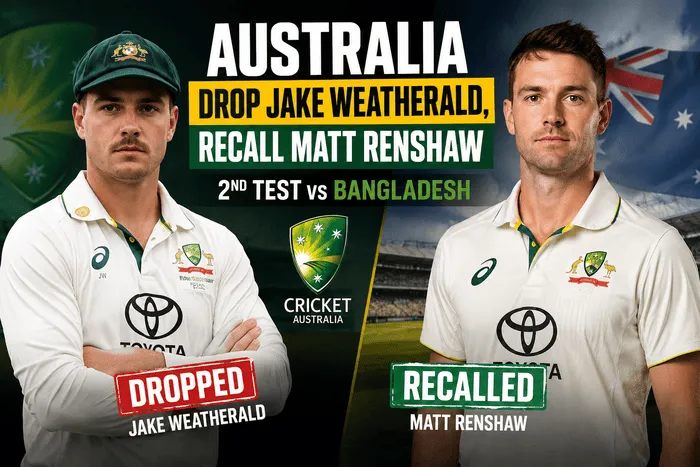
Table of Contents
- Why Australia Dropped Jake Weatherald
- Jake Weatherald’s First Test Struggles Against Bangladesh
- Matt Renshaw Recalled to Australia’s Test Squad
- Why Matt Renshaw Earned His Test Recall
- Will Matt Renshaw Open With Travis Head?
- Marnus Labuschagne Under Pressure After Bangladesh Defeat
- Australia’s Batting Problems Exposed in Darwin
- Bangladesh’s Historic Nine-Wicket Win
- What the 2nd Test Means for Australia
- Australia vs Bangladesh 2nd Test in Mackay
- How Australia Can Bounce Back
- Australia vs Bangladesh 2nd Test Squad Update
- Frequently Asked Questions
- Final Thoughts
Why Australia Dropped Jake Weatherald
Jake Weatherald has been omitted from Australia’s squad for the second Test against Bangladesh after a disappointing performance in Darwin.
Australia have responded to their shock nine-wicket defeat against Bangladesh by making one change to their squad for the second and final Test. Jake Weatherald has been dropped, with Matthew Renshaw named as his replacement for the Test in Mackay. The decision comes after Australia’s top order struggled throughout the opening match.
Weatherald’s first Test against Bangladesh proved particularly difficult. The opener scored only 23 runs in the first innings before being dismissed for a duck in the second. Australia were bowled out for just 198 in their first innings, and their batting problems eventually contributed to Bangladesh securing a historic nine-wicket victory.
Poor Returns Cost Weatherald His Place
The selectors have acted quickly rather than giving Weatherald another opportunity in the two-Test series. His combined contribution of 23 runs from the opening match was not enough to secure his position, particularly with Australia needing an immediate response after falling behind in the series.
The change also reflects Australia’s broader concern about their top-order batting. The team must now find a more reliable opening combination before the second Test begins on August 22. Renshaw’s recall gives the selectors an experienced alternative, although his place in the final XI is not yet officially confirmed.
| Jake Weatherald | First Test vs Bangladesh |
|---|---|
| First Innings | 23 runs |
| Second Innings | 0 runs |
| Squad Status | Omitted |
| Replacement | Matthew Renshaw |
| Next Test | Mackay — August 22 |
Key takeaway: Weatherald’s omission is Australia’s first major response to the Darwin defeat. His 23 and 0 have opened the door for Renshaw, while the Australian top order now faces increased pressure to deliver in Mackay.
Jake Weatherald’s First Test Struggles Against Bangladesh
Jake Weatherald’s difficult outing in Darwin ultimately cost him his place in Australia’s squad for the second Test against Bangladesh.
Jake Weatherald’s first Test against Bangladesh ended with a disappointing return that quickly put his place under pressure. The Australian opener scored 23 runs in the first innings before being dismissed for 0 in the second innings. His combined contribution was therefore just 23 runs across the match as Australia suffered a nine-wicket defeat in Darwin.
The result was particularly frustrating for Weatherald because he had only recently established himself as Australia’s preferred opening partner for Travis Head. He had been handed a national contract in April after contributing to several successful opening partnerships during Australia’s 4-1 Ashes series victory.
Two Dismissals, Two Different Problems
Weatherald was edged behind in the first innings after making 23, while his second innings ended when he chopped the ball onto his stumps. Cricket Australia reported that selectors were also assessing changes to his technique and movement patterns, making the small sample size of his Test return an important consideration.
His omission does not necessarily represent a long-term decision about his Test career. However, Australia’s immediate priority is to respond after scoring fewer than 500 runs across the two innings in Darwin. The selectors have chosen to bring in the more experienced Matthew Renshaw rather than give Weatherald another opportunity straight away.
| Weatherald’s First Test | Result |
|---|---|
| First Innings | 23 runs |
| Second Innings | 0 runs |
| Total Runs | 23 |
| Australia’s Result | Lost by nine wickets |
| Second Test Status | Omitted from squad |
Key takeaway: Weatherald’s 23 and 0 came at exactly the wrong time for Australia. With the team needing an immediate batting response in Mackay, selectors opted for Matt Renshaw as the replacement.
Matt Renshaw Recalled to Australia’s Test Squad
Matt Renshaw has been recalled to Australia’s Test squad for the second Test against Bangladesh after Jake Weatherald was omitted following the Darwin defeat.
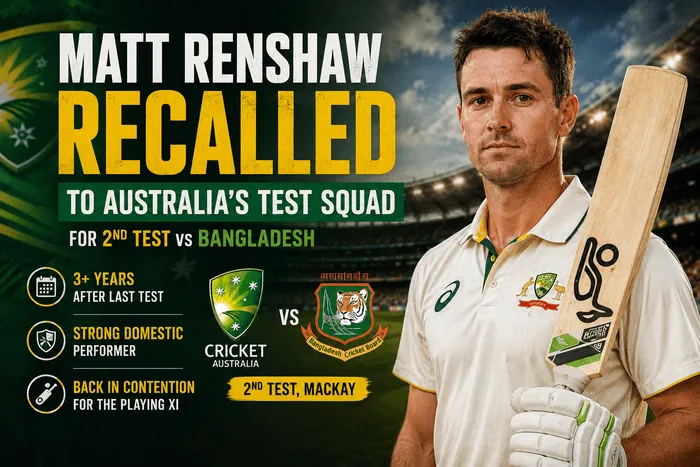
Australia have turned to Matt Renshaw after dropping Jake Weatherald from their squad for the second Test against Bangladesh. Renshaw has been recalled as Australia’s only change following the nine-wicket defeat in Darwin, giving the experienced batter another opportunity to return to the Test setup. ([cricket.com.au](https://www.cricket.com.au/news/4561673/jake-weatherald-dropped-matt-renshaw-recalled-australia-announce-one-squad-change-v-bangladesh-second-test-mackay-great-barrier-reef-arena?utm_source=chatgpt.com))
The recall comes after Renshaw produced encouraging domestic form. He scored 499 runs at 49.90 during the 2025-26 Sheffield Shield season, giving Australia’s selectors a strong reason to bring him back into contention. ([cricket.com.au](https://www.cricket.com.au/news/4561673/jake-weatherald-dropped-matt-renshaw-recalled-australia-announce-one-squad-change-v-bangladesh-second-test-mackay-great-barrier-reef-arena?utm_source=chatgpt.com))
Renshaw Returns After More Than Three Years
The Mackay Test could mark Renshaw’s first Test appearance for Australia since January 2023. His recall therefore represents a significant return to the national setup after more than three years away from Test cricket. He has previously played 14 Tests for Australia and has experience opening the innings at international level.
Experience Gives Australia Another Option
Renshaw’s experience is particularly useful at a time when Australia’s top order is under pressure. The team struggled to build substantial partnerships in Darwin, while Weatherald’s 23 and 0 ultimately led to his omission.
Renshaw now has an opportunity to provide greater stability at the top of the order. However, his recall to the squad does not automatically confirm his place in the playing XI. Australia will make the final selection closer to the second Test, with his potential opening role likely to be one of the key selection questions.
| Matt Renshaw | Latest Update |
|---|---|
| Squad Status | Recalled |
| Last Test | January 2023 |
| Test Experience | 14 Tests |
| 2025-26 Sheffield Shield | 499 runs at 49.90 |
| Potential Role | Opening contender |
Renshaw takeaway: Australia’s selectors have chosen experience and recent domestic form as their response to the Weatherald decision. Renshaw is officially back in the squad, but his final XI selection and batting position will only be confirmed closer to the Mackay Test.
Why Matt Renshaw Earned His Test Recall
Strong Sheffield Shield performances and recent international experience have strengthened Matt Renshaw’s case for a return to Australia’s Test XI.
Matt Renshaw’s recall is not simply a reaction to Jake Weatherald’s difficult Test in Darwin. The left-hander had already built a strong case through his 2025-26 Sheffield Shield campaign, where he finished with 499 runs at an average of 49.90 in six matches. He also registered three centuries, making him one of Queensland’s standout batters during the season.
Renshaw’s start to the Shield season was particularly impressive. Cricket Australia noted that he scored three hundreds in his first five innings, including a 128 against Tasmania, a 101 against Western Australia and a 112 against Victoria. Those performances pushed his name into the wider conversation for Australia’s Test setup.
Three Shield Centuries Strengthened His Case
The consistency of Renshaw’s red-ball output was important because Australia’s Test selectors were assessing several options for the batting order. His ability to score substantial first-class runs while also having previous Test experience gave him a different profile from an uncapped replacement.
Renshaw has already played 14 Tests for Australia, scoring 645 runs with a highest score of 184. He also has experience opening the innings, meaning Australia can consider him for the top order without asking him to adapt to an entirely new international role.
International Form Also Adds to the Case
Renshaw has remained involved in Australia’s international setup across formats. Earlier in 2026, he produced an unbeaten 89 from 52 balls against Bangladesh in the second T20I in Chattogram, helping Australia secure the T20I series. While that performance does not directly determine Test selection, it demonstrates that he has continued contributing at international level.
| Renshaw’s Selection Case | Record |
|---|---|
| 2025-26 Sheffield Shield Runs | 499 |
| Shield Average | 49.90 |
| Shield Centuries | 3 |
| Australia Tests | 14 |
| Test Runs | 645 |
| Test Highest Score | 184 |
Selection takeaway: Renshaw brings both recent red-ball production and international experience. His 499 Shield runs at 49.90, three centuries and 14 previous Tests make his recall a credible response to Australia’s top-order problems.
Will Matt Renshaw Open With Travis Head?
Matt Renshaw is the leading contender to replace Jake Weatherald at the top of Australia’s order, but his exact batting position will only be confirmed when the playing XI is announced.
The biggest selection question ahead of the second Test is whether Matt Renshaw will open alongside Travis Head. Australia’s decision to drop Jake Weatherald has created an immediate vacancy at the top of the order, and Renshaw’s previous experience as an opener makes him a natural candidate.
Cricket Australia currently describes Renshaw as being “in the box seat” for a Test recall in Mackay. Other reports have also identified him as a contender to partner Head, although Australia have not yet officially announced their playing XI.
Renshaw Brings Opening Experience
Renshaw has considerable experience at the top of the order for Australia. He has previously opened in Test cricket and has played 14 Tests overall. That familiarity makes his selection easier than moving a middle-order batter into an unfamiliar role immediately after a difficult series opener.
His strong Sheffield Shield campaign also strengthens the case. Renshaw scored 499 runs at 49.90 during the 2025-26 season, including three centuries. Australia therefore have both recent domestic evidence and previous international experience behind the decision to bring him back.
Why Travis Head’s Position Matters
Head’s role is another part of the equation. He has operated as an opener in Australia’s recent Test setup, but he is also an established middle-order batter. Bringing Renshaw into the XI could allow Australia to retain Head at the top, or potentially create another batting-order combination depending on the selectors’ preferred balance.
For now, the safest conclusion is that Renshaw is the leading candidate to replace Weatherald, but his exact position remains unconfirmed until the team announcement.
| Opening Selection | Current Status |
|---|---|
| Jake Weatherald | Dropped |
| Matt Renshaw | Leading contender |
| Travis Head | Likely opening option |
| Final XI | Not officially confirmed |
Selection takeaway: Renshaw appears to be Australia’s leading option to replace Weatherald, with opening alongside Travis Head a strong possibility. However, the final batting order should not be presented as confirmed until Australia’s XI is officially announced.
Marnus Labuschagne Under Pressure After Bangladesh Defeat
Marnus Labuschagne has retained his place for the second Test, but his poor returns in Darwin have increased the pressure on Australia’s experienced No.3.
While Australia have made a clear change at the top of the order by dropping Jake Weatherald, Marnus Labuschagne has retained his place in the 13-player squad for the second Test against Bangladesh. That decision does not mean the pressure has disappeared. Labuschagne made just 1 and 31 in Darwin as Australia suffered a nine-wicket defeat.
His situation is particularly important because Labuschagne occupies the No.3 position, traditionally one of the most important roles in Australia’s Test batting order. With Weatherald already removed from the squad, the selectors have chosen to give Labuschagne another opportunity rather than make multiple changes after one unexpected defeat.
Australia Still Back Labuschagne
Australia coach Andrew McDonald has indicated that the team is not planning a wholesale regeneration after the Bangladesh loss. Labuschagne therefore remains part of the immediate plans, but the expectation is clear: Australia need substantially more from one of their established batters in Mackay.
The pressure is also connected to the wider batting failure in Darwin. Australia scored only 198 in their first innings and 284 in the second. Steve Smith’s 71 and Cameron Green’s 104 were the major individual contributions, while several other established batters failed to produce decisive scores.
Mackay Could Be a Crucial Response
Labuschagne now has an immediate opportunity to answer the criticism with runs. Australia need to level the two-Test series, and a substantial contribution from their No.3 would significantly strengthen the top order around Travis Head, Steve Smith and Cameron Green.
| Marnus Labuschagne | Latest Update |
|---|---|
| First Test, 1st Innings | 1 run |
| First Test, 2nd Innings | 31 runs |
| Second Test Squad | Retained |
| Batting Position | No.3 |
| Main Requirement | Big runs in Mackay |
Labuschagne takeaway: Australia have backed their experienced No.3 for the second Test, but the margin for another low-scoring performance is getting smaller. With the series on the line, a substantial innings from Labuschagne could be central to Australia’s response in Mackay.
Australia’s Batting Problems Exposed in Darwin
Australia’s nine-wicket defeat against Bangladesh highlighted significant problems in the top order and left the selectors with limited room for error before the second Test.
Australia’s defeat in Darwin was not simply the result of one poor individual performance. Their batting unit struggled to build sustained partnerships across both innings, allowing Bangladesh to control the match despite Australia’s considerable experience at international level.
Australia were dismissed for 198 in their first innings before making 284 in the second. That left Bangladesh needing only 127 runs in the final innings to complete a historic nine-wicket victory. The low first-innings total was particularly damaging because it immediately put Australia under scoreboard pressure.
Top-Order Runs Were Missing
Jake Weatherald’s 23 and 0 became the most obvious selection issue, but the wider batting performance also created questions. Marnus Labuschagne scored 1 and 31, while Australia’s other established batters were unable to consistently convert starts into match-defining contributions.
Steve Smith’s 71 and Cameron Green’s 104 provided important resistance, but Australia needed more contributions around those innings. Against a Bangladesh side that bowled with discipline and capitalized on Australia’s mistakes, the lack of sustained partnerships proved costly.
Why the Renshaw Recall Matters
The decision to recall Matt Renshaw therefore has to be viewed in the context of Australia’s broader batting response. His domestic record gives the selectors an alternative after the top order failed to provide enough stability in Darwin.
The second Test gives Australia an immediate opportunity to correct those problems. The priority will be straightforward: build longer partnerships, reduce soft dismissals and ensure that their experienced middle order gets enough runs to put Bangladesh under pressure.
| Australia Batting Issue | Darwin Outcome |
|---|---|
| First Innings | 198 all out |
| Second Innings | 284 all out |
| Jake Weatherald | 23 and 0 |
| Marnus Labuschagne | 1 and 31 |
| Major Individual Score | Cameron Green — 104 |
| Match Result | Bangladesh won by nine wickets |
Batting takeaway: Australia’s main problem was the lack of consistent contributions across the order. Renshaw’s recall addresses one position, but Australia will need a much stronger collective batting effort in Mackay if they are to level the series.
Bangladesh’s Historic Nine-Wicket Win
Bangladesh produced a landmark Test victory in Darwin, defeating Australia by nine wickets and taking a 1-0 lead in the two-Test series.
Bangladesh created one of the biggest talking points of the series by defeating Australia by nine wickets in the opening Test at Darwin. The result gave Bangladesh a 1-0 lead in the two-Test series and left Australia needing an immediate response in Mackay.
Australia’s batting struggles were central to the result. The hosts were dismissed for only 198 in their first innings, allowing Bangladesh to establish control early. Australia fought back with 284 in their second innings, but the target of just 127 proved manageable for the visitors.
Bangladesh Kept Their Nerve in the Chase
Bangladesh’s final-innings chase demonstrated the difference in the match. Rather than allowing Australia’s bowlers to create sustained pressure, the visitors remained composed and completed the chase with nine wickets in hand. The result was particularly significant because Australia had entered the series as the more established Test side.
The victory also exposed how difficult Australia’s batting conditions became during the match. Bangladesh’s bowlers maintained pressure throughout the first Test, while Australia’s top order struggled to produce the partnerships required to establish a commanding total.
Australia Now Face a Must-Win Test
The series situation has changed completely after the Darwin result. Australia now need to win the second Test to avoid a series defeat, while Bangladesh can secure the series with another victory or potentially settle for a draw depending on the result.
That context makes the Weatherald-Renshaw change even more significant. Australia’s selectors have already responded with one batting adjustment, but the team will need a much more complete performance in Mackay.
| 1st Test Result | Match Situation |
|---|---|
| Australia 1st Innings | 198 all out |
| Australia 2nd Innings | 284 all out |
| Bangladesh Target | 127 runs |
| Result | Bangladesh won by 9 wickets |
| Series | Bangladesh lead 1-0 |
Series takeaway: Bangladesh’s nine-wicket victory has put Australia under immediate pressure. The hosts must now improve their batting substantially in Mackay to prevent Bangladesh from completing a historic series win.
What the 2nd Test Means for Australia
Australia must win the second Test in Mackay to level the series after Bangladesh’s historic nine-wicket victory in Darwin.
The second Test against Bangladesh has suddenly become a must-win match for Australia. Bangladesh took a 1-0 lead after their nine-wicket victory in Darwin, leaving Australia with no margin for error in the second and final Test of the series. A draw or another defeat would hand Bangladesh a historic series victory on Australian soil.
The match is scheduled to begin on August 22 at the Great Barrier Reef Arena in Mackay. It will also be a landmark occasion for the venue, which is preparing to host its first-ever Test match. The significance of the fixture has increased considerably after Bangladesh’s unexpected result in Darwin.
Australia Need a Complete Response
Australia’s nine-wicket defeat exposed problems in their batting rather than simply being a narrow result decided by one session. They were bowled out for 198 in the first innings and 284 in the second, allowing Bangladesh to chase only 127 in the final innings.
The selectors have already made their first response by dropping Jake Weatherald and recalling Matt Renshaw. However, the change alone will not solve Australia’s problems. Marnus Labuschagne remains under pressure, while the established middle order must produce substantially more runs if Australia are to regain control of the series.
Bangladesh Have Nothing to Lose
Bangladesh enter the Mackay Test with the psychological advantage of already having beaten Australia. Another strong performance would give them their first Test series victory in Australia, while even a competitive draw would preserve their lead.
For Australia, the equation is much simpler: win the Test or lose the series. That pressure makes the Renshaw recall, the top-order combination and Australia’s ability to respond with the bat central storylines heading into Mackay.
| 2nd Test Stakes | Current Situation |
|---|---|
| Series Score | Bangladesh lead 1-0 |
| Australia’s Requirement | Win to level the series |
| Bangladesh’s Position | Can secure series victory with a win or avoid defeat |
| Venue | Great Barrier Reef Arena, Mackay |
| Match Dates | August 22–26, 2026 |
| Venue Milestone | Mackay’s first Test match |
Series takeaway: Australia’s objective is clear. They need a much stronger batting performance and a complete team response in Mackay to prevent Bangladesh from completing a historic Test series victory in Australia.
Australia vs Bangladesh 2nd Test in Mackay
The second Test moves to Mackay, where Great Barrier Reef Arena will host its first men’s Test as Australia look to level the series against Bangladesh.
The Australia vs Bangladesh 2nd Test will be played at the Great Barrier Reef Arena in Mackay from August 22 to August 26, 2026. The match is scheduled to begin at 10:00 AM local time, giving Australia a fresh opportunity to respond after Bangladesh’s nine-wicket victory in Darwin.
The Mackay Test carries additional significance because the venue is set to become Australia’s 12th men’s Test venue. Great Barrier Reef Arena, also known as Harrup Park, has hosted first-class cricket before, but this will be its first Test match.
A New Test Venue With Local Knowledge
Although this is Mackay’s first Test, the ground is not unfamiliar to red-ball cricket. Queensland have played Sheffield Shield matches at the venue, while Australia A have also featured there in first-class cricket. The most recent first-class match at the ground was in October 2024, when Australia A defeated India A.
That history could be useful for players familiar with Queensland conditions. Renshaw, in particular, has an interesting connection with the venue, having scored two first-class centuries at the ground. His local knowledge could strengthen the case for his inclusion in Australia’s final XI.
Australia Need a Fast Response
The location may be new to Test cricket, but the equation for Australia is straightforward. Bangladesh lead the two-Test series 1-0, meaning Australia need a victory in Mackay to prevent a series defeat.
The selectors have already responded by dropping Jake Weatherald and recalling Matt Renshaw. The final playing XI will be closely watched, particularly the opening combination and whether Marnus Labuschagne retains his No.3 position after scoring 1 and 31 in Darwin.
| 2nd Test Detail | Information |
|---|---|
| Match | Australia vs Bangladesh |
| Dates | August 22–26, 2026 |
| Venue | Great Barrier Reef Arena, Mackay |
| Start Time | 10:00 AM local time |
| Series Score | Bangladesh lead 1-0 |
| Venue Status | Mackay’s first men’s Test |
Mackay Test takeaway: The new Test venue adds another layer to an already important match. Australia have the squad experience to respond, but Bangladesh arrive with the confidence of a historic Darwin victory and a 1-0 series advantage.
How Australia Can Bounce Back in Mackay
Australia need a more disciplined batting performance and stronger partnerships if they are to recover from the Darwin defeat and level the Test series.
Australia do not need to completely overhaul their Test side after one defeat, but the nine-wicket loss in Darwin exposed areas that require an immediate response. The first priority is building a more reliable top order, which explains the decision to drop Jake Weatherald and recall Matt Renshaw.
Australia’s first-innings total of just 198 created the foundation for Bangladesh’s victory. Even though the hosts improved to 284 in the second innings, they could not establish a target large enough to put Bangladesh under sustained pressure. The batting unit therefore needs to convert starts into longer partnerships in Mackay.
Renshaw Must Bring Stability
If Matt Renshaw is selected, his primary responsibility will be to provide stability at the top of the order. His recent Sheffield Shield record and previous Test experience give Australia reason to expect a more settled opening partnership.
Senior Batters Need Bigger Contributions
Australia also need more from their established players. Marnus Labuschagne made only 1 and 31 in Darwin, while the team relied heavily on individual contributions such as Cameron Green’s 104 and Steve Smith’s 71. A stronger collective effort would significantly improve Australia’s chances of controlling the second Test.
Avoid Giving Bangladesh an Early Advantage
Bangladesh demonstrated in Darwin that they can capitalize when Australia lose wickets in clusters. Australia therefore need to reduce loose dismissals, build partnerships and make Bangladesh work for every wicket.
The pressure is clear: Australia must win in Mackay to level the two-Test series. A disciplined performance across five days, rather than one or two individual innings, will be required to reverse the momentum.
| Comeback Priority | Why It Matters |
|---|---|
| Settle the Opening Pair | Australia need a reliable start |
| Build Longer Partnerships | Prevents Bangladesh from controlling sessions |
| Labuschagne’s Response | Big runs are needed at No.3 |
| Support Middle Order | Reduce dependence on individual scores |
| Control the Match | Australia must win to level the series |
Comeback takeaway: Australia’s best response is not another wholesale change. They need a settled opening combination, longer batting partnerships and substantially greater contributions from their experienced players. If those areas improve, Australia have the opportunity to reset the series in Mackay.
Australia vs Bangladesh 2nd Test Squad Update
Australia have made one change to their 13-player squad for the second and final Test, with Matt Renshaw replacing Jake Weatherald.
Australia have confirmed their latest squad update ahead of the second Test against Bangladesh in Mackay. The selectors have made one change to the 13-player squad, dropping opener Jake Weatherald and recalling left-handed batter Matt Renshaw. The change follows Australia’s nine-wicket defeat in Darwin.
Renshaw’s inclusion gives Australia an experienced red-ball option after Weatherald scored only 23 and 0 in the opening Test. If selected, Renshaw would make his first Test appearance in more than three years, with his last Test coming against India in Delhi in 2023.
Josh Inglis and Scott Boland Remain in the Squad
Australia have not made any further changes to the squad at this stage. Josh Inglis and Scott Boland, who did not play the first Test in Darwin, remain part of the 13-player group and could still come into contention when the final XI is selected.
Renshaw Is the Leading Opening Option
Renshaw appears to be the leading candidate to replace Weatherald at the top of the order, with Cricket Australia reporting that he is in the box seat to partner Travis Head. However, the playing XI and final batting order have not yet been officially confirmed, so his selection should still be described as probable rather than certain.
Australia Have Chosen a Targeted Change
The squad decision also shows that Australia are not opting for a wholesale rebuild after the Darwin defeat. Coach Andrew McDonald has previously indicated that the team needs improvement but cautioned against rushing into a wider regeneration of the Test side.
| Squad Update | Latest Status |
|---|---|
| Jake Weatherald | Omitted |
| Matt Renshaw | Recalled |
| Josh Inglis | Retained |
| Scott Boland | Retained |
| Squad Size | 13 players |
| Final Playing XI | Not yet confirmed |
Squad takeaway: Australia’s response has been targeted rather than dramatic. Weatherald has made way for Renshaw, while the rest of the 13-player squad remains unchanged. The major selection question now is whether Renshaw gets the opening role alongside Travis Head in Mackay.
Australia Drop Jake Weatherald, Recall Matt Renshaw FAQs
Key questions about Jake Weatherald’s omission, Matt Renshaw’s recall and Australia’s second Test squad against Bangladesh.
Australia dropped Jake Weatherald after he scored 23 and 0 in the first Test against Bangladesh in Darwin, which Australia lost by nine wickets.
Matt Renshaw has been recalled to Australia’s 13-player squad as Weatherald’s replacement for the second Test against Bangladesh.
Renshaw’s most recent Test appearance for Australia came in January 2023 against India in Delhi.
Renshaw scored 499 runs at an average of 49.90 in the 2025-26 Sheffield Shield season, including three centuries.
Renshaw is a leading candidate to replace Weatherald at the top of the order and could partner Travis Head, but Australia’s final playing XI and batting order have not yet been officially confirmed.
Yes. Marnus Labuschagne has retained his place in Australia’s 13-player squad for the second Test despite scoring 1 and 31 in Darwin.
Bangladesh defeated Australia by nine wickets in Darwin and took a 1-0 lead in the two-Test series.
The second Test will be played at the Great Barrier Reef Arena in Mackay from August 22 to August 26, 2026.
Australia have named a 13-player squad for the second and final Test against Bangladesh.
Australia must win the second Test in Mackay to level the two-Test series after Bangladesh took a 1-0 lead in Darwin.
Australia vs Bangladesh 2nd Test: Final Thoughts
Australia’s decision to drop Jake Weatherald and recall Matt Renshaw gives the team a fresh option as they look to recover from their nine-wicket defeat in Darwin.
Australia’s decision to drop Jake Weatherald and recall Matt Renshaw is the first clear response to their disappointing performance in the opening Test against Bangladesh. Weatherald managed only 23 and 0 in Darwin, while Australia eventually suffered a nine-wicket defeat and fell 1-0 behind in the two-Test series.
Renshaw arrives with a strong domestic case. He scored 499 runs at 49.90 in the 2025-26 Sheffield Shield season, including three centuries, and brings the experience of 14 previous Test matches. His ability to bat at the top of the order makes him a logical candidate to replace Weatherald, although Australia’s final XI is still to be confirmed.
The bigger challenge for Australia is that the problem extends beyond one opening position. Marnus Labuschagne also needs a stronger performance after making 1 and 31 in Darwin, while the wider batting group must produce longer partnerships. Cameron Green’s 104 and Steve Smith’s 71 showed that Australia can still produce substantial individual innings, but they need more consistency across the order.
Bangladesh, meanwhile, enter the second Test with considerable confidence after their historic victory. Australia now have to win in Mackay to level the series, adding significant pressure to the return of Renshaw and the entire top order.
99ExCh Final Take: Renshaw’s recall is a logical and targeted selection change after the Darwin defeat. His domestic form and Test experience give Australia a credible option, but the real test will be whether the entire batting unit can respond. With Bangladesh leading 1-0, the Mackay Test could become a defining moment in this series.
The second Test is therefore about much more than one player’s recall. Australia need a stronger opening partnership, bigger contributions from their senior batters and a disciplined five-day performance if they are to stop Bangladesh from completing a historic series victory.