
India vs Sri Lanka 1st Test: India in Command as Rain Threatens Galle Finish
India have taken control of the first Test against Sri Lanka in Galle, but persistent rain remains a major threat to India’s chances of forcing a result. Here is the latest match situation, key developments and the weather factor.
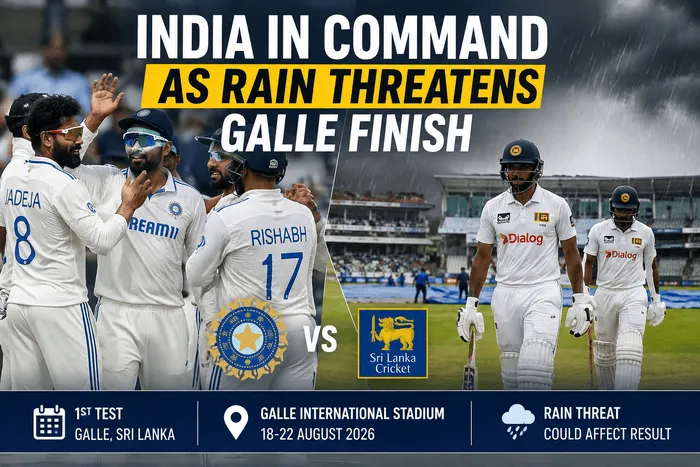
Table of Contents
- India vs Sri Lanka 1st Test Match Situation
- How India Took a 178-Run First-Innings Lead
- Sri Lanka’s First-Innings Fightback Falls Short
- Ravindra Jadeja Reaches 350 Test Wickets
- India Extend Their Lead in the Second Innings
- Rain Threatens India’s Victory Push in Galle
- Dinesh Chandimal Injury Adds to Sri Lanka’s Problems
- Galle Pitch Conditions and Spin Factor
- What India Need to Force a Result
- Can Sri Lanka Survive India’s Bowling Attack?
- Galle Weather Forecast and Match Impact
- Key Performers From the 1st Test
- India vs Sri Lanka 1st Test Latest Update
- Frequently Asked Questions
- Final Thoughts
India vs Sri Lanka 1st Test Match Situation
India have strengthened their grip on the Galle Test after taking a 178-run first-innings lead and building a massive advantage in their second innings.
India remain firmly in control of the India vs Sri Lanka 1st Test at the Galle International Stadium. After posting 462 in their first innings, India bowled Sri Lanka out for 284 to secure a valuable 178-run first-innings lead. Manav Suthar and Ravindra Jadeja were the main architects of that advantage, sharing seven wickets between them.
Sri Lanka showed some resistance through their middle and lower order, but their total still left India with a strong position. Suthar finished with 4/76 on his Test debut, while Jadeja claimed 3/57 and also reached the landmark of 350 Test wickets.
India Build a Huge Second-Innings Lead
India then returned to bat and continued extending their advantage. At lunch on Day 4, they were 116/4, giving them an overall lead of 294 runs. Later updates showed India moving beyond a 350-run advantage, with the visitors looking to give their bowlers enough time to dismiss Sri Lanka again.
Rishabh Pant has also added another major milestone to the contest, becoming the first Indian batter to hit 100 Test sixes and the fastest player to reach the mark in Test cricket.
| Match Situation | India | Sri Lanka |
|---|---|---|
| First Innings | 462 | 284 |
| First-Innings Lead | 178 runs | Trail by 178 |
| Second Innings | Building a huge lead | Awaiting second innings |
| Match Advantage | India | Under pressure |
Match takeaway: India have created a dominant position, but the final result will depend on how quickly they can finish their second innings and how much playing time remains for their bowlers. Rain continues to be the biggest threat to India’s push for victory.
How India Took a 178-Run First-Innings Lead
India posted 462 in Galle before their spinners helped bowl Sri Lanka out for 284, creating the foundation for their commanding position in the Test.
India’s dominance in the first Test began with a commanding batting performance. The visitors posted 462 all out in their first innings, putting Sri Lanka under scoreboard pressure from the start. The major highlight was Devdutt Padikkal’s 167, his maiden Test century, which became the backbone of India’s imposing total.
Padikkal’s innings was particularly important because rain had already interrupted the match earlier in the Test. India needed to make the most of the available batting time, and his long stay at the crease allowed the visitors to build a total that gave their bowlers considerable room to attack.
India’s Batting Created the Pressure
Once India crossed 400, Sri Lanka were facing the difficult task of staying competitive on a Galle surface expected to offer increasing assistance to spin. India also had plenty of bowling resources available, making every additional Sri Lankan wicket potentially costly.
The 462-run total ultimately proved decisive in establishing the first major advantage of the match. Sri Lanka needed a substantial batting effort simply to avoid conceding a large deficit, but India’s spinners prevented the hosts from getting close.
| India First Innings | Performance |
|---|---|
| Total | 462 all out |
| Top Performer | Devdutt Padikkal — 167 |
| Opposition Total | Sri Lanka — 284 |
| First-Innings Lead | 178 runs |
The 178-Run Lead Changed the Match
Sri Lanka’s eventual 284 meant India entered their second innings with a 178-run advantage. That gave India the freedom to attack in their second innings rather than worrying about setting up a conventional Test total.
With two full innings still potentially available and rain already affecting the schedule, India’s challenge became one of time management: score quickly enough to create an unmanageable target, then leave their bowlers sufficient overs to force a result.
Key takeaway: India’s 462 and Padikkal’s 167 gave the visitors the platform they needed. Sri Lanka’s 284 left India with a 178-run lead, putting the match firmly on India’s terms.
Sri Lanka’s First-Innings Fightback Falls Short
Sri Lanka showed resistance after India’s huge first-innings total, but India’s spin attack eventually bowled them out for 284 in Galle.
Sri Lanka entered their first innings needing a substantial batting effort after India posted 462. The hosts managed periods of resistance, but they could not build enough partnerships to keep pace with India’s total. Sri Lanka were eventually dismissed for 284, leaving India with a 178-run first-innings advantage.
The deficit was particularly damaging because the Galle surface was beginning to offer increasing assistance to spin. India’s bowling attack was able to exploit those conditions effectively, putting sustained pressure on the Sri Lankan middle and lower order.
Suthar Makes an Immediate Impact
India debutant Manav Suthar was one of the major stories of the innings. The left-arm spinner finished with 4/76, providing India with crucial breakthroughs when Sri Lanka threatened to establish partnerships. His ability to maintain pressure alongside the more experienced Ravindra Jadeja made India’s spin attack particularly effective.
Jadeja Adds More Pressure
Ravindra Jadeja took 3/57, continuing his influence with both bat and ball. His experience on a turning Galle surface allowed India to keep attacking even when Sri Lankan batters attempted to rebuild the innings.
| Sri Lanka First Innings | India’s Bowling Response |
|---|---|
| Sri Lanka Total | 284 all out |
| Deficit | 178 runs |
| Manav Suthar | 4/76 |
| Ravindra Jadeja | 3/57 |
| India’s Advantage | 178-run first-innings lead |
Sri Lanka’s inability to reduce the deficit meant India could approach their second innings aggressively. Instead of protecting a small lead, the visitors had the freedom to attack and build a target that would require Sri Lanka to bat for a long period under pressure.
Key takeaway: Sri Lanka’s 284 showed resistance but not enough to avoid a major deficit. India’s spin combination of Suthar and Jadeja was central to securing the 178-run lead.
Ravindra Jadeja Reaches 350 Test Wickets
Ravindra Jadeja created Test history against Sri Lanka in Galle by reaching 350 wickets and joining an elite all-rounders’ club.
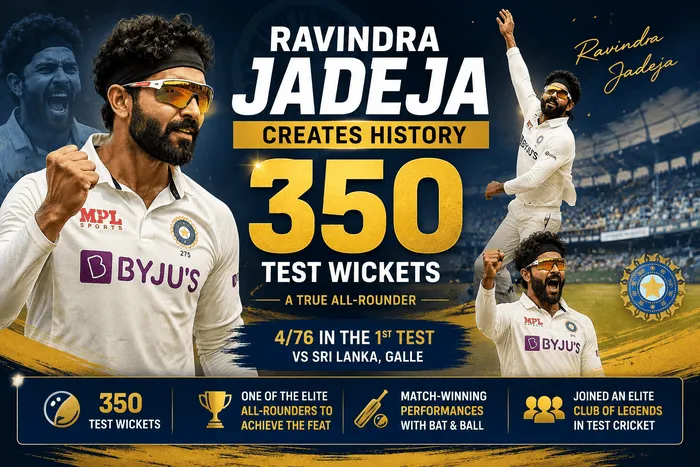
Ravindra Jadeja added another major achievement to his Test career during India’s first Test against Sri Lanka in Galle. The left-arm spinner claimed his 350th Test wicket, becoming only the fifth Indian bowler to reach the landmark. The milestone also placed him alongside some of the greatest all-rounders in Test history.
Jadeja entered the Test needing only two wickets to reach 350. He eventually completed the landmark during Sri Lanka’s first innings, where he finished with 3/57. His performance helped India bowl Sri Lanka out for 284 and secure a 178-run first-innings lead.
Fourth Player to Complete the 4,000-Run, 350-Wicket Double
The significance of the achievement goes beyond the wicket tally. Jadeja became only the fourth player in Test cricket to combine more than 4,000 runs with at least 350 wickets. He joined Kapil Dev, Ian Botham and Daniel Vettori in the elite group.
| Jadeja Milestone | Achievement |
|---|---|
| Test Wickets | 350+ |
| Test Runs | 4,000+ |
| Test Matches | 90 |
| Elite Club | 4th player in Test history |
| Other Members | Kapil Dev, Ian Botham, Daniel Vettori |
| 1st Test Bowling Figures | 3/57 |
Another Landmark for India’s Premier All-Rounder
The achievement underlines Jadeja’s unusual value as a Test cricketer. He has combined reliable batting, left-arm spin and elite fielding throughout his career, allowing India to use him as both a frontline bowler and a genuine all-round option.
His 350th wicket also arrived at a crucial moment for India. Alongside debutant Manav Suthar, who took 4/76, Jadeja helped dismantle Sri Lanka’s batting lineup on a surface offering significant assistance to spin.
Milestone takeaway: Jadeja’s 350th Test wicket is not just a numerical landmark. By combining 4,000-plus Test runs with 350-plus wickets, he has joined one of the most exclusive all-rounder clubs in Test cricket.
India Extend Their Lead in the Second Innings
India continued to build a commanding advantage on Day 4, reaching 193/8 and taking their overall lead to 371 runs despite losing wickets regularly.
India’s second innings has followed a more aggressive and risk-taking approach as the visitors attempt to create enough time for their bowlers to force a result. After gaining a 178-run first-innings lead, India returned to bat with the clear objective of extending the advantage quickly rather than spending another full day at the crease.
At the latest verified Day 4 score update, India had reached 193/8, giving them a massive overall lead of 371 runs. The visitors had lost wickets regularly, but the growing target remained the most important factor as India looked to put Sri Lanka under pressure in the final innings.
Sri Lanka Fight Back With the Ball
Sri Lanka’s bowlers have not allowed India to bat completely freely. Asitha Fernando led the attack with four wickets, while Prabath Jayasuriya added three wickets. Their breakthroughs prevented India from simply accelerating without losing wickets and kept the hosts involved in the contest.
India Have a Huge Fourth-Innings Advantage
Even with eight wickets down, India’s position remains extremely strong. A target above 370 would already represent an enormous fourth-innings challenge, particularly on a Galle surface where spin is becoming increasingly important.
The bigger question is now timing rather than the size of India’s lead. Every additional run improves India’s safety margin, but every over spent batting reduces the time available to dismiss Sri Lanka. With rain having already interrupted several days of the Test, India’s declaration strategy could ultimately determine whether their dominance produces a win or a draw.
| India Second Innings | Latest Position |
|---|---|
| Score | 193/8 |
| First-Innings Lead | 178 runs |
| Overall Lead | 371 runs |
| Top Sri Lankan Bowler | Asitha Fernando — 4 wickets |
| Other Leading Bowler | Prabath Jayasuriya — 3 wickets |
Second-innings takeaway: India have already created a huge lead, but the remaining overs are extremely valuable. The visitors must balance adding runs with giving their bowling attack enough time to take 10 Sri Lankan wickets.
Rain Threatens India’s Victory Push in Galle
India’s dominant position is clear, but rain and lost playing time remain the biggest obstacles to a potential result in the Galle Test.
India have done almost everything required to put themselves in a winning position, but the rain threat in Galle remains a crucial factor. The opening Test has already been affected by weather interruptions, including a significantly shortened first day and further delays during the match. That lost time has become increasingly important now that India are trying to force a result.
India entered the fourth innings equation with a huge advantage after taking a 178-run first-innings lead. By the latest Day 4 position, their second innings had reached 193/8, leaving them 371 runs ahead overall. The visitors therefore have the scoreboard pressure firmly on Sri Lanka, but they also need enough remaining overs to dismiss the hosts for a second time.
Why Every Lost Over Matters
In a Test where one team is already in such a commanding position, weather can become the opposition’s biggest ally. India cannot simply add runs indefinitely because every additional over spent batting reduces the time available for their bowlers. The challenge is to choose the right moment to declare or finish the innings and maximize the opportunity for a result.
The Galle surface has also shown increasing turn and bounce, which should encourage India’s spin attack. However, those conditions only matter if sufficient playing time remains.
| Rain Factor | Impact on the Test |
|---|---|
| Previous Interruptions | Several periods of play have already been affected |
| India’s Position | 371-run lead at the latest Day 4 position |
| Main Concern | Remaining overs to dismiss Sri Lanka |
| Pitch Factor | Increasing assistance for spin |
Rain takeaway: India have created enough scoreboard pressure to dominate the Test, but weather could ultimately determine whether that dominance converts into a victory. The visitors must balance their declaration timing with the possibility of further interruptions.
Dinesh Chandimal Injury Adds to Sri Lanka’s Problems
Dinesh Chandimal has been ruled out of the remainder of the Galle Test after suffering a shoulder and neck injury while fielding on Day 4.
Sri Lanka suffered another setback on Day 4 when experienced batter Dinesh Chandimal was forced off the field after suffering a right shoulder and neck injury. Chandimal was attempting to prevent a boundary during India’s second innings when he dived and landed awkwardly, immediately appearing to be in significant discomfort.
The 36-year-old was initially taken from the ground for medical attention and subsequently underwent precautionary scans. The injury became an additional concern for Sri Lanka because the hosts were already facing a huge target after India established a commanding first-innings lead and then extended it in the second innings.
Chandimal Ruled Out of the Test
The situation later became clearer, with Chandimal ruled out for the remainder of the Test. Match officials approved Pasindu Sooriyabandara as his concussion substitute, giving Sri Lanka another batting option for their fourth-innings chase.
Another Problem for Sri Lanka’s Chase
Chandimal’s absence comes at an important stage of the match. India eventually set Sri Lanka a target of 372 runs, after being dismissed for 193 in their second innings. Rishabh Pant’s attacking 66 and Devdutt Padikkal’s 44 helped India establish the imposing target.
Chandimal had scored only four runs in Sri Lanka’s first innings, but his experience remains valuable in a pressure situation. With India looking to exploit a Galle surface offering assistance to spin, losing an experienced batter further complicates Sri Lanka’s attempt to survive the final innings.
| Chandimal Injury Update | Latest Information |
|---|---|
| Injury | Right shoulder and neck |
| Incident | Diving attempt to save a boundary |
| Medical Action | Hospital scans |
| Match Status | Ruled out of the Test |
| Replacement | Pasindu Sooriyabandara |
Injury takeaway: Chandimal’s absence is another blow for Sri Lanka at a critical stage of the Galle Test. With India setting a 372-run target, the hosts now need a major batting effort from their remaining players and concussion substitute Sooriyabandara.
Galle Pitch Conditions and Spin Factor
The Galle surface has become increasingly helpful for spin, making India’s attack of Jadeja, Suthar and Kuldeep particularly important in the final stages of the Test.
The Galle International Stadium pitch has played an important role in shaping the India vs Sri Lanka 1st Test. The surface offered reasonable batting conditions early in the match, allowing India to build a huge first-innings total, but it has increasingly provided turn and bounce as the Test has progressed.
That development is particularly significant because both teams entered the match expecting spin to be a major factor. India’s bowling combination included three left-arm spinners — Ravindra Jadeja, Kuldeep Yadav and debutant Manav Suthar — reflecting the conditions expected in Galle.
Spin Has Become India’s Biggest Weapon
India’s spinners have already demonstrated how effective they can be on this surface. Suthar claimed 4/76 on debut, while Jadeja took 3/57 as Sri Lanka were dismissed for 284. Their ability to repeatedly attack the stumps and extract assistance from the pitch was central to India’s 178-run first-innings lead.
Why the Pitch Favors India in the Final Innings
Sri Lanka now face an extremely difficult fourth-innings challenge. A target of 372 runs has been set, and the pitch is no longer at its easiest for batting. India’s spinners can attack from both ends while using the rough and natural variation to create pressure.
The surface does not guarantee a result, however. Time remains the biggest variable because rain has already interrupted the Test. If enough overs are lost, even favorable pitch conditions may not be enough for India to take all 10 wickets.
| Pitch Factor | Expected Match Impact |
|---|---|
| Early-Test Batting | Generally favorable for stroke-making |
| Later-Test Surface | Increasing turn and bounce |
| Spin Factor | Very important |
| India’s Advantage | Three quality spin options |
| Fourth-Innings Challenge | 372-run target on a deteriorating surface |
Pitch takeaway: The longer the Test has gone, the more valuable spin has become. India’s ability to exploit the turning Galle surface gives them a major bowling advantage, provided rain does not remove too much playing time.
What India Need to Force a Result
India have set Sri Lanka a 372-run target, but the biggest challenge now is taking 10 wickets before rain or lost time ends their victory push.
India have already created the scoreboard pressure required for a potential Test victory. After being bowled out for 193 in their second innings, India set Sri Lanka a target of 372 runs. The visitors therefore do not need to chase further runs; their entire focus now shifts to taking 10 wickets.
The equation is particularly favorable because the Galle surface has begun offering increasing assistance to spin. India have already demonstrated the effectiveness of their slow-bowling attack, with Manav Suthar taking 4/76 and Ravindra Jadeja claiming 3/57 in Sri Lanka’s first innings.
Early Wickets Will Be Crucial
India’s best route to victory is to strike early and prevent Sri Lanka from building a long opening partnership. A couple of wickets in the first session could expose the middle order to a deteriorating surface and increase the pressure of the enormous target.
Spin Could Decide the Final Innings
Jadeja, Suthar and India’s other bowling options can attack the stumps and use the increasing turn at Galle. Suthar’s debut has already shown how much assistance a left-arm spinner can extract from the surface. His 4/76 was one of the defining performances of the match so far.
Time Remains India’s Biggest Concern
The only major obstacle to India’s victory equation is time. Rain has already interrupted this Test, meaning India cannot assume that every scheduled over will be available. Even a target of 372 becomes less useful if repeated weather interruptions remove the overs required to take all 10 wickets.
| Victory Requirement | India’s Situation |
|---|---|
| Target | 372 runs |
| Wickets Required | 10 Sri Lankan wickets |
| Key Bowling Strength | Left-arm spin |
| Pitch Advantage | Increasing turn and bounce |
| Biggest Threat | Rain and lost playing time |
Victory takeaway: India’s route is straightforward — take early wickets, keep attacking with spin and maximize every available over. Sri Lanka’s 372-run target provides India with a huge safety margin, but weather could still prevent them from completing the job.
Can Sri Lanka Survive India’s Bowling Attack?
Sri Lanka face a difficult fourth-innings challenge after India set a 372-run target on a Galle surface offering increasing assistance to spin.
Sri Lanka’s immediate objective is not necessarily to chase down the 372-run target. With the Galle pitch offering increasing turn and bounce, their more realistic route is to bat time, preserve wickets and force India to work for every breakthrough. A long, disciplined innings would also keep the possibility of a draw alive if rain continues to interrupt play.
The hosts will need a much stronger batting performance than they managed in the first innings, when they were dismissed for 284. India’s spin attack has already shown that it can create sustained pressure, with Manav Suthar taking four wickets and Ravindra Jadeja claiming three.
The Opening Partnership Could Be Crucial
Sri Lanka’s best chance of surviving the final innings could be an extended opening partnership. New batters need to avoid unnecessary risks, particularly against India’s spinners. If the opening pair can negotiate the first spell without losing wickets, the pressure on the middle order will be reduced.
Rain Could Become Sri Lanka’s Biggest Ally
Weather is arguably the hosts’ most significant advantage. India need 10 wickets, while Sri Lanka only need to survive the available playing time. Any substantial rain interruption would reduce India’s opportunity to complete the victory and increase the possibility of a draw.
| Sri Lanka’s Priority | Why It Matters |
|---|---|
| Protect Early Wickets | Prevents India from exposing the middle order quickly |
| Play for Time | Every surviving session reduces India’s victory window |
| Counter Spin Carefully | Galle is offering increasing turn and bounce |
| Use Weather | Rain interruptions could help preserve a draw |
Sri Lanka takeaway: A successful chase would require an extraordinary batting performance, but survival is a more realistic objective. If Sri Lanka can preserve wickets and rain removes significant playing time, they have a pathway to escape with a draw.
Galle Weather Forecast and Match Impact
Rain has already interrupted the Galle Test, and further showers could determine whether India have enough time to force a result.
The Galle weather forecast remains one of the most important factors in the India vs Sri Lanka 1st Test. India have created a dominant position, but the match has already lost valuable playing time because of rain. Day 2 was heavily affected by weather, while further interruptions remained a concern as the Test moved into its decisive stages.
That makes the final phase particularly interesting. India have now set Sri Lanka a 372-run target and need 10 wickets to complete a victory. Sri Lanka, meanwhile, can benefit from every weather interruption because their objective is to survive the available playing time rather than chase the target at all costs.
Rain Could Change the Result
Forecast reports for Galle have repeatedly indicated a risk of showers during the Test. Earlier predictions showed substantial precipitation chances across several parts of the day, while Day 4 forecasts also warned of cloudy conditions and possible rain interruptions.
If the weather allows long uninterrupted sessions, India’s spin attack should have an excellent opportunity to attack Sri Lanka on a deteriorating surface. But repeated showers, delays and wet outfield conditions could remove the overs India need to take all 10 wickets.
India vs Rain: The Final Contest
The scoreboard is heavily in India’s favor, but weather is effectively giving Sri Lanka another defensive weapon. A few lost sessions could be enough to turn a likely Indian win into a draw.
| Weather Factor | Potential Impact |
|---|---|
| Rain Risk | Significant |
| Previous Lost Time | Already affected the Test |
| India’s Requirement | 10 wickets |
| Sri Lanka’s Advantage | Every lost over helps survival |
| Potential Result Impact | Rain could turn an India win into a draw |
Weather takeaway: India have the cricketing advantage, but Galle’s weather could decide whether that advantage produces a result. If enough uninterrupted overs are available, India should have a strong opportunity to attack Sri Lanka with spin.
Key Performers From the India vs Sri Lanka 1st Test
Devdutt Padikkal, Manav Suthar and Ravindra Jadeja have been among India’s standout performers, while Sri Lanka’s bowlers have shown resistance despite the pressure.
India’s commanding position in the Galle Test has been built around several individual performances. While the visitors have operated effectively as a unit, a few players have made particularly significant contributions with either bat or ball.
Devdutt Padikkal — India’s Batting Standout
Devdutt Padikkal has been one of the biggest stories of the Test. He scored a magnificent 167 in India’s first innings, registering his maiden Test century. His long innings provided India with the foundation for their imposing 462 total and helped establish the first major advantage of the match.
Manav Suthar — Dream Test Debut
Debutant Manav Suthar immediately made an impact with the ball. His figures of 4/76 were crucial as Sri Lanka were dismissed for 284. Suthar repeatedly attacked the stumps and extracted useful assistance from the Galle surface.
Ravindra Jadeja — Milestone and Match Impact
Ravindra Jadeja combined a major personal milestone with an important bowling contribution. He claimed his 350th Test wicket and finished Sri Lanka’s first innings with 3/57. His experience has been particularly valuable on a turning surface.
Rishabh Pant Adds Firepower
Rishabh Pant also produced an important second-innings contribution, scoring 66 as India pushed towards a declaration-style target. His aggressive approach helped India add runs quickly while preserving the opportunity for their bowlers to attack Sri Lanka.
| Player | Team | Key Contribution |
|---|---|---|
| Devdutt Padikkal | India | 167 runs |
| Manav Suthar | India | 4/76 |
| Ravindra Jadeja | India | 350th Test wicket, 3/57 |
| Rishabh Pant | India | 66 runs |
Key-performer takeaway: Padikkal’s 167 created India’s first-innings platform, while Suthar and Jadeja led the spin attack. Pant’s aggressive 66 then helped India establish the 372-run target and give their bowlers a genuine chance to force the result.
India vs Sri Lanka 1st Test Latest Update
India have set Sri Lanka a 372-run target after being bowled out for 193 in the second innings, leaving the hosts facing a difficult final-innings challenge in Galle.
The latest development from the India vs Sri Lanka 1st Test has moved the match into its decisive phase. India were bowled out for 193 in their second innings on Day 4, setting Sri Lanka a target of 372 runs. The visitors had already taken a 178-run first-innings lead after dismissing Sri Lanka for 284.
Rishabh Pant provided the attacking spark India needed, scoring 66 from 69 balls. His aggressive approach helped India add important runs despite losing wickets regularly. India eventually finished their second innings at 193, leaving Sri Lanka with a substantial target and a difficult task on a surface offering increasing assistance to spin.
Sri Lanka Begin the Final Chase Under Pressure
Sri Lanka now need 372 runs to win the Test, while India require 10 wickets to complete a victory. The target is imposing, particularly because Galle has become more challenging for batting as the match has progressed. A successful chase would also be historically significant, with only Pakistan previously chasing a 300-plus target at Galle, when they reached 344 against Sri Lanka in 2022.
Chandimal’s Absence Adds Another Concern
Sri Lanka’s task has become harder because Dinesh Chandimal has been ruled out of the remainder of the Test due to concussion. Pasindu Sooriyabandara has been approved as his concussion substitute and is set to make his Test debut during Sri Lanka’s fourth-innings chase.
| Latest Match Situation | Update |
|---|---|
| India 1st Innings | 462 |
| Sri Lanka 1st Innings | 284 |
| India 2nd Innings | 193 all out |
| Target for Sri Lanka | 372 runs |
| India’s Requirement | 10 wickets |
| Key Sri Lankan Absence | Dinesh Chandimal — ruled out |
Latest update takeaway: India have created an excellent position with a 372-run target, but the result will still depend on how many overs remain and whether rain interrupts Sri Lanka’s chase. The hosts face an enormous challenge, while India need to turn scoreboard dominance into 10 wickets.
India vs Sri Lanka 1st Test FAQs
Key questions about India’s lead, the 372-run target, Jadeja’s milestone, rain threat and the latest Galle Test situation.
India were bowled out for 193 in their second innings and set Sri Lanka a target of 372 runs. India need 10 wickets to win, while Sri Lanka need 372 runs.
India scored 462 in their first innings, with Devdutt Padikkal making a standout 167.
Sri Lanka were dismissed for 284, giving India a 178-run first-innings lead.
Ravindra Jadeja reached 350 Test wickets against Sri Lanka and became only the fourth player to combine more than 4,000 Test runs with at least 350 wickets.
Rain has already caused interruptions during the Test. India need enough uninterrupted playing time to take all 10 Sri Lankan wickets, so further delays could reduce their chances of forcing a result.
Devdutt Padikkal was India’s leading scorer with 167 runs, his maiden Test century.
India set Sri Lanka a target of 372 runs after being dismissed for 193 in their second innings.
Dinesh Chandimal suffered a right shoulder and neck injury while fielding and was subsequently ruled out of the remainder of the Test. Pasindu Sooriyabandara was approved as his concussion substitute.
Manav Suthar and Ravindra Jadeja have been particularly important. Suthar took 4/76 and Jadeja claimed 3/57 in Sri Lanka’s first innings.
Sri Lanka face a major challenge, but further rain interruptions could reduce the available playing time and improve their chances of securing a draw.
India vs Sri Lanka 1st Test: Final Thoughts
India have put themselves in a commanding position in Galle, but rain remains the biggest factor between their dominance and a possible Test victory.
The India vs Sri Lanka 1st Test has reached a fascinating stage. India posted 462 in their first innings, dismissed Sri Lanka for 284 to secure a 178-run lead, and then set the hosts a target of 372 runs after making 193 in their second innings.
Several Indian players have played important roles in establishing that advantage. Devdutt Padikkal’s 167 provided the foundation for India’s huge first-innings total, while debutant Manav Suthar’s 4/76 showed that India’s spin attack can be highly effective on the Galle surface.
Ravindra Jadeja also produced a landmark performance by reaching 350 Test wickets and joining an elite group of all-rounders. His experience, combined with Suthar and India’s other bowling options, gives the visitors a strong chance of putting Sri Lanka under sustained pressure.
Sri Lanka’s challenge is enormous. Chasing 372 on a surface offering increasing turn is difficult enough, while the absence of Dinesh Chandimal creates another problem for the hosts. Their best route may be to bat for time, protect wickets and hope weather interruptions reduce India’s available overs.
99ExCh Final Take: India have the clear cricketing advantage and are in the stronger position to force a result. However, the weather remains the decisive variable. If India get enough uninterrupted overs, their spin attack should have a strong opportunity to take the remaining wickets.
For the latest developments, follow the match situation closely as the Test enters its decisive phase. Playing conditions, rain interruptions and the performance of India’s spinners will determine whether the visitors convert their dominant position into a victory.