
England vs Pakistan 1st Test: Pakistan Collapse as England Win by 103 Runs
England produced a dominant performance at Headingley, defeating Pakistan by an innings and 103 runs after dismissing them for 171 and 135 in their two innings. Ollie Robinson and Josh Tongue led England’s pace attack, while Pakistan’s batting collapse proved decisive.
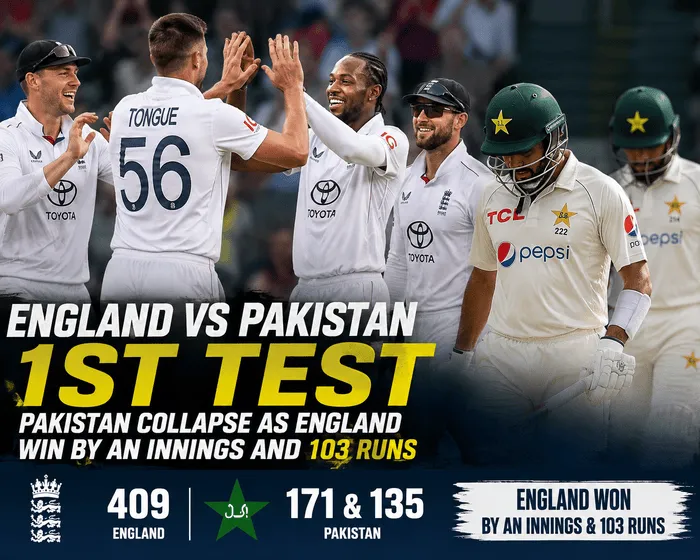
England vs Pakistan 1st Test: Match Overview
England made a powerful start to the three-match Test series against Pakistan, winning the opening match by an innings and 103 runs at Headingley, Leeds. The result was completed on August 21 after Pakistan were dismissed for 135 in their second innings, having already been bowled out for 171 in the first innings.
England’s victory was built around a disciplined pace-bowling performance and a strong first-innings batting display. Ollie Robinson and Josh Tongue were the standout bowlers, taking eight wickets each across the match. Their ability to consistently challenge Pakistan’s batters with pace and movement made it difficult for the visitors to establish long partnerships.
Pakistan’s first innings ended at 171, giving England an early opportunity to take control. England then capitalized on that advantage by scoring 409, with Harry Brook leading the way with 91. Jordan Cox scored 73, Joe Root made 66 and Dan Lawrence contributed 51 as England established a substantial 238-run first-innings lead.
That deficit left Pakistan with an extremely difficult task in the second innings. Instead of producing the response needed to extend the Test, Pakistan again lost wickets at regular intervals. Mohammad Rizwan’s 41 provided some resistance, but England’s bowlers maintained control and dismissed the visitors for 135.
The result gave England a 1-0 lead in the series and provided an immediate boost to Joe Root’s return as Test captain. For Pakistan, the defeat highlighted major concerns around their top-order stability, ability to handle England’s seam attack and their failure to build meaningful partnerships in English conditions.
Match Result: England defeated Pakistan by an innings and 103 runs at Headingley to take a 1-0 lead in the three-match Test series.
Pakistan Collapse in Both Innings
Pakistan’s biggest problem at Headingley was the inability to produce a sustained batting response in either innings. After being dismissed for 171 in the first innings, the visitors needed a significant improvement when they returned to bat with a 238-run deficit. Instead, England’s bowlers continued to find regular breakthroughs and Pakistan were bowled out for just 135.
The first innings began with immediate pressure when Ollie Robinson dismissed Azan Awais with the opening delivery of the Test. Abdullah Shafique provided some resistance with 61, while Imam-ul-Haq contributed 42, but Pakistan could not turn those starts into a substantial team total.
Robinson and Josh Tongue were particularly effective. Both England fast bowlers finished the first innings with five-wicket hauls, leaving Pakistan without the opportunity to build a competitive total. Robinson returned figures of 5-51, while Tongue claimed 5-46.
The second innings followed a similar pattern. Imam-ul-Haq was dismissed without scoring, and Azan Awais soon followed as England’s new-ball attack put Pakistan under pressure again. Shan Masood scored 29, while Mohammad Rizwan fought back with an aggressive 41, but the lower order could not sustain the resistance.
Josh Tongue again became central to the collapse, removing Saud Shakeel, Shan Masood and Salman Ali Agha. England eventually dismissed Pakistan for 135 in 37.3 overs, completing an innings victory before the match could move into a fourth day.
The two innings exposed a recurring weakness in Pakistan’s batting. Individual contributions were not enough because the team repeatedly lost clusters of wickets before meaningful partnerships could develop. Against an England attack operating with confidence, those collapses made recovery extremely difficult.
Key Concern: Pakistan scored only 306 runs across both innings, while England’s 409 in their single innings was enough to establish a 238-run lead and put the match firmly beyond Pakistan’s reach.
Ollie Robinson and Josh Tongue Lead England’s Pace Attack
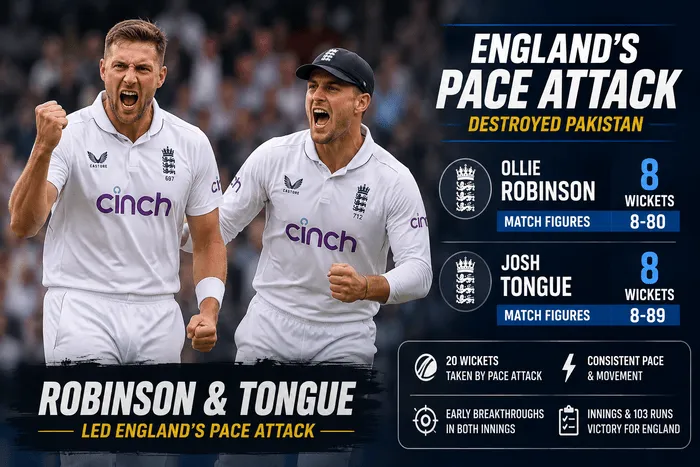
England’s pace attack was the biggest difference between the two teams at Headingley. Ollie Robinson and Josh Tongue repeatedly found ways through Pakistan’s batting lineup, combining control, movement and consistent pressure across both innings.
Robinson set the tone from the very first delivery of the Test. He dismissed Azan Awais with the opening ball, immediately putting Pakistan’s top order under pressure. He continued to trouble the visitors throughout the first innings and finished with five wickets for 51 runs.
Josh Tongue provided an equally damaging contribution from the other end. His first-innings spell ended with five wickets for 46 runs, meaning both England fast bowlers completed five-wicket hauls in the same innings.
Their impact continued after Pakistan were asked to bat again. Robinson added three more wickets, while Tongue claimed another three as England completed the second-innings collapse. Robinson finished the match with eight wickets for 80 runs, while Tongue ended with eight wickets for 89 runs.
The pressure created by the two seamers also allowed England to attack with aggressive field placements. Pakistan were rarely able to settle for long periods, and wickets arrived before partnerships could develop into match- changing stands.
Joe Root’s Captaincy Makes an Immediate Impact
Joe Root could hardly have asked for a stronger return to the England Test captaincy. Leading the side again at Headingley, Root watched his team complete an innings-and-103-run victory over Pakistan and take a 1-0 lead in the three-match series.
England’s decision to bowl first after winning the toss immediately paid off. Ollie Robinson removed Azan Awais with the opening delivery of the match, setting the tone for an aggressive bowling performance. Root’s field settings then helped England maintain pressure as Pakistan struggled to build partnerships.
One of the most notable tactical moments came in Pakistan’s second innings when Root positioned himself at leg slip. The move paid off when Azan Awais edged Jofra Archer and Root completed the catch. That dismissal also created a major personal milestone for the England captain.
With that catch, Root moved to 219 catches in Test cricket and overtook Australia’s Steven Smith, who had previously held the record for the most catches by a non-wicketkeeper in Test history. The milestone added another significant moment to an already impressive return to the captaincy.
Root’s leadership was not limited to his field placements. England consistently attacked Pakistan with a combination of pace, close catching positions and pressure-building fields. The approach helped the bowlers stay on the front foot, particularly when Pakistan’s middle and lower order attempted to resist.
Root also contributed with the bat. He scored 66 during England’s first innings, joining Harry Brook, Jordan Cox and Dan Lawrence among the players who helped England build a commanding total of 409. That score ultimately gave England a 238-run first-innings lead.
Captaincy Highlight: Root’s aggressive field positioning, including his leg-slip placement, helped England create key opportunities while his 66 with the bat strengthened the team’s control of the Test.
England’s Batting Made Pakistan’s Task Even Harder
England’s bowling attack put Pakistan under pressure, but the home side’s batting performance ensured that the visitors had very little chance of recovering from their first-innings collapse. England converted their bowling advantage into a commanding total of 409, creating a 238-run lead before Pakistan returned to bat.
Harry Brook was England’s leading run-scorer with 91 from 93 balls. His aggressive approach prevented Pakistan’s bowlers from building sustained pressure and helped England keep the scoreboard moving even when wickets fell.
Jordan Cox also made an important contribution with 73, while Joe Root scored 66 during his first Test match as England captain in his latest stint. Dan Lawrence added another valuable 51, giving England several substantial contributions rather than relying on one batter to carry the innings.
That depth proved crucial. Pakistan’s bowlers needed to remove England’s established batters quickly after the early breakthroughs, but the middle order repeatedly rebuilt the innings. Every partnership increased the pressure on Pakistan and reduced the impact of their first-innings bowling success.
Ali Usman provided Pakistan with a major individual highlight by taking five wickets for 92 runs. However, England’s batting depth meant that his five-wicket haul did not translate into a competitive position for the visitors.
By the time England were dismissed for 409, Pakistan were facing a deficit of 238 runs. That margin changed the nature of the Test completely. Pakistan needed to produce an exceptional second-innings batting performance simply to make England bat again.
Instead, England’s bowlers returned with the same intensity and dismissed Pakistan for 135. The combination of a strong first-innings total and relentless pace bowling therefore became the central reason England completed the Test inside three days.
Pakistan’s Opening Partnership Problem Continues
One of the most worrying statistics to emerge from Pakistan’s defeat at Headingley is their continuing struggle to build reliable opening partnerships in England. The problem has now stretched across 27 Test innings on English soil without a 50-run opening stand. Pakistan’s last opening partnership of at least 50 runs in England came back in 2010.
The Headingley Test extended that unwanted run in both innings. In the first innings, Azan Awais was dismissed by Ollie Robinson with the very first ball of the series. That left Pakistan immediately exposed to England’s new-ball attack and put pressure on the rest of the batting order from the start.
Abdullah Shafique and Imam-ul-Haq did manage to provide some stability after the early damage. Shafique eventually scored 61, while the pair produced a 91-run third-wicket partnership. However, because the opening combination had already failed, England’s bowlers were able to attack the middle order earlier than Pakistan would have wanted.
The second innings brought another poor start. Imam-ul-Haq was dismissed for a duck by Jofra Archer, while Azan Awais was removed soon afterwards. Pakistan were reduced to 13 for two, leaving England in complete control during the opening phase of the innings.
The significance of the statistic goes beyond one match. In English conditions, early wickets allow seamers to attack with attacking fields while the ball is still moving. A stable opening partnership can absorb that initial pressure and give the middle order a better platform, but Pakistan have repeatedly struggled to achieve that on recent tours.
For Pakistan, fixing this issue will be one of the most important priorities before the second Test at Lord’s. England’s pace attack has already demonstrated how effectively it can exploit early wickets, so another fragile start could put the visitors under pressure before their middle order has time to settle.
Unwanted Record: Pakistan have now gone 27 Test innings in England without a 50-plus opening partnership, with the last one coming in 2010.
Pakistan’s Fielding and Bowling Also Fell Short
Pakistan’s batting collapse was the clearest reason for the heavy defeat, but their bowling and fielding also made it difficult to put England under sustained pressure at Headingley. After dismissing England’s top order at different stages, Pakistan were unable to prevent the home side from rebuilding and reaching 409.
Ali Usman provided Pakistan’s strongest individual bowling performance of the match, taking five wickets for 92 runs. His five-wicket haul showed that Pakistan could create pressure when their bowlers found the right areas, but the attack lacked the collective consistency needed to restrict England’s scoring.
England’s middle order repeatedly turned promising moments for Pakistan into extended partnerships. Harry Brook’s 91 was particularly important, while Jordan Cox, Joe Root and Dan Lawrence also made substantial contributions. By the time Pakistan finally dismissed England for 409, the damage had already been done.
Fielding also became an important part of the difference between the teams. England’s fielders supported their bowlers with sharp catching and aggressive positioning, allowing Root to maintain attacking fields throughout Pakistan’s innings.
Joe Root’s leg-slip catch to dismiss Azan Awais in the second innings was one of the clearest examples. Dan Lawrence also completed an important catch at backward square leg when Josh Tongue removed Saud Shakeel, helping England maintain their grip on the innings.
Pakistan therefore needed improvement in more than one area. Their bowlers had to find ways to sustain pressure after early breakthroughs, while the fielding unit needed to make every opportunity count against an England batting lineup capable of building long partnerships.
Key Takeaway: Pakistan’s five-wicket haul through Ali Usman was a positive individual performance, but England’s greater batting depth and stronger support in the field ultimately made the difference.
Key Performers from the Headingley Test
Ollie Robinson
Ollie Robinson was one of the main reasons England maintained control throughout the Test. He dismissed Azan Awais with the opening delivery and finished the match with eight wickets, including a five-wicket haul in Pakistan’s first innings.
Josh Tongue
Josh Tongue matched Robinson’s impact with eight wickets of his own. His five-wicket haul in the first innings prevented Pakistan from building a competitive total, while three more wickets in the second innings helped complete the collapse.
Harry Brook
Harry Brook provided England with their highest individual score of the match. His 91 helped England move from a position of opportunity into one of complete control and contributed significantly to the team’s 409-run total.
Joe Root
Joe Root contributed in both leadership and batting roles. He scored 66 runs and made a significant fielding contribution with his leg-slip catch of Azan Awais. The catch moved Root to 219 Test catches as a non-wicketkeeper.
Mohammad Rizwan
Mohammad Rizwan offered Pakistan’s strongest resistance in the second innings, scoring 41 from 39 balls. His aggressive approach briefly challenged England’s control, but Pakistan’s lower order could not continue the recovery.
Pakistan’s Bright Spots Despite the Defeat
Pakistan’s defeat at Headingley was comprehensive, but there were still a few individual performances that offered something to build on before the second Test. The biggest positives came from Abdullah Shafique, Mohammad Rizwan and Ali Usman, although none of those contributions were enough to change the result.
Abdullah Shafique provided Pakistan’s best batting performance in the first innings, scoring 61. His innings showed that Pakistan’s batters could withstand England’s pace attack when they settled into the conditions. He also formed a useful partnership with Imam-ul-Haq after Pakistan had lost an early wicket.
Mohammad Rizwan was Pakistan’s leading scorer in the second innings with 41 from 39 balls. His counterattacking approach briefly changed the tempo of the innings and gave Pakistan some resistance after England had reduced them to five wickets down.
Ali Usman was another significant positive. He finished with five wickets for 92 runs and was Pakistan’s only bowler to claim a five-wicket haul in the match. His performance demonstrated that Pakistan’s attack could still create pressure against England’s batting lineup when the bowlers found consistent areas.
The challenge for Pakistan is turning these individual contributions into a collective performance. Shafique’s 61, Rizwan’s 41 and Usman’s five wickets were useful numbers, but England’s overall balance meant that Pakistan needed several players to contribute in the same innings.
The second Test at Lord’s therefore gives Pakistan an immediate opportunity to build on these positives. A stronger opening partnership, longer middle-order stays and greater support for the bowlers could give the visitors a much better chance of competing in the next match.
Positive Takeaway: Abdullah Shafique’s 61, Mohammad Rizwan’s 41 and Ali Usman’s five-wicket haul provide Pakistan with individual positives despite the heavy innings defeat.
What This Loss Means for Pakistan
Pakistan now face an immediate response test after their innings-and-103-run defeat at Headingley. The result leaves them 1-0 behind in the three-match series, with the second Test scheduled at Lord’s from August 27.
The biggest concern is the batting. Pakistan were dismissed for 171 in the first innings and 135 in the second, meaning they never managed to put together a total that could seriously challenge England. The lack of sustained partnerships made England’s task considerably easier.
The opening combination is an especially important area. Pakistan’s long-running record of failing to produce a 50-plus opening partnership in England has now extended to 27 Test innings. A stronger start at Lord’s would give the middle order a better platform and reduce the amount of pressure placed on the batters coming in at No. 3 and below.
Pakistan’s bowlers also need greater support from the batting unit. Ali Usman’s five-wicket haul showed that the attack can create problems, but England’s 409 demonstrated how quickly a good start can lose value when the opposition is allowed to build partnerships.
The team will also have to assess its approach against England’s pace attack. Robinson and Tongue took eight wickets each in the match, while Jofra Archer contributed three wickets in the second innings. Pakistan’s batters will need to find a more effective method of handling the new ball and avoiding clusters of wickets.
Pakistan may also receive a boost from the potential availability of Babar Azam for the Lord’s Test. However, one player’s return cannot by itself resolve the wider batting problems exposed at Headingley. The response will need to come from the entire top and middle order.
Series Situation: Pakistan trail England 1-0 and need a substantially stronger batting performance at Lord’s to level the series.
What This Win Means for England
England’s innings-and-103-run victory at Headingley gives the team an ideal start to Joe Root’s second tenure as full-time Test captain. More importantly, the win showed that England can combine attacking cricket with the flexibility required to control different phases of a Test match.
England dominated the opening Test in all three major departments. Their bowlers dismissed Pakistan for 171 in the first innings, their batters responded with 409, and the pace attack returned to finish Pakistan for 135 in the second innings. That combination left very little opportunity for the visitors to recover.
The performances of Ollie Robinson and Josh Tongue were particularly encouraging. Both bowlers took eight wickets in the match, while Jofra Archer added three wickets in Pakistan’s second innings. The attack therefore showed enough variety and depth to keep Pakistan under pressure throughout the Test.
England’s batting also provided important confidence. Harry Brook’s 91 was the highest score of the match for the home side, while Jordan Cox, Joe Root and Dan Lawrence all made useful contributions. England’s ability to turn several starts into a 409-run total was a major reason Pakistan were unable to recover.
The result also carries significance in the ICC World Test Championship 2025-27. England collected a full victory from the opening match of the series, while Pakistan’s defeat pushed them to the bottom of the current WTC standings according to ICC’s post-match assessment.
England now have a chance to build on that momentum at Lord’s. The second Test is scheduled to begin on August 27, giving the home side several days to assess the Headingley performance and prepare for a different venue.
The biggest positive for England is that the victory did not depend on one department alone. The bowlers created the pressure, the batters converted it into a substantial lead, and Root’s field leadership helped keep Pakistan from finding a way back into the contest.
England’s Advantage: A 1-0 series lead, an in-form pace attack and contributions throughout the batting order give England a strong platform heading into the second Test at Lord’s.
England vs Pakistan 1st Test: Key Statistics
| Venue | Headingley, Leeds |
|---|---|
| England | 409 all out |
| Pakistan 1st Innings | 171 all out |
| Pakistan 2nd Innings | 135 all out |
| England’s First-Innings Lead | 238 runs |
| Match Result | England won by an innings and 103 runs |
| Series Score | England lead 1-0 |
| Harry Brook | 91 runs |
| Jordan Cox | 73 runs |
| Joe Root | 66 runs |
| Abdullah Shafique | 61 runs |
| Ollie Robinson | 8 wickets in the match |
| Josh Tongue | 8 wickets in the match |
| Ali Usman | 5-92 |
| Second Test | August 27, Lord’s |
Match Summary: England’s 238-run first-innings advantage, followed by Pakistan’s second-innings total of 135, resulted in an innings-and- 103-run victory and a 1-0 series lead.
Frequently Asked Questions
England dominated with both bat and ball. Pakistan were dismissed for 171 and 135, while England scored 409. Ollie Robinson and Josh Tongue took eight wickets each in the match, giving England control throughout the Test.
Pakistan scored 171 in their first innings and 135 in their second innings. England scored 409 in their only innings and won the match by an innings and 103 runs.
Ollie Robinson and Josh Tongue were England’s leading bowlers. Both finished the match with eight wickets. Robinson took 5-51 in Pakistan’s first innings, while Tongue claimed 5-46.
Harry Brook was England’s highest scorer with 91 runs. Jordan Cox scored 73, Joe Root made 66 and Dan Lawrence contributed 51 as England reached 409.
Abdullah Shafique was Pakistan’s highest scorer in the first innings, making 61 runs. Imam-ul-Haq also contributed 42.
Mohammad Rizwan top-scored for Pakistan in the second innings with 41 runs from 39 balls, but England eventually dismissed Pakistan for 135.
Pakistan have now gone 27 Test innings in England without producing a 50-plus opening partnership. Their last such partnership in England came in 2010.
The second Test is scheduled to begin on August 27, 2026, at Lord’s. England enter the match with a 1-0 lead in the three-match series.
Final Thoughts
England’s innings-and-103-run victory over Pakistan at Headingley was a comprehensive result that highlighted the difference between the two sides across all three days. Pakistan struggled to build competitive totals in either innings, while England combined disciplined fast bowling with a strong batting performance to take a 1-0 lead in the three-match Test series.
Ollie Robinson and Josh Tongue were central to England’s success, taking eight wickets each in the match. Harry Brook’s 91, along with valuable contributions from Jordan Cox and Joe Root, gave England the substantial first-innings total they needed to put Pakistan under extreme pressure.
For Pakistan, the focus now has to shift quickly toward the second Test at Lord’s. The batting unit needs longer partnerships, the opening combination needs a better start and the bowlers will need greater support from the fielding unit. The first Test exposed several areas that require an immediate response.
England, meanwhile, have momentum on their side. Joe Root’s return to the captaincy began with a convincing win, and the performances of their pace attack provide plenty of confidence heading into the next match.
Looking Ahead: England lead the series 1-0, with the second Test scheduled for August 27 at Lord’s. Pakistan will need a much stronger all-round performance to level the series.