
Mitchell Starc Destroys Bangladesh With 6/12 as 18 Wickets Fall in Mackay Test
Mitchell Starc produced a devastating spell in the second Test at Mackay, taking 6/12 as Bangladesh were bowled out for just 64. The Australian quick reached five wickets in only 22 balls as 18 wickets fell on a dramatic opening day.

Australia vs Bangladesh 2nd Test: Match Overview
Australia vs Bangladesh second Test began with a dramatic opening day in Mackay, where the fast bowlers dominated from the first session. Australia won the toss and elected to field, a decision that immediately paid off as Bangladesh struggled to cope with Australia’s pace attack.
Mitchell Starc was at the centre of the action from the very first delivery. The left-arm fast bowler removed Shadman Islam with the opening ball of the Test and continued to dismantle Bangladesh’s batting lineup throughout the innings. He eventually finished with remarkable figures of 6/12 from 10 overs, including six maidens.
Bangladesh were eventually bowled out for just 64. Starc’s spell was particularly destructive because he reached five wickets in only 22 balls, leaving Bangladesh unable to establish any meaningful partnership during their first innings.
The visitors’ collapse gave Australia an early advantage, but the home side did not have everything their own way with the bat. Bangladesh’s Shoriful Islam responded with an outstanding spell of his own, taking 6/35 and causing significant damage to Australia’s batting order.
Australia reached 165/8 by the close of play, giving them a 101-run first-innings lead. Cameron Green provided important resistance with an unbeaten 51, while Bangladesh’s bowlers ensured that Australia could not turn their early advantage into an overwhelming position before stumps.
The result was a remarkable first day in which 18 wickets fell. Starc’s six-wicket haul dominated the headlines, but Shoriful’s response and Australia’s late batting collapse ensured that the Test remained competitive heading into the next phase.
Day 1 Snapshot: Bangladesh were dismissed for 64, Mitchell Starc took 6/12, Shoriful Islam claimed 6/35, and Australia finished on 165/8 with a 101-run lead.
Mitchell Starc’s Devastating 6/12 Spell
Mitchell Starc produced one of the most destructive opening spells of the Australia vs Bangladesh Test series, finishing Bangladesh’s first innings with remarkable figures of 6/12 from 10 overs. The left-arm quick maintained relentless pressure throughout his spell and gave Bangladesh almost no opportunity to settle.
Starc’s impact was immediate. He removed Shadman Islam with the very first ball of the match, setting the tone for an innings that quickly turned into a major batting collapse. His ability to attack the stumps while generating movement made it difficult for Bangladesh’s batters to find a reliable scoring option.
The Australian fast bowler then continued his assault through the top and middle order. Bangladesh struggled to build partnerships as Starc repeatedly found ways to break through whenever the visitors appeared capable of recovering.
His figures were especially impressive because he bowled six maiden overs during the 10-over spell. That combination of wickets and sustained pressure meant Bangladesh were unable to rotate the strike consistently or release the pressure created by Australia’s bowling attack.
Starc’s performance also carried a wider statistical significance. The six-wicket haul took his Test wicket tally beyond 440, moving him past South African great Dale Steyn on the all-time Test wicket list. It was another major milestone in a Test career that has already produced several memorable spells.
Key Moment: Starc claimed his fifth wicket in just 22 balls, underlining how quickly Bangladesh’s first innings slipped away at Mackay.
Starc Takes Five Wickets in 22 Balls
The most remarkable part of Mitchell Starc’s 6/12 spell was the speed at which he dismantled Bangladesh’s batting order. The Australian left-arm quick reached five wickets in just 22 balls, leaving the visitors unable to establish any meaningful resistance during the opening phase of their innings.
Starc had already made an immediate impact by removing Shadman Islam with the first delivery of the Test. That early breakthrough allowed Australia to attack Bangladesh with confidence, and Starc continued to exploit the pressure with disciplined lines and relentless movement.
His spell became particularly damaging as wickets continued to arrive in quick succession. Bangladesh’s top order could not develop the partnerships required to absorb the pressure, while Starc repeatedly found the edge or exposed the batters’ defensive technique.
Reaching five wickets in 22 balls was an extraordinary passage of Test bowling, although it was not the fastest five-wicket haul in Starc’s career. He previously took five wickets in only 15 balls against the West Indies in 2025. That distinction makes the Mackay spell even more interesting: Starc was operating at an exceptional level without matching his own record.
The five-wicket burst effectively decided the direction of Bangladesh’s first innings. Once Starc had removed the key batters, Australia’s other bowlers could maintain attacking pressure while Bangladesh’s lower order faced an increasingly difficult task.
Important Context: Starc’s five wickets in 22 balls were extraordinary, but his own fastest five-wicket haul remains 15 balls, achieved against the West Indies in 2025.
Bangladesh Bowled Out for Just 64
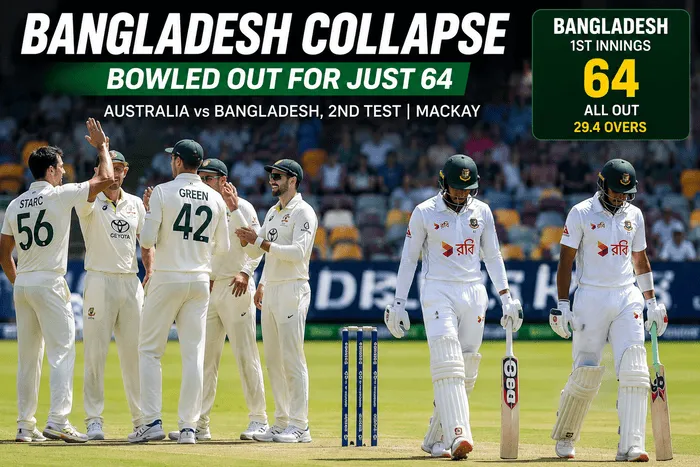
Bangladesh’s first innings turned into a dramatic collapse as Australia’s pace attack dismissed the visitors for just 64 in the second Test at Mackay. The total left Bangladesh with very little room for error and gave Australia an immediate advantage after choosing to bowl first.
Mitchell Starc was the central figure in the collapse. The left-arm fast bowler struck with the opening delivery of the Test and continued to find breakthroughs at regular intervals. His eventual figures of 6/12 were the standout numbers in an innings where Bangladesh struggled to cope with the Australian attack.
The pressure created by Starc was not limited to his wicket tally. He bowled six maiden overs from his 10-over spell, making it extremely difficult for Bangladesh’s batters to rotate the strike and rebuild through partnerships.
Bangladesh’s top order never established the foundation required for a competitive Test innings. Once the early wickets fell, Australia were able to maintain attacking fields and keep the pressure on the middle and lower order.
The 64-run total also highlighted how quickly conditions and bowling pressure can change the direction of a Test match. Australia had the opportunity to build a substantial lead after Bangladesh’s collapse, although Shoriful Islam later produced his own six-wicket spell to bring Australia back under pressure.
Bangladesh Collapse: Bangladesh were bowled out for 64, with Mitchell Starc finishing with 6/12 after taking five wickets in just 22 balls.
Mitchell Starc Moves Past Dale Steyn
Mitchell Starc’s six-wicket haul in Mackay was significant beyond the immediate impact on Bangladesh’s innings. The performance also pushed the Australian fast bowler beyond South African great Dale Steyn on the all-time Test wicket list.
Starc entered the second Test already established among the leading wicket-takers in Test cricket, but his 6/12 spell added another important milestone to his career. The wickets against Bangladesh took his Test tally beyond the 440-wicket mark and moved him into the top 10 of the all-time list.
Overtaking Steyn is particularly notable because the South African was widely regarded as one of the most destructive fast bowlers of his generation. Starc’s ability to reach that territory highlights the longevity and consistency he has maintained across a long international career.
The achievement also came in typically Starc-like fashion. Rather than simply collecting wickets through a long spell, he made an immediate impact with the first ball of the Test and then produced a devastating burst that left Bangladesh unable to recover.
His six-wicket performance therefore combined a major statistical milestone with one of the most influential spells of the match. For Australia, having a bowler capable of producing such a burst remains a major advantage in a Test where the pitch and conditions can create opportunities for high-quality pace bowling.
Career Milestone: Starc’s six-wicket haul against Bangladesh took him past Dale Steyn and into the top 10 of the all-time Test wicket-takers.
Shoriful Islam Hits Back With 6/35
Bangladesh’s first innings collapse looked set to put Australia completely in control, but Shoriful Islam produced an outstanding response when his side took the field. Returning to the Test XI after recovering from a hamstring injury, the left-arm pacer finished Day 1 with figures of 6/35.
Shoriful’s spell was particularly important because Australia had moved to 41/3 after Bangladesh were dismissed for 64. Steve Smith and Cameron Green then began rebuilding the innings, putting together a 77-run partnership from 112 balls.
Bangladesh needed a breakthrough to prevent Australia from turning their first innings advantage into a large lead, and Shoriful provided exactly that moment. He trapped Steve Smith lbw to break the partnership and immediately shifted the momentum back towards Bangladesh.
The pressure continued after Smith’s dismissal. Bangladesh claimed four Australian wickets in just 14 balls, leaving the hosts at 148/8. What had looked like a straightforward Australian response to Bangladesh’s 64 suddenly became a competitive contest.
Shoriful’s six-wicket haul was also significant statistically. He completed five wickets in 8.5 overs, registering the second-fastest five-wicket haul by a Bangladesh bowler in Test cricket, behind Taijul Islam’s five-for in 6.5 overs against the West Indies in 2018. :contentReference[oaicite:1]{index=1}
His performance prevented Bangladesh from losing control of the Test despite Starc’s extraordinary spell earlier in the day. With Australia ending on 165/8, Bangladesh had reduced the first-innings deficit to 101 runs by stumps.
Momentum Shift: Shoriful Islam’s 6/35 pulled Bangladesh back into the contest after Mitchell Starc’s six-wicket haul had put Australia in a dominant position.
Australia Stumble Despite Taking the Lead
Australia finished the opening day with a 101-run first-innings lead, but their batting performance was far less comfortable than the scoreline might initially suggest. After Bangladesh were dismissed for 64, Australia appeared to have an opportunity to build a commanding advantage. Instead, Shoriful Islam’s outstanding spell brought the hosts into a difficult position.
Australia slipped to 41/3 before Steve Smith and Cameron Green began to rebuild. The pair added 77 runs from 112 balls, giving Australia some stability after the early wickets and allowing the hosts to move beyond Bangladesh’s first-innings total.
Shoriful eventually broke the partnership by dismissing Smith lbw. That wicket triggered another sharp Australian collapse, with four wickets falling for just 14 runs. Australia went from a relatively comfortable position to 148/8, leaving Bangladesh with a realistic chance of limiting the first-innings deficit.
Cameron Green’s unbeaten 51 became particularly valuable in that context. His resistance ensured Australia crossed 160 and finished the day on 165/8 rather than surrendering the advantage they had created with Starc’s devastating bowling.
The late collapse also changed the complexion of the Test. Bangladesh had been bowled out for only 64, but their bowlers responded strongly enough to prevent Australia from establishing a decisive lead on the same day.
With Australia still holding a 101-run advantage at stumps, the hosts remain in the stronger position. However, the remaining Australian wickets could prove important because Bangladesh’s bowlers have already shown that they can make the Mackay conditions difficult for batters.
Turning Point: Shoriful Islam’s dismissal of Steve Smith triggered a four-wicket burst for 14 runs and kept Bangladesh within striking distance despite Australia’s first-innings lead.
Cameron Green Keeps Australia Ahead
Cameron Green played an important role in ensuring Australia retained the advantage after Bangladesh’s bowlers mounted a strong fightback. Green remained unbeaten on 51 at stumps, giving Australia a valuable lower-order platform after the hosts lost wickets in quick succession.
Australia had reached a relatively stable position when Green joined Steve Smith in the middle. The pair added 77 runs from 112 balls, helping Australia recover from 41/3 and move beyond Bangladesh’s first-innings total of 64.
The partnership became even more important after Bangladesh’s early collapse. Australia needed to convert their huge advantage with the ball into a substantial first-innings lead, but Shoriful Islam’s spell changed the momentum.
After Shoriful removed Smith, Australia lost four wickets for only 14 runs and slipped to 148/8. Green’s composure then became crucial. Rather than allowing another cluster of wickets to erase Australia’s advantage, he stayed at the crease and helped the hosts finish the day on 165/8.
Green’s unbeaten half-century therefore has greater significance than the number alone suggests. With only two Australian wickets remaining, his ability to add further runs could determine whether Australia establish a substantial first- innings advantage or allow Bangladesh back into the contest.
Australia’s Key Batter: Cameron Green’s unbeaten 51 kept Australia ahead after Shoriful Islam’s six-wicket spell triggered a late collapse.
Why Mackay Conditions Favored the Pacers
The playing conditions at Great Barrier Reef Arena played an important role in the dramatic opening day of the second Test. The Mackay surface offered noticeable bounce and assistance for the fast bowlers, allowing both Australia and Bangladesh to create sustained pressure with pace.
That was reflected directly in the scorecard. Eighteen wickets fell across the three sessions, while Mitchell Starc and Shoriful Islam collected six wickets apiece. The match quickly became a contest dominated by seam and swing rather than prolonged periods of comfortable batting.
Australia’s decision to bowl first therefore proved highly effective. Pat Cummins won the toss and chose to field, allowing Starc and the Australian pace attack to use the fresh surface and new ball against Bangladesh’s top order.
Starc’s opening delivery illustrated the value of that decision. He removed Shadman Islam with the first ball of the Test, and Bangladesh were eventually dismissed for only 64. The Australian captain’s decision to attack with his quicks was rewarded almost immediately.
Bangladesh’s response later in the day showed that the conditions were not exclusively beneficial to Australia. Shoriful Islam exploited the same surface effectively, taking 6/35 and helping Bangladesh reduce Australia to 165/8 after the hosts had established a substantial lead.
The venue had already been identified as a potentially pace-friendly ground before the Test. First-class data from the ground suggested fast bowlers had historically taken considerably more wickets than spinners, although this was Mackay’s first Test match. :contentReference[oaicite:1]{index=1}
The first day’s play therefore provided strong evidence that pace would remain a major factor in the match. Batters who can handle the bounce, movement and sustained pressure will be crucial as the Test moves into its next phase.
Conditions Report: A bouncy Mackay surface assisted the fast bowlers, with 18 wickets falling on Day 1 and both Starc and Shoriful producing six-wicket hauls.
What Mitchell Starc’s Performance Means for Australia
Mitchell Starc’s 6/12 has given Australia a major advantage at a crucial stage of the second Test. After losing the opening match of the series in Darwin, Australia needed a strong response in Mackay, and Starc’s opening spell provided exactly that.
The most important aspect of the performance was how quickly Starc put Bangladesh under pressure. His first-ball wicket of Shadman Islam immediately exposed the visitors’ middle order, while his five-wicket burst in just 22 balls prevented Bangladesh from developing any meaningful partnership.
Starc’s six-wicket haul also gives Australia an important psychological advantage. Bangladesh’s batters have already experienced how difficult the Mackay conditions can become against a high-quality left-arm fast bowler, and Australia can continue attacking with pace when the new ball is available.
At the same time, Australia’s own batting collapse means Starc’s spell has not completely settled the Test. Shoriful Islam’s 6/35 showed that Bangladesh can produce an equally damaging response with the ball, while Australia ended the day on 165/8.
That makes the remaining Australian wickets particularly important. If Cameron Green and the lower order can add another substantial partnership, Starc’s first innings effort could translate into a much larger lead. If Bangladesh quickly removes the final two wickets, however, the visitors will have an opportunity to use their own pace attack again.
From Australia’s perspective, Starc has already done the hardest part: creating a huge advantage with the new ball. The next challenge is converting that advantage into a match-defining first-innings lead and avoiding another batting collapse.
Australia’s Advantage: Starc’s 6/12 put Bangladesh under immediate pressure, but Australia still need to finish their first innings strongly after reaching 165/8.
Australia vs Bangladesh 2nd Test: Key Statistics
| Venue | Great Barrier Reef Arena, Mackay |
|---|---|
| Bangladesh 1st Innings | 64 all out |
| Australia at Stumps | 165/8 |
| Australia’s Lead | 101 runs |
| Mitchell Starc | 6/12 |
| Starc’s Overs | 10 |
| Starc’s Maidens | 6 |
| Starc’s Five-Wicket Burst | 5 wickets in 22 balls |
| Shoriful Islam | 6/35 |
| Cameron Green | 51* at stumps |
| Smith-Green Partnership | 77 runs |
| Wickets on Day 1 | 18 |
Day 1 Summary: Bangladesh were dismissed for 64 before Shoriful Islam’s 6/35 helped restrict Australia to 165/8. Australia ended the day 101 runs ahead, with Cameron Green unbeaten on 51.
Frequently Asked Questions
Mitchell Starc took 6 wickets for 12 runs in 10 overs during Bangladesh’s first innings in the second Test at Mackay.
Starc completed his five-wicket haul in just 22 balls during his devastating opening spell against Bangladesh.
Bangladesh were bowled out for 64 in their first innings, with Mitchell Starc taking 6/12 as Australia’s pace attack dominated.
Shoriful Islam took 6/35 for Bangladesh. His spell helped Bangladesh fight back after Australia had dismissed them for 64.
Australia finished Day 1 on 165/8, giving them a 101-run first-innings lead over Bangladesh.
Cameron Green was unbeaten on 51 at stumps, providing important resistance after Australia lost four wickets for 14 runs late in the innings.
A total of 18 wickets fell on the opening day, highlighting how strongly the Mackay conditions favored the fast bowlers.
Starc’s 6/12 gave Australia immediate control, included a first-ball wicket and a five-wicket burst in 22 balls, and moved him beyond Dale Steyn on the all-time Test wicket list.
Final Thoughts
Mitchell Starc’s 6/12 has given Australia a commanding start to the second Test against Bangladesh at Mackay. His first-ball breakthrough, six-wicket haul and five wickets in just 22 balls turned Bangladesh’s first innings into a dramatic collapse for 64.
The opening day, however, was not completely one-sided. Shoriful Islam produced an outstanding response with 6/35, restricting Australia to 165/8 after the hosts had taken a substantial early advantage. Cameron Green’s unbeaten 51 ensured Australia still finished the day 101 runs ahead.
With 18 wickets falling on Day 1, the Mackay surface has already established itself as a major factor in the contest. The fast bowlers have extracted enough bounce and movement to make batting difficult, meaning the remaining Australian wickets could be extremely important to the eventual shape of the Test.
For Australia, the immediate objective will be to finish the first innings strongly and turn Starc’s extraordinary spell into a decisive advantage. For Bangladesh, the challenge is to keep the deficit as small as possible before using their own pace attack again.
Final Takeaway: Starc’s 6/12 was the defining performance of Day 1, but Shoriful Islam’s six-wicket response has kept Bangladesh within reach. Australia lead by 101 runs with two wickets remaining.