
India recovered from a difficult chase to defeat New Zealand in the second T20I at Christchurch. Tilak Varma and Nitish Kumar Reddy produced a decisive late partnership, helping India chase 181 with one ball remaining and move two wins ahead in the five-match series.
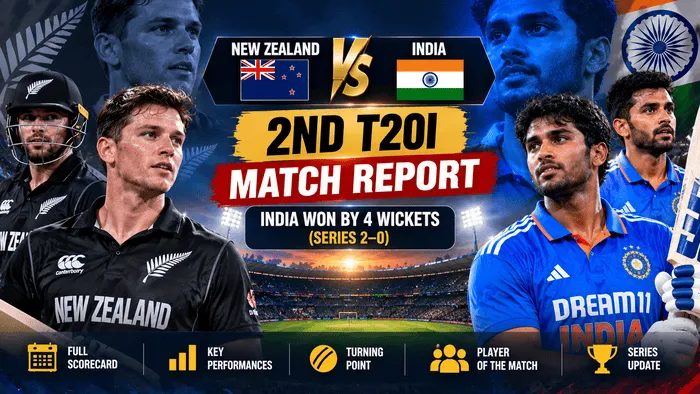
India beat New Zealand by four wickets in the second T20I at Hagley Oval, Christchurch, on October 24, 2026. Chasing 181, India reached 181/6 in 19.5 overs after Tilak Varma and Nitish Kumar Reddy rescued the innings with an unbeaten seventh-wicket stand worth 69 runs from 30 balls. The result gave India a 2–0 lead in the five-match T20I series.
For much of the chase, New Zealand looked capable of pulling the contest back. India lost wickets in clusters and were under pressure to find boundaries late in the innings. Tilak held his nerve, while Reddy attacked at the other end. Their partnership changed the match in the closing overs and gave India another tense win in Christchurch.
New Zealand had earlier recovered from an uncertain start to post 180/5. Glenn Phillips scored 70 from 43 balls and Bevon Jacobs added 58 from 46, but their efforts were not enough to prevent India from finishing the chase.
New Zealand vs India 2nd T20I: Match Summary and Scorecard
New Zealand set India a target of 181, but the visitors completed the chase in the final over.
| Match | New Zealand vs India, 2nd T20I |
|---|---|
| Date | October 24, 2026 |
| Venue | Hagley Oval, Christchurch, New Zealand |
| New Zealand | 180/5 in 20 overs |
| India | 181/6 in 19.5 overs |
| Result | India won by 4 wickets with one ball remaining |
| Player of the Match | Tilak Varma |
| Series Score | India lead the five-match series 2–0 |
Quick Scorecard
| New Zealand Batting | Runs | Balls |
|---|---|---|
| Glenn Phillips | 70 | 43 |
| Bevon Jacobs | 58 | 46 |
| Finn Allen | 16 | 14 |
| Michael Bracewell* | 10 | 2 |
| New Zealand total | 180/5 (20 overs) | |
| India Batting | Runs | Balls |
|---|---|---|
| Tilak Varma* | 51 | 26 |
| Nitish Kumar Reddy* | 26 | 13 |
| Naman Dhir | 31 | 17 |
| Abhishek Sharma | 27 | 21 |
| India total | 181/6 (19.5 overs) | |
Scorecard note: The tables above highlight the leading contributions and match result. Refer to the official final scorecard for the complete batting, bowling, extras and fall-of-wickets details.
Glenn Phillips and Bevon Jacobs Rebuild New Zealand’s Innings
New Zealand’s innings did not begin as smoothly as the hosts would have wanted. Tim Seifert fell for seven, Finn Allen made 16 and Daryl Mitchell scored six as India took early wickets. The hosts needed a partnership to prevent the innings from losing direction.
Phillips and Jacobs supplied that response. Phillips mixed boundary hitting with smart rotation of strike, while Jacobs gave the partnership stability. They added 116 runs from 77 balls, turning a difficult start into a competitive total.
Phillips finished with 70 from 43 deliveries, including four fours and four sixes. Jacobs contributed 58 from 46 balls, with five fours and a six. Their partnership was the foundation of New Zealand’s 180/5.
India did manage to break the stand before the end of the innings. Arshdeep Singh finished with two wickets, while Bhuvneshwar Kumar, Prince Yadav and Nitish Kumar Reddy took one each. New Zealand’s late runs kept the target challenging, but the total left India a chance if they could build a meaningful partnership during the chase.
India Stumble After the Powerplay as New Zealand Fight Back
India needed 181 to win, but the chase quickly became more complicated than the target suggested. Sanju Samson made 14 before falling to Jacob Duffy. Abhishek Sharma scored 27 from 21 balls, while teenager Vaibhav Sooryavanshi managed four after being promoted to No. 3.
New Zealand’s bowlers kept taking wickets, preventing India from settling into a steady rhythm. Shreyas Iyer and Axar Patel also departed, and India slipped to 70/5 in the 11th over. At that stage, India still needed 111 runs from 55 balls according to the live match account. The required rate had climbed, and the visitors had very little room for another quiet over.
Naman Dhir gave the chase fresh energy. He scored 31 from 17 balls and added 42 runs from 24 balls with Tilak Varma. Dhir’s dismissal in the 15th over, however, left India needing a major late push with six wickets down.
Tilak then took responsibility for the innings. Rather than forcing every delivery, he picked his moments and kept India within reach. Nitish Kumar Reddy joined him and immediately added intent, giving New Zealand a new problem: the hosts had to defend against two batters who could find the boundary and run hard between the wickets.
Tilak Varma and Nitish Reddy Turn the Match in the Final Overs
The decisive phase came in the last five overs. India still had a steep asking rate, but Tilak and Reddy refused to let the required runs dictate their shot selection. Their unbeaten 69-run partnership from 30 balls shifted the pressure back onto New Zealand.
The 18th over, bowled by Jacob Duffy, went for 17 runs. India followed that with an 18-run over against Nathan Smith. Those two overs transformed the equation: from needing 31 off 12 balls, India entered the final over requiring 11 runs.
New Zealand still had a chance to force a finish under pressure, but Tilak and Reddy kept their composure. Tilak completed his half-century and Reddy helped bring the target within reach. India crossed the line at 181/6 in 19.5 overs, with Reddy scoring the winning runs.
The partnership was not simply about hitting boundaries. It combined calculated aggression, strike rotation and an understanding of how much risk each delivery required. New Zealand had controlled much of the middle phase, but the final overs belonged to the Indian pair.
Match-defining moment: India’s 35 runs across the 18th and 19th overs dramatically changed the chase and left 11 runs to get from the final over.
Key Performances That Decided the Second T20I
Tilak Varma: An Unbeaten 51 Under Pressure
Tilak Varma’s 51 not out from 26 balls was the defining innings of the match. He had to rebuild after India’s wickets fell, then change gears when the required rate became demanding. His ability to stay until the end made him the natural Player of the Match.
Nitish Kumar Reddy: The Finisher at the Other End
Reddy’s unbeaten 26 from 13 balls complemented Tilak’s innings. He scored quickly without leaving Tilak isolated, and his contribution to the 69-run stand gave India the acceleration needed to finish the chase. Reddy also took a wicket during New Zealand’s innings.
Naman Dhir: An Important Bridge in the Chase
Dhir’s 31 from 17 balls helped India recover after the middle-order collapse. His 42-run stand with Tilak gave India a platform for the final assault. Although he fell before the finish, his attacking contribution kept the chase alive.
Glenn Phillips: New Zealand’s Leading Batter
Phillips’ 70 from 43 balls was central to New Zealand reaching 180. After early wickets, he kept the innings moving and built a substantial partnership with Jacobs. His innings gave the hosts a total they could defend if their bowlers had held their nerve at the death.
Bevon Jacobs: A Crucial Supporting Role
Jacobs scored 58 from 46 balls and worked effectively with Phillips during the recovery. His innings was less explosive, but it gave Phillips time to attack and helped New Zealand rebuild after losing three early wickets.
Arshdeep Singh Leads India’s Wicket-Takers
Arshdeep took two wickets, including Tim Seifert and Glenn Phillips. His dismissal of Phillips ended the key partnership and prevented the batter from carrying New Zealand through the full innings. India still conceded 180, but the early breakthroughs helped keep the hosts from posting an even larger total.
What India’s 2–0 Lead Means for the T20I Series
The second win puts India in a strong position in the five-match series. Winning two close contests in succession also gives the team confidence in its ability to handle pressure, although the narrow finishes show that there is still room to improve the middle overs and reduce the number of wickets lost during a chase.
For New Zealand, the result will be frustrating. Phillips and Jacobs gave the team a competitive total, and the bowlers had India in trouble at 70/5. The missed opportunity came at the end, when two expensive overs allowed the partnership between Tilak and Reddy to take control.
New Zealand will need to turn those promising phases into a complete performance in the next match. India, meanwhile, will look to keep the series momentum while tightening its batting approach through the middle overs.
The third T20I is scheduled for October 27 in Wellington. Both sides have clear areas to address before that match: India will want a steadier chase, while New Zealand need a stronger finish with the ball.
India’s Late Recovery Makes It 2–0
New Zealand made India work for every run, and the chase looked difficult after the visitors lost five wickets for 70 runs. But Tilak Varma and Nitish Kumar Reddy produced the kind of late partnership that changes a match in a handful of overs.
India’s four-wicket win was built on composure as much as power. Tilak’s unbeaten half-century, Reddy’s quick scoring and Dhir’s earlier contribution combined to finish a chase that New Zealand had controlled for long stretches. Phillips and Jacobs gave the hosts a fighting total, but their bowlers could not close out the game.
The result gives India a 2–0 lead, with three matches still to play. The series remains alive, but New Zealand now need a response in Wellington to avoid falling further behind.
Frequently Asked Questions
Quick answers about the New Zealand vs India second T20I.
India won the second T20I by four wickets at Hagley Oval in Christchurch on October 24, 2026.
New Zealand scored 180/5 in 20 overs. India chased the target with 181/6 in 19.5 overs.
Tilak Varma was named Player of the Match after scoring an unbeaten 51 from 26 balls.
Tilak Varma and Nitish Kumar Reddy added an unbeaten 69 runs from 30 balls for the seventh wicket, helping India complete the chase with one ball remaining.
India lead the series 2–0 after winning both the first and second T20Is.
Glenn Phillips scored 70 from 43 balls and Bevon Jacobs scored 58 from 46 balls, combining for a key 116-run partnership.
Sources and Match Verification
This report is based on published match coverage and scorecard information. Check the final official scorecard before making any last-minute corrections to the full batting, bowling or fall-of-wickets tables.