
Harmanpreet Kaur’s unbeaten 91 and Shafali Verma’s 69 powered India Women to 216/7 before Nandani Sharma’s three-wicket haul helped restrict Zimbabwe Women to 124/7. India won the third T20I by 92 runs in Raipur to complete a clean sweep of the series.
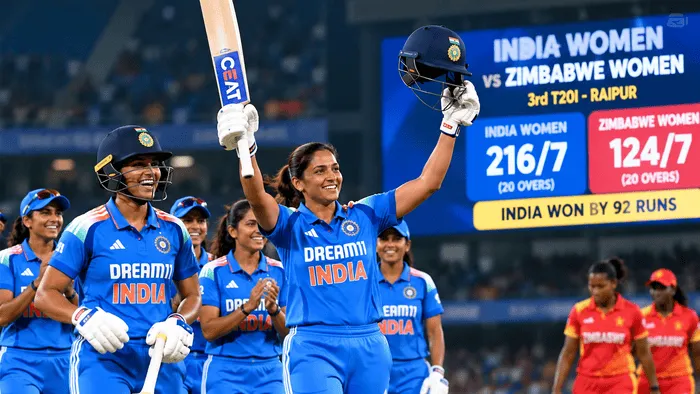
India Women finished their three-match T20I series against Zimbabwe Women with another convincing performance, winning the third match by 92 runs in Raipur on October 20, 2026. The hosts posted 216/7 after choosing to bat, with Harmanpreet Kaur remaining unbeaten on 91 from 41 balls and Shafali Verma adding an aggressive 69 from 37 deliveries. Zimbabwe managed 124/7 in reply, leaving India with a comprehensive victory and a 3–0 series result.
The result was built on India’s ability to turn a promising start into a demanding total. Shafali supplied early momentum, Harmanpreet took charge through the middle and late overs, and the bowlers kept Zimbabwe from mounting a realistic chase. Nandani Sharma finished with 3/18, while Sharne Mayers’ 60 was the most substantial contribution from the visitors.
There was more to this match than the final margin. India also tried a different opening combination, with Anushka Sharma partnering Shafali while Smriti Mandhana did not bat. The experiment offered an opportunity to assess batting depth, even as the established performers ultimately made the difference.
India Women vs Zimbabwe Women: Match Information
The key details from the third and final T20I of the series.
| Match | India Women vs Zimbabwe Women, 3rd T20I |
|---|---|
| Date | October 20, 2026 |
| Venue | Shaheed Veer Narayan Singh International Stadium, Raipur |
| Toss | India Women won the toss and elected to bat |
| India Women | 216/7 in 20 overs |
| Zimbabwe Women | 124/7 in 20 overs |
| Result | India Women won by 92 runs |
| Player of the Match | Harmanpreet Kaur |
| Series Result | India Women won the series 3–0 |
India Women vs Zimbabwe Women 3rd T20I Scorecard
The leading batting and bowling performances from both innings.
India Women — 216/7 (20 Overs)
| Batter | Runs | Balls | 4s | 6s |
|---|---|---|---|---|
| Shafali Verma | 69 | 37 | 6 | 5 |
| Anushka Sharma | 28 | 20 | 4 | 1 |
| Niki Prasad | 9 | 12 | 1 | 0 |
| Harmanpreet Kaur | 91* | 41 | 10 | 5 |
Zimbabwe Women — 124/7 (20 Overs)
| Batter | Runs | Balls |
|---|---|---|
| Sharne Mayers | 60 | 49 |
| Beloved Biza | 44 | 50 |
Bowling Highlights
| Bowler | Team | Figures |
|---|---|---|
| Nandani Sharma | India Women | 3/18 in 4 overs |
| Beloved Biza | Zimbabwe Women | 3/50 in 4 overs |
Note: The tables highlight key performers rather than reproduce every entry from the full official scorecard. An asterisk (*) denotes a batter who was not out.
How India Women Built a Total of 216/7
A fast start and a powerful finish gave Zimbabwe a difficult target to chase.
India chose to bat after winning the toss, and the opening partnership immediately gave the innings a positive direction. Shafali Verma attacked from the outset, while Anushka Sharma supported her with a useful contribution. Their 54-run opening stand gave India early momentum without requiring the middle order to rebuild from a difficult position.
Anushka made 28 from 20 balls before being dismissed by Nomvelo Sibanda. Her innings included four boundaries and a six, giving India a solid contribution from an altered opening combination. Niki Prasad came in next but could not turn her start into a substantial score, making nine from 12 balls.
Shafali, meanwhile, continued to find the boundary. Her 69 from 37 deliveries included six fours and five sixes. The innings combined controlled placement with power hitting, allowing India to maintain a strong scoring rate before the final overs.
The defining acceleration came when Harmanpreet Kaur took control. She found the gaps, cleared the boundary and kept scoring even as wickets fell at the other end. India reached 216/7 from their 20 overs, a total that placed substantial pressure on Zimbabwe before the chase began.
Harmanpreet Kaur’s Unbeaten 91 Changed the Game
A 41-ball innings that turned India’s strong start into a commanding total.
Harmanpreet’s 91 not out was the standout performance of the match. She faced 41 balls and struck 10 fours and five sixes, finishing with a strike rate above 220. Rather than allowing India’s innings to lose momentum after the early partnership, she kept the scoring pressure on Zimbabwe’s bowlers.
Her partnership with Shafali was especially important. The pair added 84 runs for the third wicket, giving India the platform to push well beyond a merely competitive total. Shafali provided the initial aggression, while Harmanpreet continued to score at a high rate through the middle and later stages.
The innings also demonstrated the value of having an experienced batter at the crease late in a T20 innings. Harmanpreet stayed unbeaten, assessed the bowling and converted scoring opportunities into boundaries. Her contribution earned her Player of the Match honours.
The final score of 216/7 reflected both the start and the finish. Shafali’s attacking approach created the opening, but Harmanpreet’s ability to sustain the pressure was what made the target so challenging for Zimbabwe.
Zimbabwe’s Chase Never Reached the Required Pace
Sharne Mayers offered resistance, but the target proved too steep.
Chasing 217 to win, Zimbabwe needed an aggressive start and sustained partnerships. Instead, the required scoring rate made every quiet over more costly. India had already built a substantial cushion with the bat, so Zimbabwe needed more than occasional boundaries to stay in contention.
Sharne Mayers led the response with 60 from 49 balls. Her innings gave Zimbabwe a measure of stability, but it could not keep pace with the target. Beloved Biza added 44 from 50 deliveries, and the pair provided the most notable resistance during the chase.
The difficulty was not simply a lack of individual contributions. Zimbabwe needed a much faster scoring rate and a sequence of productive overs. As the required rate climbed, the visitors were left trying to balance the need for boundaries with the risk of losing wickets.
Zimbabwe finished on 124/7 after 20 overs. The total reflected India’s control of the chase and left the hosts with a 92-run win. Mayers and Biza fought to keep the innings moving, but neither contribution was enough to threaten India’s score.
Turning Point: India’s Third-Wicket Partnership
The partnership between Shafali Verma and Harmanpreet Kaur gave India the decisive advantage.
The key phase was India’s 84-run third-wicket partnership. After the opening stand had provided a strong foundation, the middle order needed to keep the scoring rate high. Shafali and Harmanpreet did exactly that, preventing Zimbabwe from slowing the innings through the middle overs.
The partnership mattered because it combined two different forms of pressure. Shafali’s 69 kept the innings moving at an aggressive pace, while Harmanpreet’s unbeaten 91 carried that momentum into the closing stages. Zimbabwe’s bowlers took wickets, but they could not stop India from reaching 216.
Why India Won
- A strong opening stand: Shafali and Anushka added 54 runs to establish the platform.
- Powerful middle-order batting: Harmanpreet and Shafali’s partnership prevented Zimbabwe from controlling the innings.
- A demanding target: India’s 216/7 forced Zimbabwe to chase at a high rate from the start.
- Effective wicket-taking: Nandani Sharma’s 3/18 helped restrict the chase.
- Limited scoring opportunities: Zimbabwe finished 92 runs short despite useful contributions from Mayers and Biza.
Where Zimbabwe Fell Short
Zimbabwe’s main challenge was the size of the target. Mayers and Biza contributed, but their innings did not produce the scoring rate needed for a successful chase. India’s total also left little room for a slow start or a prolonged rebuilding phase.
Beloved Biza did take three wickets in India’s innings, showing that Zimbabwe had moments with the ball. The difference was that India had enough batting depth and a major partnership to recover from those dismissals and finish with a total Zimbabwe could not match.
What India’s 3–0 Series Sweep Means
The result was convincing, while the match also offered useful selection and batting-order lessons.
India completed the series with three wins from three matches, finishing the final game with their biggest margin of victory in this series. The 92-run result was a strong closing statement after India had already secured the series in the first two matches.
Harmanpreet’s innings and Shafali’s continued attacking form were clear positives. India also had contributions from Anushka at the top, while Nandani’s three wickets gave the bowling unit an important role in the final result.
The experiment with the opening combination is worth noting, but one match is not enough to draw firm conclusions about future selections. Anushka’s 28 gave India a useful start, while Niki Prasad’s nine showed that not every change produced a major score. The broader lesson is that rotation can provide opportunities, but the team still depends on partnerships and players converting starts into match-shaping performances.
For Zimbabwe, the series offers areas to work on, particularly batting tempo when chasing a large target. The visitors showed resistance through Mayers and Biza, but will need more sustained scoring and partnerships to compete with totals above 200.
Frequently Asked Questions
Quick answers about the third T20I and India’s series victory.
India Women won the third T20I by 92 runs on October 20, 2026, at Raipur. The win completed a 3–0 sweep of the three-match series.
Harmanpreet Kaur scored an unbeaten 91 from 41 balls, hitting 10 fours and five sixes. She was named Player of the Match.
Shafali Verma scored 69 from 37 balls, including six fours and five sixes. Her aggressive innings helped India establish a strong platform.
India Women scored 216/7 in 20 overs after winning the toss and choosing to bat.
Sharne Mayers was Zimbabwe’s leading scorer with 60 from 49 balls. Beloved Biza also contributed 44 runs.
Nandani Sharma took three wickets for 18 runs in four overs, making her India’s leading wicket-taker in the match.
India Women won all three matches to take the T20I series 3–0 against Zimbabwe Women.
Final Verdict: Harmanpreet and Shafali Lead India’s Clean Sweep
India’s 92-run victory was built on a strong opening partnership, a decisive stand between Shafali Verma and Harmanpreet Kaur, and disciplined bowling in the chase. Harmanpreet’s unbeaten 91 was the innings of the match, while Shafali’s 69 ensured India had the momentum to post 216/7.
Zimbabwe found resistance through Sharne Mayers and Beloved Biza, but 124/7 was never enough to threaten India’s total. With Nandani Sharma taking three wickets and the batting unit delivering the decisive performance, India closed the series with a 3–0 sweep.
The result gives India clear positives to take forward, especially the form of its key batters. The selection experiments also provide points for the team to assess. For Zimbabwe, improving the scoring rate in high-target chases will be an important takeaway from the series.
Sources and Related Coverage
Match facts and score details should be checked against reliable reporting and the official scorecard.
- BCCI — India Women vs Zimbabwe Women, 3rd T20I
- Moneycontrol — Third T20I scorecard
- The Indian Express — Match report and analysis
- Mumbai Indians — Shafali and Harmanpreet lead India’s series win
For more match reports, team updates and cricket analysis, explore the 99ExCh cricket blog.
Editorial note: This article is a post-match report based on published scorecard information and match coverage. The hero image is an illustrative graphic and is not an actual match photograph.