
India begin their T20I campaign against New Zealand at Hagley Oval, Christchurch. Here is a closer look at team balance, recent form, venue conditions, probable playing XIs and the matchups that could shape the opening game.
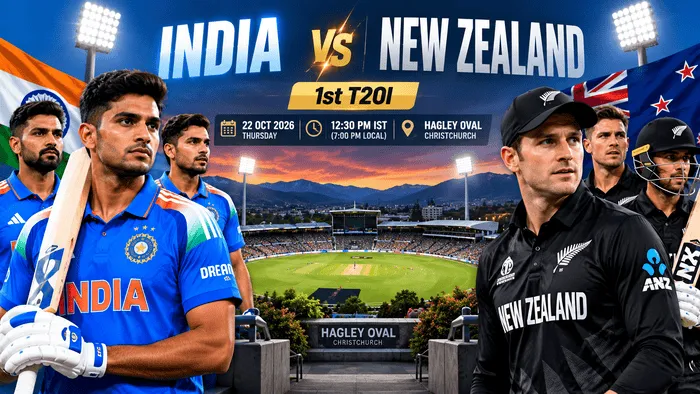
India’s T20I tour of New Zealand opens with a challenge that goes beyond reputation. India have a strong pool of power-hitters and several bowling options, but Christchurch presents a different environment from the familiar conditions at home. New Zealand can use that familiarity to make the opening contest uncomfortable, particularly if its seamers find movement with the new ball.
The key question for this India vs New Zealand 1st T20I prediction 2026 is how well both sides adapt to the conditions. India’s batting depth could put pressure on the hosts, while New Zealand’s home advantage and pace resources could make the powerplay decisive. The prediction below weighs those factors without treating an expected outcome as a certainty. Final playing XIs, the latest forecast and the confirmed start time should be checked again before the match.
India vs New Zealand 1st T20I: Match Details
The opening fixture is scheduled for 22 October 2026 at Hagley Oval in Christchurch. Check the official fixture listing for the final local start time and broadcast details.
| Match | India vs New Zealand, 1st T20I |
|---|---|
| Date | Thursday, 22 October 2026 |
| Venue | Hagley Oval, Christchurch, New Zealand |
| Format | Men’s Twenty20 International |
| Series | India tour of New Zealand, 2026 |
| Start time | Confirm against the latest official fixture before publication. |
Recent Form: What Each Team Needs to Get Right
India: Turn batting depth into a complete performance
India’s recent T20I series against West Indies finished level at 2–2, with the final match abandoned because of rain. That result provides useful context, but it does not tell the whole story about how India will perform in Christchurch. Conditions, team selection and the first few overs will all influence this match.
India’s batting options allow them to attack at different stages. The challenge is to avoid losing too many wickets while trying to establish an early scoring rate. If the top order gives the middle order a stable platform, the side can keep attacking without having to rebuild after every breakthrough.
New Zealand: Make home conditions count
New Zealand do not need to out-hit India in every phase to remain competitive. Early wickets, disciplined lengths and smart use of slower balls can limit the visitors’ scoring options. Their batters will then need to manage India’s varied attack rather than rely only on a late surge.
Recent results should be checked against the latest official scorecards before publication. A short, verified form summary is more useful than listing results from different formats without explaining their relevance to T20 cricket.
India vs New Zealand T20I Head-to-Head
The overall T20I record has historically favoured India, but head-to-head numbers should be treated as background rather than a prediction on their own. Results from different venues and playing eras do not automatically describe what will happen at Hagley Oval in 2026.
Before publishing a numerical win-loss summary, cross-check the official match list and make sure tied matches, Super Overs and abandoned games are counted consistently. The final article should include the verified totals and a clear timeframe rather than an unsourced number.
Team News, Squads and Player Availability
India squad watch
India’s announced squad includes Shreyas Iyer, Abhishek Sharma, Sanju Samson, Ishan Kishan, Tilak Varma, Axar Patel, Shivam Dube, Arshdeep Singh, Bhuvneshwar Kumar, Varun Chakravarthy and Kuldeep Yadav, among others. The final combination will depend on conditions, role balance and the team management’s selection decisions.
Bhuvneshwar Kumar’s swing could be relevant if the surface and atmosphere offer assistance, while India’s spin options give the captain different ways to manage the middle overs. These are tactical possibilities, not confirmation that any particular player will be selected.
New Zealand squad watch
Mitchell Santner leads New Zealand’s T20I squad. The available group includes Finn Allen, Devon Conway, Tim Seifert, Glenn Phillips, Daryl Mitchell, Lockie Ferguson and Matt Henry. Mark Chapman and Zak Foulkes have been reported unavailable for the series because of injuries, with replacements named.
Squad status can change close to match day. Recheck the New Zealand Cricket update and the official match sheet before describing any player as ruled out, available or included in the XI.
Probable Playing XIs for India vs New Zealand
These are provisional selection projections based on available squad information. Neither lineup is confirmed; update this section after the toss and official team announcements.
India — Probable XI
| 1 | Abhishek Sharma |
|---|---|
| 2 | Sanju Samson |
| 3 | Shreyas Iyer (captain) |
| 4 | Tilak Varma |
| 5 | Ishan Kishan |
| 6 | Shivam Dube |
| 7 | Axar Patel |
| 8 | Additional all-rounder or bowling option — to be confirmed |
| 9 | Arshdeep Singh |
| 10 | Varun Chakravarthy |
| 11 | Final bowling selection — to be confirmed |
New Zealand — Probable XI
| 1 | Finn Allen |
|---|---|
| 2 | Devon Conway or Tim Seifert |
| 3 | Top-order selection — to be confirmed |
| 4 | Glenn Phillips |
| 5 | Daryl Mitchell |
| 6 | Replacement or middle-order batter — to be confirmed |
| 7 | Mitchell Santner (captain) |
| 8 | All-round option — to be confirmed |
| 9 | Matt Henry |
| 10 | Lockie Ferguson |
| 11 | Final bowling selection — to be confirmed |
Selection note: These are not official playing XIs. Verify each player’s availability and the final squad before publishing specific names as likely starters. Update the lists after the toss when the official team sheets are available.
Hagley Oval Pitch Report
Hagley Oval has hosted international cricket in conditions where seam movement can matter, particularly early in an innings. That does not mean every match will be dominated by fast bowling: the actual pitch preparation, weather and how the bowlers use the new ball all influence the contest.
For India, the first task is to assess the pace and bounce without allowing the powerplay to become a high-risk hitting contest. For New Zealand, the opportunity is to attack the stumps and make the batters play early rather than offer easy width.
As the innings progresses, batters who rotate strike and pick boundary options carefully should be able to build a competitive total. The surface should be assessed from the latest ground report on match day; avoid describing it as definitely green, flat or spin-friendly without direct evidence.
What the pitch could mean tactically
- New-ball discipline may be more important than raw pace alone.
- Batters should identify scoring areas before expanding their range.
- Captains need a clear plan for the middle overs after the powerplay.
- The final pitch report should guide the balance between pace and spin.
Christchurch Weather Forecast
Weather in Christchurch can change, and an early forecast is not a guarantee of conditions at match time. Check a reliable local forecast on the day for rain risk, cloud cover, temperature and wind.
Cloud cover and moisture may influence how captains assess the opening overs, but they should not be used as automatic proof that the ball will swing or that one team must bowl first. The final forecast should be paired with the visible pitch conditions and the toss decision.
Key Players and Matchups to Watch
India’s top order against New Zealand’s new ball
India’s opening batters can put pressure on the bowling side if they find boundaries without losing early wickets. The first matchup is therefore not simply batter versus bowler; it is India’s ability to judge length and movement while keeping the scoring rate healthy.
New Zealand’s top order against India’s pace attack
Arshdeep Singh and the other selected seamers will need to balance wicket-taking deliveries with control. If New Zealand get through the powerplay with wickets in hand, they can build around their middle-order options. If India strike early, the hosts may have to delay their acceleration.
India’s spin options in the middle overs
Axar Patel, Varun Chakravarthy and Kuldeep Yadav offer different styles if selected. Their effectiveness will depend on matchups, conditions and the batters at the crease. The captain’s timing of spin overs could be as important as the choice of bowlers.
Toss Prediction and Its Possible Impact
There is not enough verified evidence to call a specific toss decision a clear statistical advantage. Captains should weigh the live pitch, cloud cover, ground conditions and their preferred bowling matchups before choosing to bat or field.
If the surface offers visible early assistance, bowling first may appeal to a captain who trusts the seam attack. If the pitch looks good for batting and the team prefers scoreboard pressure, batting first remains a reasonable alternative. The toss is a factor, not a substitute for team quality or execution.
India vs New Zealand 1st T20I Prediction
Who has the edge?
India’s batting depth and range of bowling options give them a strong route into the contest. Their challenge is to adapt quickly to Christchurch and avoid losing multiple wickets while trying to set the tempo. If the top order builds a platform, India can put pressure on New Zealand through the middle and death overs.
New Zealand’s case rests on home familiarity, disciplined seam bowling and a top order capable of scoring quickly. If the hosts make early inroads or get a stable start with the bat, they can turn the match into a close contest.
99ExCh prediction
Pre-match lean: India, narrowly, subject to final team selection and conditions. India’s overall squad depth is the main reason for that lean, but it is not a guarantee of victory. New Zealand’s home conditions and the possibility of early movement are meaningful counterweights. The assessment should be revisited after the official XIs, pitch report and weather update are available.
What could change the prediction?
- Unexpected changes to either team’s first-choice players.
- A pitch that offers more or less seam movement than expected.
- Rain or wind that affects playing conditions.
- Early wickets that force either team to rebuild rather than attack.
- A strong powerplay from either batting side.
A numerical win probability or projected score should only be added after the underlying method and relevant data have been checked. An unsupported percentage would make the prediction look more precise than the available evidence allows.
Frequently Asked Questions
The opening T20I is scheduled for 22 October 2026. Confirm the latest official fixture for the exact start time.
The match is scheduled at Hagley Oval in Christchurch, New Zealand.
The pre-match assessment gives India a narrow edge because of their squad depth. New Zealand’s home conditions and bowling attack could change the balance.
Early seam movement may be a factor, but the actual pitch should be assessed using the latest match-day report rather than assumptions based on the venue alone.
No. Probable XIs are projections based on available squad information. The official lineups are confirmed at the toss.
Check the official BCCI and New Zealand Cricket updates alongside the latest match-day team sheet and forecast.
Final Verdict
India have the batting depth and bowling variety to begin the series strongly, but Christchurch is not a venue where reputation alone should decide a prediction. New Zealand can stay in control if its bowlers make use of the new ball and the top order handles India’s attack without losing momentum.
The current lean is India, narrowly, with the final call dependent on team selection, the pitch report and weather conditions. Check the article again after official lineups are announced; that is when the most important uncertainties can be resolved.
This is a cricket analysis, not a guaranteed result. Readers should use the confirmed team sheet and match conditions when assessing any pre-match view.
Sources and Further Reading
Use official sources for fixture details, squad announcements and final team sheets. Recheck links before publication and update the article when reliable new information becomes available.