
Arafat Minhas delivered a decisive all-round performance as Pakistan recovered from 81/4 to post 302/9 before bowling England out for 215 in the ODI tri-series clash at Rawalpindi.
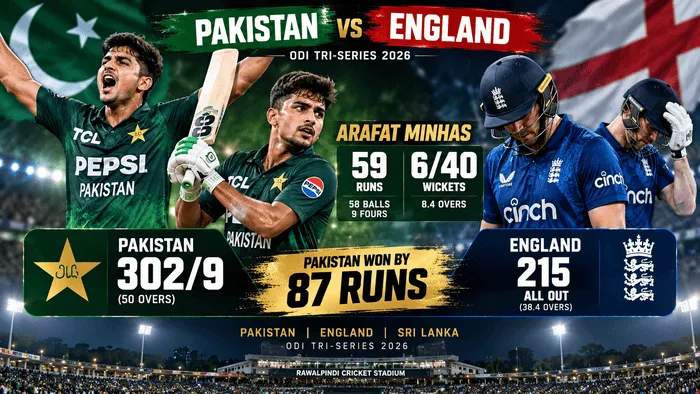
Pakistan beat England by 87 runs in the second match of the Pakistan, England and Sri Lanka ODI tri-series on October 20, 2026, at Rawalpindi Cricket Stadium. After being reduced to 81/4, Pakistan recovered to score 302/9 in 50 overs. England made a promising start to their chase but were dismissed for 215 in 38.4 overs.
The match belonged to Arafat Minhas. He scored 59 off 58 balls to help rebuild Pakistan’s innings and then took 6/40 with his left-arm spin. Hasan Nawaz’s 79 and Faheem Ashraf’s late contribution of 39 off 26 balls also helped Pakistan pass 300. England reached 91 without losing a wicket, but the chase fell apart once Pakistan found a breakthrough. Minhas’s spell turned a competitive contest into a convincing home victory. Official PCB match report.
Pakistan vs England: Match Summary and Scorecard
The key scores, leading performances and match details from Rawalpindi.
| Match | Pakistan vs England, 2nd Match |
|---|---|
| Series | Pakistan, England and Sri Lanka Tri-Nation ODI Series 2026/27 |
| Date | October 20, 2026 |
| Venue | Rawalpindi Cricket Stadium, Rawalpindi |
| Toss | England won the toss and chose to field |
| Result | Pakistan won by 87 runs |
| Player of the Match | Arafat Minhas |
Quick Scorecard
| Team | Score | Top Performers |
|---|---|---|
| Pakistan | 302/9 (50 overs) | Hasan Nawaz 79, Arafat Minhas 59 |
| England | 215 all out (38.4 overs) | Tom Banton 57, Ben Duckett 45 |
Leading Bowling Figures
| Bowler | Figures |
|---|---|
| Arafat Minhas (Pakistan) | 8.4 overs, 40 runs, 6 wickets |
| Haris Rauf (Pakistan) | 6 overs, 32 runs, 2 wickets |
| Sonny Baker (England) | 9 overs, 65 runs, 3 wickets |
Figures and match details are based on the official PCB scorecard.
How Pakistan Recovered to Post 302/9
A difficult start made the middle-order partnerships crucial to Pakistan’s total.
Pakistan’s innings began badly. Fakhar Zaman was dismissed for a first-ball duck, and Saim Ayub followed for eight. Babar Azam made 34 from 52 balls, but his innings did not provide the acceleration Pakistan needed. When Salman Ali Agha fell for 16, the hosts were 81/4 and England had a clear opportunity to control the game.
Hasan Nawaz and Saad Baig helped steady the innings before Hasan and Arafat Minhas took the recovery forward. Hasan’s 79 from 74 balls gave Pakistan a reliable scoring base, while Minhas rotated the strike and found boundaries at important moments. Their 78-run partnership moved the total beyond the danger zone.
Minhas then continued to attack, scoring 59 from 58 deliveries with nine fours. Faheem Ashraf added a timely burst of 39 from 26 balls, including five fours and a six. His contribution helped Pakistan maintain momentum at the death and finish on 302/9. England’s Sonny Baker was the leading wicket-taker with 3/65. The official scorecard records the full batting and bowling figures.
Why the Recovery Mattered
Pakistan’s lower-middle order did more than add runs: it changed the pressure of the chase. At 81/4, England could reasonably have expected to pursue a smaller target. Instead, Pakistan crossed 300, giving their bowlers room to attack rather than simply defend a modest total.
England’s Chase Unravels After a Promising Start
A strong opening stand gave way to a collapse that Pakistan’s spinners exploited.
England began confidently. Ben Duckett and Tom Banton put on 91 runs for the first wicket, with Duckett scoring 45 from 46 balls and Banton making 57 from 53. At that stage, England were well placed to build a serious challenge to the target of 303.
Haris Rauf broke the opening partnership by dismissing Duckett. Minhas then removed Banton and England captain Harry Brook, who scored five. Those wickets changed the chase: England lost the platform created by their openers and had to rebuild against a Pakistan attack that had found its rhythm.
Joe Root scored 33 from 35 balls and Sam Curran made 27 from 39, but neither could restore the innings. Root fell to Naseem Shah, while Haris dismissed Curran. Minhas continued to strike through the middle and lower order, finishing with 6/40 in 8.4 overs. England were all out for 215, with the final wicket falling to a direct-hit run-out involving Minhas.
The Problem Was More Than the Required Rate
England did not lose because the chase was immediately out of reach. The opening stand had put them in a useful position. The larger issue was the inability to form another substantial partnership after the first wicket fell. As wickets came in clusters, the batters had fewer options to pace the chase and the asking rate became harder to manage.
Arafat Minhas Delivers a Match-Winning All-Round Performance
A half-century and six wickets made Minhas the clear standout in Rawalpindi.
Minhas shaped both innings. His 59 from 58 balls helped Pakistan recover from a difficult position and push beyond 300. With the ball, his left-arm spin repeatedly disrupted England’s attempt to rebuild. He finished with six wickets for 40 runs, earning Player of the Match.
The Pakistan Cricket Board reported that Minhas’s bowling figures were the second-best by a Pakistan bowler in men’s ODIs on home soil, behind Shoaib Akhtar’s 6/16 against New Zealand in Karachi in 2002. The PCB also described the result as Pakistan’s largest ODI winning margin over England since 2005. These milestones underline the significance of the performance without needing exaggerated claims.
His impact was not limited to the statistics. Minhas contributed during Pakistan’s recovery, took key wickets after England’s strong start and was involved in the final run-out. It was a complete performance at a moment when Pakistan needed both middle-order runs and a bowler capable of breaking partnerships. Read the PCB’s match report.
The Turning Point: England Lose Control After 91/0
England’s opening partnership was the clearest sign that the target could be chased. Duckett and Banton had put pressure on Pakistan, but Duckett’s dismissal gave the bowlers a route back into the match. Minhas took advantage by removing Banton and Brook in quick succession.
Once England’s top order was separated, the middle order could not create another partnership of similar size. Minhas’s six-wicket spell kept the pressure on, while Rauf and Naseem Shah contributed important breakthroughs. England’s collapse turned the match from a competitive chase into an 87-run defeat.
The key shift was therefore not one delivery alone. It was Pakistan’s ability to turn the first breakthrough into sustained pressure—and England’s failure to interrupt that sequence with a substantial partnership.
Why Pakistan Won and England Fell Short
Three Reasons Pakistan Won
- Middle-order recovery: Hasan Nawaz and Arafat Minhas helped Pakistan rebuild after four early wickets.
- A strong finish: Faheem Ashraf’s 39 from 26 balls lifted Pakistan to 302/9.
- Wickets at the right time: Haris Rauf broke the opening stand, and Minhas dismantled the middle and lower order.
Where England Went Wrong
- Missed chances: England’s fielding errors gave Pakistan opportunities to recover, according to match reporting.
- No second major partnership: After reaching 91/0, England could not build another stand capable of stabilising the chase.
- Difficulty against spin: Minhas repeatedly beat England’s batters and finished with six wickets.
Pakistan’s victory came from a combination of batting depth and disciplined bowling. England had a strong start, but Pakistan handled the middle overs more effectively and finished the match with control.
What the Result Means for the ODI Tri-Series
The win gave Pakistan two victories from their first two matches in the tri-series. It also gave the hosts a useful boost ahead of the remaining fixtures, with Minhas emerging as one of the major talking points from the contest.
According to the PCB’s schedule, England are due to face Sri Lanka at Rawalpindi Cricket Stadium on October 22, while Pakistan are scheduled to meet England again at Gaddafi Stadium in Lahore on October 25. England will need a stronger middle-order response in their next match, while Pakistan will look to carry this momentum forward.
Fixture information can change, so readers should check the Pakistan Cricket Board’s official website for the latest schedule and team updates.
Frequently Asked Questions
Quick answers about the Pakistan vs England ODI tri-series match.
Pakistan beat England by 87 runs at Rawalpindi Cricket Stadium in the ODI tri-series.
Pakistan scored 302/9 in 50 overs. England were all out for 215 in 38.4 overs.
Arafat Minhas scored 59 runs from 58 balls and took 6 wickets for 40 runs in 8.4 overs.
Arafat Minhas was named Player of the Match for his all-round performance.
Hasan Nawaz top-scored for Pakistan with 79. Tom Banton was England’s leading scorer with 57.
The PCB schedule lists their next meeting for October 25, 2026, at Gaddafi Stadium in Lahore. Check the official schedule for any changes.
Final Verdict: Minhas Leads Pakistan to a Convincing Win
Pakistan’s 87-run win over England was built on resilience with the bat and precision with the ball. The recovery from 81/4 to 302/9 gave the hosts a defendable total, but Arafat Minhas’s six-wicket spell ensured England could not turn their promising start into a successful chase.
Hasan Nawaz’s 79 and Faheem Ashraf’s late hitting were important parts of the result, yet Minhas was the defining performer. His 59 runs helped set up the contest, and his 6/40 dismantled England’s batting order. For England, the main lesson is clear: a good start counts for little without a partnership capable of carrying the chase through the middle overs.
Pakistan now move forward with two wins from two matches, while England must regroup before their next tri-series fixture.
Sources and Further Reading
- Pakistan Cricket Board — Official match report
- Pakistan Cricket Board — Full scorecard
- The Guardian — Pakistan vs England match report
- BBC Sport — Cricket coverage
- Explore more cricket news on 99ExCh
Editorial note: Match figures and the reported result are based on published scorecard and match-report sources. The hero graphic is illustrative and is not an authentic match photograph.